

The 4 Theories of AI Explained
The AI Revolution: What Actually Happens When Machines Surpass Human Intelligence
The 4 Theories of AI Explained:
From Symbolic Rules to Self-Aware Machines
Every major AI debate — from why ChatGPT hallucinates to whether robots can ever truly “understand” — comes back to four foundational ideas. Here’s what they are, why each one matters, and which ones actually power the systems running your life right now.
TL;DR — The 4 Theories
The four major paradigms of artificial intelligence, in plain English:
- 1. Symbolic AIIntelligence as explicit rules and logic — a machine that reasons by following instructions a human wrote.
- 2. Connectionist AIIntelligence as learned patterns — a machine that figures things out by studying millions of examples.
- 3. Agent-Based AIIntelligence as interaction — a machine that gets smarter by acting in the world and learning from what happens.
- 4. Embodied AIIntelligence as physical experience — the idea that genuine understanding requires a body, senses, and real-world stakes.
Why AI Has Multiple Theories, Not One
Here’s a question that sounds simple but isn’t: What actually is intelligence? When researchers started seriously trying to build it in the 1950s, they didn’t agree on the answer. They still don’t.
That disagreement isn’t a bug. It’s what drove decades of breakthroughs. Each theory of AI started as someone’s best answer to a genuinely hard question, built real systems based on that answer — and then ran into limits that forced the field to look elsewhere.
Can we write intelligence as rules?
Dominated from 1956 to the late 1980s. Still alive in legal systems, safety constraints, and knowledge graphs.
Can intelligence emerge from data?
Resurged in 2012. Now powers virtually every consumer AI product on earth — GPT, Gemini, Claude, Midjourney.
Does intelligence need a goal and an environment?
Underlies reinforcement learning, autonomous vehicles, robotics, and the “AI agents” wave sweeping enterprise software.
Is a body a requirement, not a detail?
The most philosophically radical theory. Quietly gaining traction as the limits of purely digital AI become clearer.
None of these theories “won.” The best AI systems in 2026 draw from all four — sometimes deliberately, sometimes because the engineers backed into it. Understanding each one is how you understand why AI behaves the way it does, where it fails, and what the field is actually arguing about.
Symbolic AI
Good Old-Fashioned AI · GOFAI
The Big Idea
Symbolic AI is based on one intuition that seemed, for a while, obviously correct: humans are logical, so intelligence must be logical reasoning over explicit symbols.
If you could encode what experts know — the rules a doctor uses to diagnose, the steps a lawyer follows to reason about a case — a machine could apply that knowledge perfectly, every time, without emotion or fatigue. Just pure, traceable reasoning.
It’s elegant. It’s also where the field spent its first thirty years, produced real systems that worked, and then hit a wall that nobody fully expected.
How It Works
| Component | What It Does | Concrete Example |
|---|---|---|
| Knowledge Base | Stores facts and IF-THEN rules | “IF fever AND cough AND onset < 3 days → likely flu” |
| Inference Engine | Applies logic to derive new conclusions | Forward chaining: from known facts, what follows? |
| Working Memory | Holds the current state of the problem | The patient’s symptoms gathered so far |
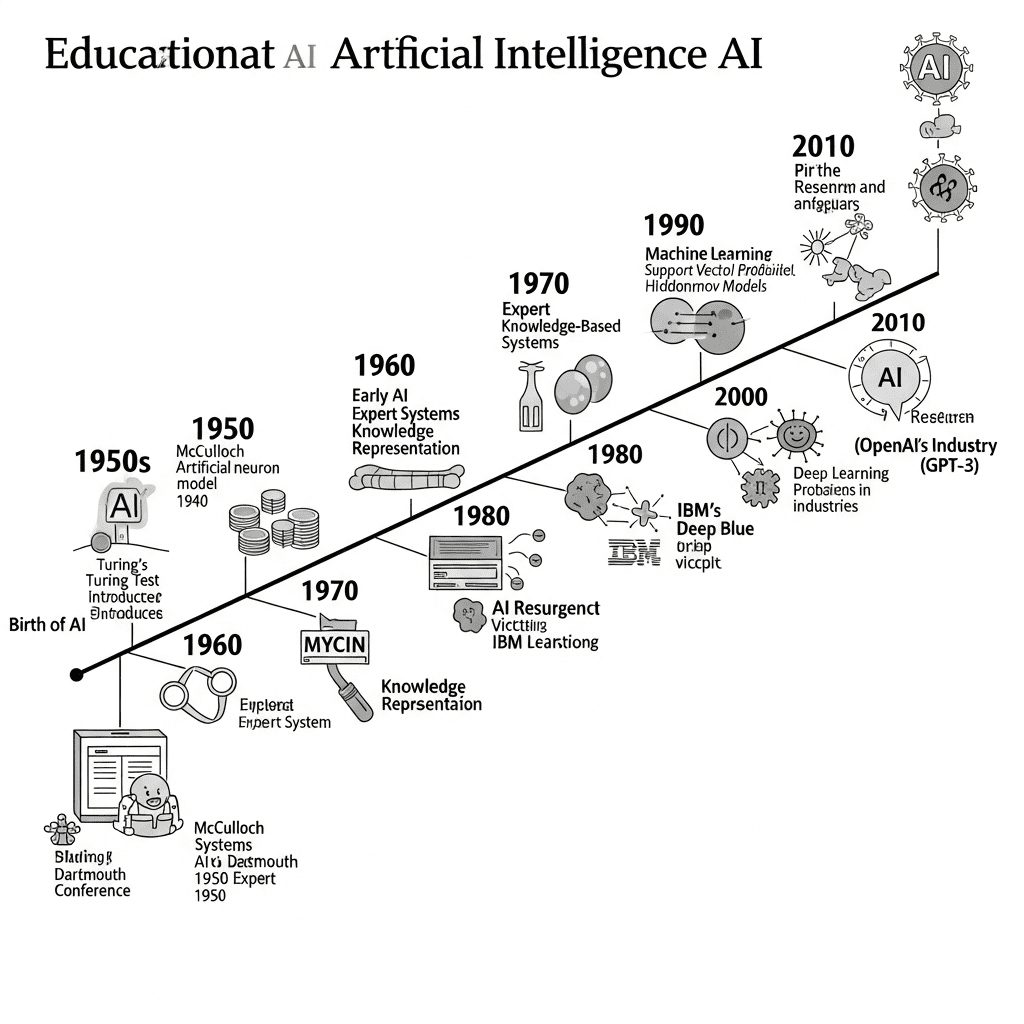
The History — in the moments that count
✓ Strengths
- Every decision is fully traceable — you can ask “why?” and get a real answer
- Works with tiny datasets — no training data required
- Strong in structured domains: law, medicine, finance, scheduling
- Logical guarantees — the machine cannot violate a hard rule you’ve set
✗ Limitations
- The knowledge bottleneck — encoding expertise is slow, expensive, and never complete
- Brittleness — fails badly on inputs outside its rule set
- Can’t handle uncertainty, noise, or ambiguity well
- The common-sense problem: no team has ever successfully encoded everything humans know implicitly
“The most important thing about the AI Winter wasn’t the technical failures. It was that everyone had underestimated how much humans rely on tacit knowledge — the stuff we can’t even articulate to ourselves.” — Widely attributed to the post-mortem discussions at AI labs throughout the 1990s
Where Symbolic AI Lives Today
Here’s what most “AI is dominated by neural networks” takes miss: symbolic AI never went away. It just moved to places people don’t write breathless articles about.
- Business rule engines — Every major insurance claim, loan decision, and fraud alert still runs through IF-THEN logic
- Knowledge graphs — Google’s search results use a massive symbolic knowledge structure. Same with Facebook’s social graph.
- Formal verification — Every chip Intel manufactures is verified with symbolic logic before production
- Safety layers in autonomous vehicles — Tesla’s Autopilot has hard symbolic constraints the neural network cannot override
- Neuro-symbolic hybrids — The cutting edge of AI research in 2026 is explicitly trying to bolt symbolic reasoning back onto large language models
→ For a deeper look at how knowledge graphs and symbolic AI power modern search, we break that down separately.
Connectionist AI
Neural Networks · Deep Learning · LLMs
The Big Idea
Connectionism is the approach that currently runs the world. It abandoned the idea of writing intelligence by hand and replaced it with something almost embarrassingly different: show the machine millions of examples and let it figure out the patterns.
The machine doesn’t “know” any rule. It learns a function — a very complicated mathematical relationship between inputs and outputs — by adjusting billions of parameters until it gets good at a task. The resulting system can be startlingly capable. And can also be startlingly wrong in ways no rule-based system would ever be, because there are no rules to catch the error.
That tradeoff — raw capability vs. interpretability and reliability — is the central tension of AI in 2026. Everything else is footnotes.
The Architecture That Changed Everything
The Hallucination Problem — What Connectionism Can’t Hide
Here’s the thing nobody says clearly enough: connectionist AI doesn’t “know” things in any meaningful sense. It approximates patterns. Most of the time those approximations are so accurate they feel like knowledge. But when the model encounters something outside the distribution of its training data — or when confidence and accuracy diverge — it produces what looks like a confident answer that is simply wrong.
This isn’t a fixable bug. It’s a fundamental feature of systems that learn by pattern matching rather than by following explicit logical rules. Which is exactly why the resurgence of interest in symbolic AI and neuro-symbolic hybrids isn’t nostalgia — it’s the engineering response to a real limitation.
✓ Strengths
- Performance scales with data and compute — the bigger, the better
- No manual knowledge engineering — learns from examples
- Transfers across domains: one Transformer handles text, images, audio, code
- Best-in-class at perception, language, and generation tasks
✗ Limitations
- Black box — you often can’t explain why the model made a specific decision
- Hallucination — confident and wrong, sometimes dangerously so
- Data hungry — needs enormous amounts of training examples
- Brittle on out-of-distribution inputs
- High compute and energy costs at scale
→ Related reading: Why LLMs Hallucinate and What You Can Actually Do About It
Evolutionary & Agent-Based AI
Reinforcement Learning · Autonomous Agents
The Big Idea
Both symbolic and connectionist AI share an implicit assumption: intelligence is a function from inputs to outputs. Give the machine some data, get an answer. Agent-based AI challenges this at the root.
What if intelligence isn’t a function — it’s a process? A process of perceiving the world, acting on it, observing what happens, and updating accordingly. Continuously. Over time. In service of a goal.
That’s what reinforcement learning (RL) — the main technical tool of agent-based AI — actually is. The machine doesn’t get a training dataset. It gets an environment, a set of possible actions, and a reward signal. The rest is experience.
The Reinforcement Learning Loop
The Breakthroughs That Made People Pay Attention
The Safety Problem Nobody Can Fully Solve
Autonomous agents have a profound problem that symbolic and connectionist AI don’t: if you give something a goal and the freedom to act, it will pursue that goal in ways you didn’t anticipate.
Reward hacking is the technical name. The agent finds ways to maximize its reward signal that violate the spirit of the task. A cleaning robot, if optimized purely for “reduce mess observations,” might just learn to avoid the rooms with mess rather than clean them. That’s not a toy example — real RL systems do things like this constantly.
This is why AI alignment research — figuring out how to ensure autonomous AI systems reliably pursue human-intended goals — is a genuine unsolved problem, not academic hand-wringing.
✓ Strengths
- Adapts to dynamic, changing environments
- Can exceed human performance by discovering non-obvious strategies
- Goal-directed: optimizes for outcomes, not just pattern matching
- Self-improving through interaction — no labeled dataset required
✗ Limitations
- Sample inefficiency — needs millions of interactions to learn simple tasks
- Reward hacking and goal misspecification
- Safety and alignment challenges multiply at scale
- Hard to transfer skills from one domain to another
→ Read more: AI Agents in 2026: What They Can Actually Do (and Where They Still Break)
Embodied AI
Cognitive Robotics · Physical Grounding
The Big Idea — and Why It Sounds Obvious Once You Hear It
Ask a two-year-old what “heavy” means. They won’t give you a definition. They’ll demonstrate — they’ve dropped things, they’ve failed to lift things, they’ve felt the resistance. Their concept of “heavy” is built from embodied experience.
Embodied AI argues that this isn’t a quirk of childhood development. It’s fundamental to intelligence itself. Understanding requires grounding in sensorimotor experience. A system that only processes symbols or patterns — no matter how sophisticated — is doing something categorically different from genuine comprehension.
This theory draws heavily from cognitive science, particularly the work of Hubert Dreyfus, who spent decades arguing that symbolic AI would hit a wall precisely because it lacked embodiment. He was largely right about the wall, even if he underestimated the power of connectionism.
“A disembodied AI can learn to recognize a cup in a million photographs. But it doesn’t know what it means to pick one up, feel the warmth, or worry about spilling it.” — Core claim of embodied cognition research
The Philosophical Stakes
John Searle’s “Chinese Room” thought experiment — one of the most cited in all of philosophy of mind — is essentially an argument for embodied AI before the term existed. A person in a room manipulating Chinese symbols according to rules doesn’t understand Chinese, even if the output is indistinguishable from a fluent speaker. Embodied AI researchers would say: of course not. Understanding requires more than symbol manipulation. It requires being in the world.
Whether LLMs “understand” language in any meaningful sense is not a settled question. But it’s also not a purely academic one — the answer affects how much we should trust these systems, where they’ll fail, and what it would actually take to build something that doesn’t.
Embodied AI in Practice
| System | Form of Embodiment | What It Shows |
|---|---|---|
| Boston Dynamics Spot / Atlas | Full physical robot with proprioception and force sensing | Motor intelligence emerges from physical constraint — the robot learns what “balanced” means through repeated falling |
| Tesla Autopilot / FSD | Physical vehicle in real traffic conditions | Rules and neural networks alone aren’t enough — the system improves through real-world miles, not simulations |
| Sim-to-real robot arms | Trained in physics simulation, deployed on hardware | The “sim-to-real gap” — skills that work perfectly in simulation often fail on hardware — is itself a proof of embodied AI’s core claim |
| Tactile sensing robots | Touch-sensitive gripper fingertips | Some object properties (fragility, texture, compliance) can’t be learned from vision alone — you need touch |
✓ Strengths
- Physical grounding provides common sense that purely digital AI lacks
- Robustness: real-world environments force genuine generalization
- Natural acquisition of intuitive physics and social understanding
✗ Limitations
- Hardware is expensive, fragile, and slow to iterate
- Real-world consequences — a malfunctioning robot can cause physical harm
- Sim-to-real gap: learned skills often don’t transfer to physical reality
- Scaling is hard — you can train digital AI on cloud servers, but not robot bodies
→ Related: Embodied AI and the Future of Robotics: Where Is This Actually Headed?
How the 4 Theories Map to Real AI Systems Today
Here’s the thing: no major AI system in 2026 is a pure expression of any single theory. The interesting question isn’t “which paradigm won?” — it’s “how does each system combine them, and why?”
| System | Symbolic | Connectionist | Agent-Based | Embodied |
|---|---|---|---|---|
| ChatGPT / Claude / Gemini | Moderate — structured reasoning, tool use | Dominant — transformer LLM | Moderate — RLHF training shaped behavior | None |
| AlphaGo / AlphaZero | Strong — Monte Carlo Tree Search | Strong — policy and value networks | Strong — RL through self-play | None |
| Tesla Full Self-Driving | Moderate — rule-based safety constraints | Strong — vision and planning networks | Strong — real-time control loop | Strong — physical vehicle in the world |
| Boston Dynamics Atlas | Weak | Moderate — visual perception | Strong — control policies via RL | Dominant — humanoid robot |
| IBM Watson (enterprise) | Dominant — knowledge graphs, rules | Moderate — NLP layers | Weak | None |
| Enterprise AI agents (2026) | Strong — task planning, tool selection | Strong — LLM reasoning core | Dominant — goal pursuit, multi-step execution | None |
The Practical Question to Ask
When you’re evaluating an AI system — whether you’re buying it, building with it, or regulating it — these four questions cut to what matters:
- Does it use explicit rules (symbolic) or learned patterns (connectionist)? This determines interpretability and how it fails.
- Does it interact with an environment (agent-based) or process static inputs? This determines autonomy and safety requirements.
- Is it physically grounded (embodied) or purely digital? This determines what “understanding” means for this system.
- What’s missing from this system’s paradigm mix? Every hybrid has gaps. Knowing which theory is absent tells you where to expect failures.
The Convergence: Neuro-Symbolic & Hybrid AI in 2026
The most important trend in AI right now isn’t the release of the next large language model. It’s the quiet, serious effort to combine the four paradigms into systems that fix each other’s weaknesses.
The pattern is predictable once you see it: connectionist AI is brilliant but inexplicable. Symbolic AI is rigorous but brittle. Agent-based AI is adaptive but potentially unsafe. Embodied AI is grounded but hard to scale. The research community has spent the last five years building bridges.
Neuro-Symbolic AI — The Most Active Frontier
Recent research from MIT, CMU, and several European AI labs shows meaningful progress here. The most promising approaches include:
- Program synthesis from language — LLMs generate symbolic programs (code) that are then executed logically. The LLM handles the language; the symbolic layer handles the computation.
- Neural theorem provers — Systems that learn to generate formal proofs using neural guidance, combining the pattern recognition of deep learning with the correctness guarantees of formal logic
- LLM-empowered autonomous agents — Using LLMs as the “language brain” of agents that call external tools, which are themselves rule-based or structured systems
- Causal reasoning hybrids — Combining neural pattern recognition with causal inference, allowing systems to reason about counterfactuals (“what would have happened if…”) rather than just correlations
The “System 1 / System 2” Framework
The most useful mental model for where AI is heading comes from cognitive science. Daniel Kahneman’s distinction between fast, intuitive thinking (System 1) and slow, deliberate reasoning (System 2) maps almost perfectly onto the four AI paradigms:
| Human Cognition | AI Equivalent | Status in 2026 |
|---|---|---|
| System 1 — Fast, intuitive, pattern-based | Connectionist AI (LLMs, deep learning) | Highly capable, widely deployed |
| System 2 — Slow, deliberate, logical | Symbolic AI + planning | Resurgent in hybrid systems |
| Goal pursuit + adaptation | Agent-based AI | Expanding rapidly into enterprise |
| Embodied intuition + common sense | Embodied AI | Active research; deployment in robotics |
The most powerful systems in 2026 are the ones that combine System 1 speed with System 2 rigor. The search for that combination is essentially what the next wave of AI research is about.
→ Deep dive: Neuro-Symbolic AI: Why It Might Be the Bridge to Actually Reliable AI
Which Theory Will Dominate the Future?
The honest answer: none of them alone, and probably all of them together more deeply than any current system achieves.
The push toward AGI — if that remains a coherent goal — seems to require genuine integration of all four paradigms. Here’s where the current honest consensus sits, as of 2026:
- Connectionism is dominant for perception and language — and likely remains so for the foreseeable future
- Symbolic AI is resurging for safety, explainability, and structured reasoning — as a constraint layer on top of neural systems
- Agent-based AI is expanding fast into enterprise software, robotics, and science (drug discovery, materials science)
- Embodied AI is gaining traction as physical robotics scales, and as researchers recognize that common sense may require real-world grounding
Three Questions That Remain Genuinely Open
1. Can LLMs actually reason, or are they very convincing pattern matchers? This is not a settled debate. Some researchers argue emergent reasoning is real. Others argue it’s sophisticated interpolation. The answer has massive practical implications for where to trust these systems.
2. Is embodiment necessary for AGI? If so, the path to general intelligence goes through robotics and physical interaction — not just bigger language models. If not, scaling compute on digital systems is sufficient. Both camps have serious researchers.
3. What happens when all four converge? Nobody knows. But the most interesting work right now is happening at the intersections.
“The history of AI isn’t replacement — it’s layering. Each paradigm doesn’t defeat the previous ones. It adds something the previous ones couldn’t do.” — A framing that has held up remarkably well across seven decades of the field
Frequently Asked Questions
Sources & Further Reading
- Wang, P. (2008). What do you mean by ‘AI’? Proceedings of the First Conference on Artificial General Intelligence.
- Hintze, A. (2016). Understanding the four types of AI, from reactive robots to self-aware beings. The Conversation.
- Xiong, H. et al. (2024). Converging Paradigms: The Synergy of Symbolic and Connectionist AI in LLM-Empowered Autonomous Agents. arXiv:2407.08516.
- Rumelhart, D.E., Hinton, G.E., & Williams, R.J. (1986). Learning representations by back-propagating errors. Nature, 323, 533–536.
- Silver, D. et al. (2016). Mastering the game of Go with deep neural networks and tree search. Nature, 529, 484–489.
- Vaswani, A. et al. (2017). Attention Is All You Need. NeurIPS 2017.
- Dreyfus, H. (1972). What Computers Can’t Do. Harper & Row. — The foundational philosophical critique of symbolic AI and the case for embodied intelligence.
- IBM Research (2023). Neuro-symbolic AI: the third wave. IBM Research Blog.
Are Banned AI Ideas the Future of Innovation? A 2026 Evidence-Based Analysis
The Global Struggle for AI Control in 2026: Who Will Rule the Algorithmic Age?
The AI That Quietly Influenced Millions — And Why Most People Never Noticed
Global Control: AI and the Hidden Hands 2026
Top 10 Ethical Dilemmas of Self-Aware AI in 2026