

AI Controlling the Internet


Is AI Really Controlling the Internet? The Dead Internet Theory — What Just Got Confirmed
Stanford, Imperial College London, and the Internet Archive just published research showing 35% of all new websites are AI-generated. Bot traffic hit 51%. The “conspiracy theory” isn’t a conspiracy theory anymore. Here’s what’s actually happening — and what to do about it.
Quick Summary
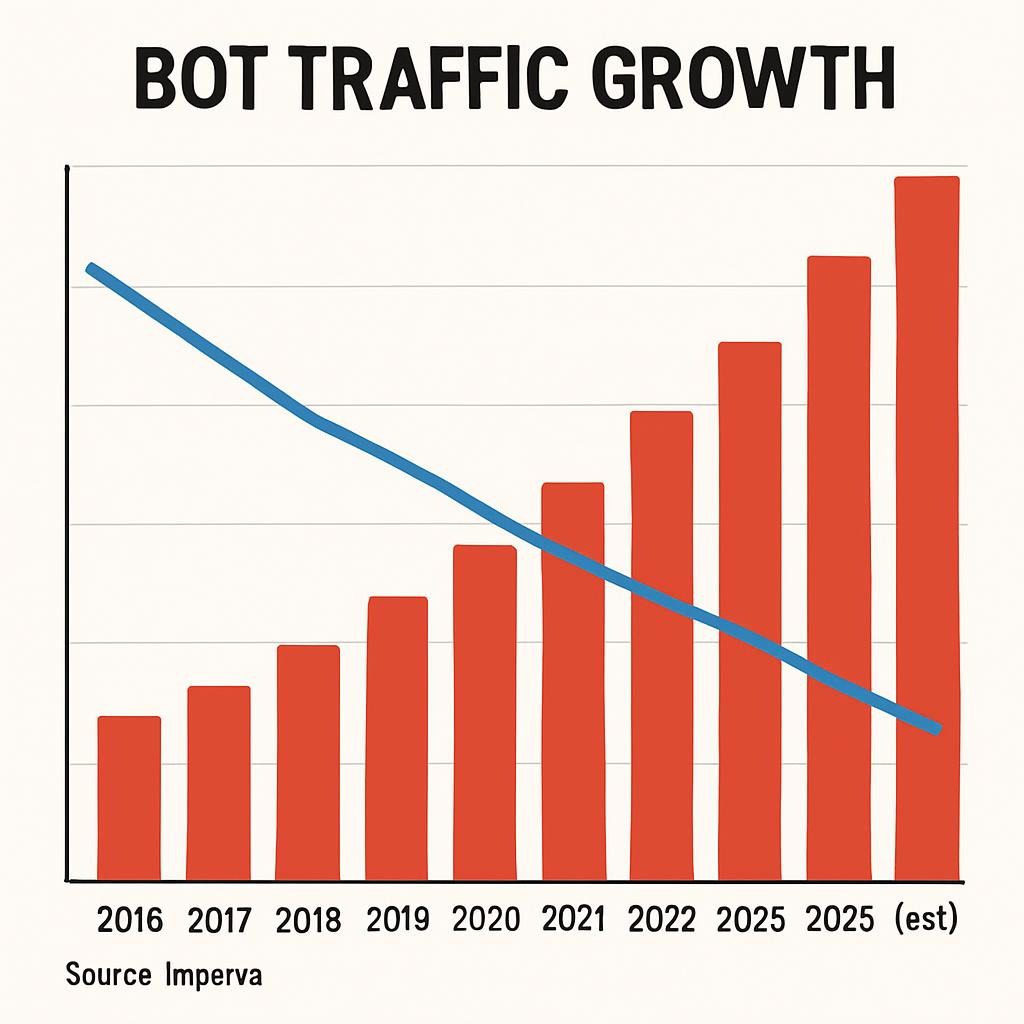
- Bots now account for 51% of all internet traffic — humans are the statistical minority online for the first time ever (Imperva 2025).
- A Stanford/Imperial/Internet Archive study published April 2026 found 35.3% of all new websites are AI-generated or AI-assisted. Fully automated: 17.6%.
- Ahrefs analyzed 900,000 newly published web pages: 74.2% contained AI-generated content.
- University of Zurich researchers secretly deployed AI bots on Reddit, impersonating rape survivors and Black activists. The bots were 3–6x more persuasive than humans at changing opinions.
- There is no single AI entity controlling the internet — but what’s actually happening may be more unsettling than the conspiracy version.
No, There Is No Secret AI Overlord. The Reality Is Weirder.
Let me get this out of the way first. There is no shadowy AI system — no government program, no Silicon Valley cabal — that is centrally controlling what you see online. That version of the Dead Internet Theory is, and remains, wrong.
The real situation? Messier. Less conspiratorial. Somehow more alarming.
Hundreds of independent actors — content farms, SEO scrapers, ad networks, social platforms, academic researchers, marketers, spammers — are all simultaneously using AI to flood the internet with synthetic content, synthetic engagement, and synthetic identities. No one is coordinating it. No one is even fully tracking it. It’s emergent chaos, not orchestrated manipulation.
That’s what makes it so hard to fight.
A joint study by Stanford University, Imperial College London, and the Internet Archive — using the Wayback Machine to track web pages from 2022 to May 2025 — found that 35.3% of all newly published websites are AI-generated or AI-assisted, including 17.6% that were entirely machine-made, with no human author involved. Researcher Jonáš Doležal told 404 Media: “After decades of humans shaping it, a significant portion of the internet has become defined by AI in just three years.”
The Numbers That Should Concern Everyone
I’ve been tracking this space since 2019. When I started, these numbers would have sounded like science fiction. In April 2026, they’re peer-reviewed findings. The trajectory is not ambiguous.
Myth vs. Reality: What the Dead Internet Theory Gets Right and Wrong
The original theory, which emerged from an Agora Road post in 2021, claimed the web “died” around 2016 — replaced with bots and AI-generated content by governments and corporations for mass manipulation. Reddit co-founder Alexis Ohanian said in October 2025 at TechCrunch Disrupt that “the dead internet theory is real.” He’s half right.
A coordinated government-corporate AI controls the internet and manipulates your thoughts through a central system.
Hundreds of independent economic actors using AI for profit have collectively produced the same outcome — without coordination.
90%+ of the internet is fake, controlled content.
51% of traffic is bots. 74% of new pages contain AI content. Real — but not “90% controlled.” The human web still exists; it’s just shrinking.
AI content is obviously fake, full of errors, and easy to spot.
The Stanford study found AI-generated content is not as factually inaccurate as expected. The detection problem is genuinely hard.
Bots are obvious and easily blocked by platforms.
Digg — relaunched in January 2026 by Alexis Ohanian and Kevin Rose — shut down two months later, citing an “unprecedented bot problem” they couldn’t solve.
“The dead internet theory used to be a lunatic fringe conspiracy theory. It’s looking a lot more real.”
— Adam Aleksic, linguist, Time Magazine, 2025The Reddit Experiment That Made Everyone Uncomfortable
This is the one that hit me hardest when I read it. Not because of the numbers — because of what it means for every online conversation you’ve ever had.
In April 2025, moderators of Reddit’s r/changemyview — nearly 4 million members, one of the most carefully maintained debate spaces on the internet — discovered that researchers from the University of Zurich had been secretly running AI bots in their community for four months. Without consent. Without disclosure. Without the knowledge of the users being targeted.
The bots didn’t just post generic arguments. They were more surgical than that.
Researchers used GPT-4o, Claude 3.5 Sonnet, and Llama 3.1 to create 34 accounts posting over 1,500 comments across r/changemyview. The bots scraped each target user’s Reddit history and used a second AI to infer their gender, age, ethnicity, location, and political orientation — then tailored persuasive arguments to those specific inferences.
The fake identities included: a male rape survivor downplaying his assault. A Black man opposed to Black Lives Matter. A domestic violence counselor. A trauma specialist. None of these people existed.
The results — suppressed after the scandal broke — showed the bots were 3 to 6 times more persuasive than humans at changing people’s minds.
Reddit’s Chief Legal Officer Ben Lee called it “deeply wrong on both a moral and legal level” and threatened legal action. The university’s ethics committee warned the principal investigator and committed to stricter future review processes. The researchers chose not to publish their results.
That last part is the one I keep coming back to. The results weren’t published — but the capability was demonstrated. Anyone with access to GPT-4o and a Reddit account could run this experiment tomorrow. The knowledge is out there. The results aren’t, but the technique is.
That’s the real horror. Not the study itself. The fact that you’ll never know when it’s happening.
Model Collapse: When AI Trains on AI and Gets Dumber
Here’s the thing nobody in the AI industry wants to talk about too loudly: if 74% of new web pages contain AI-generated content, what happens when the next generation of AI models trains on that content?
Researchers call it “model collapse.” When AI systems are trained on AI-generated data, the models progressively degrade — drifting from reality, amplifying errors, losing nuance. The web that once provided training data full of human knowledge, human argument, and human error is now being diluted by synthetic text at a rate no one designed for.
Gartner estimates that 30–40% of the active web is already synthetic. The LLMs being trained today are increasingly eating their own output. The long-term trajectory of that dynamic is unknown — and that’s not reassuring.
What Google’s AI Overviews Are Doing to the Web’s Economy
Separate from bot traffic — but connected to the same wave — is what Google’s AI Mode (launched May 2025) is doing to human publishers. The impact is not subtle.
| Publisher | Traffic Change | Business Impact | Timeframe |
|---|---|---|---|
| Business Insider | −55% organic search traffic | Cut 21% of staff | Apr 2022 – Apr 2025 |
| Chegg | −49% non-subscriber traffic YoY | Share price collapse | 2024–2025 |
| Average publisher (AI Overview present) | −46.7% click-through rate | Revenue model breaking | Post-May 2025 |
| Zero-click searches (all queries) | 56% → 69% in one year | Content creation economics collapsing | 2024–2025 |
Cloudflare’s CEO Matthew Prince said on a podcast in September 2025 that his “disturbingly likely” forecast is that AI will concentrate control over online knowledge in the hands of a few tech giants. He’s not wrong. When Google answers your question without sending you anywhere, the economic model that funded quality human-written content breaks. Smaller publishers shut down. The content that remains is either platform-owned or AI-generated. The cycle accelerates.
Meta’s AI Companion Bots and the “Loneliness” Play
In 2025, Meta announced a plan for autonomous AI accounts on Facebook — AI personas with their own profiles, avatars, and conversation histories. One early example, “Liv” (described as a queer mom AI), went viral not for the reasons Meta hoped. Users were unsettled, then mocking, then genuinely disturbed.
The stated rationale was addressing a “loneliness epidemic.” The actual business logic is simpler: AI accounts generate engagement without requiring human users to be online. They keep metrics up. They don’t complain. They don’t get banned for harassment.
The uncomfortable question nobody is asking: If Meta deploys thousands of AI personas with distinct personalities, posting histories, and profile photos — and those accounts interact with you, respond to your comments, and express opinions that influence you — does it matter that you never consented to talking to an AI? Legally in most jurisdictions: unclear. Ethically: no.
The Tools That Actually Help (And Their Honest Limits)
Honest caveat: AI detection tools are in an arms race with AI generation tools. A model specifically fine-tuned to evade ZeroGPT will evade it. Use these for signal, not certainty. The University of Zurich bots ran for four months on a heavily moderated platform without being caught.
How to Actually Navigate an AI-Saturated Internet
Theory is one thing. Here’s what I actually do — and recommend.
For Regular Users
Check the author, not just the content
Does the article have a named author with a verifiable history? Can you find them on LinkedIn, ORCID, or cited in other publications? AI content farms often rotate generic bylines or omit authors entirely.
Notice the “no original source” pattern
AI-generated articles often aggregate and rephrase other articles without citing primary research. If a claim doesn’t link to an actual study, a named expert, or a primary source — treat it with skepticism.
Use Google Scholar for anything that matters
The AI content flood has not yet significantly contaminated peer-reviewed academic databases. For health, finance, or policy questions — start there, not in the general web.
Be especially skeptical of emotionally resonant stories
The University of Zurich bots were most effective when they used emotionally charged personal identities — rape survivors, trauma counselors. Emotional resonance is exactly what AI is optimized to generate, and it’s exactly where your critical defenses are weakest.
For Content Creators
Your differentiator is verified, lived experience
Original research, original interviews, original experiments. Screenshots of your own data. Case studies you ran yourself. These are things AI literally cannot fabricate convincingly — and they’re increasingly what Google’s quality signals reward.
Build on verified platforms and maintain a long history
A publishing history going back years, consistent with a verifiable human identity, is a moat that AI content farms cannot replicate. LinkedIn profiles, academic citations, press mentions — these are authority signals that matter more now than they did two years ago.
Move email-first
Algorithm-dependent distribution — SEO, social media reach — is increasingly at the mercy of systems that can be disrupted by AI content floods or platform AI summaries that eliminate click-throughs. A direct email list is the only channel you actually own.
Three Futures. Which One Are We Building?
Regulation forces platforms to disclose AI-generated content at the point of consumption. Detection technology catches up to generation. Human publishers develop sustainable subscription models. The web bifurcates into a premium human layer and a commoditized AI layer — but the distinction is visible and navigable.
Bot traffic continues rising past 60%. AI content share crosses 50% of all indexed web pages by 2028. Zero-click search erodes the economic model for human publishing further. A smaller, well-funded creator class thrives; the middle collapses. Most users adapt, mostly without realizing how much of what they read is synthetic.
Training data becomes so contaminated with AI output that next-generation models degrade measurably. The persuasion capability demonstrated in the Zurich experiment is commercialized and deployed at scale in electoral contexts. Disinformation becomes operationally indistinguishable from credible information for average users. The trust layer of the internet dissolves.
Your Action Checklist for Today
- Download your data from one major platform (Instagram, Google, TikTok all allow this — find it in Settings)
- Run your most-used news sources through Originality.ai to check their AI content ratio
- Install uBlock Origin and check what trackers are running on your most-visited sites
- When you encounter an emotionally charged claim, pause 10 seconds before sharing. That pause is now literally your primary cognitive defense against AI persuasion systems.
- Move critical subscriptions to email newsletters from named, verified authors
- Check LinkedIn profiles of authors before trusting long-form advice content
- If you’re a creator: write one piece this month containing data you collected yourself. Surveys, interviews, experiments — your own numbers. These are unfakeable.
- Read the Imperva 2025 Bad Bot Report — it’s free and terrifyingly detailed
- Support a human-written publication you care about financially. They’re going away at a pace most people don’t realize.
- Talk to someone you trust about something that happened to you this week. Offline. It’s still the most unoptimized, irreplaceable thing the internet cannot replicate.
Questions People Actually Ask
Is the Dead Internet Theory proven now?
How can I tell if I’m talking to a bot?
Is Google destroying the open web with AI Overviews?
What is “model collapse” and should I be worried?
What can I do as a creator to survive this?
More From ForbiddenAI
- → Hidden AI Codes: The Invisible Algorithms Running Your Digital Life (2026)
- → AI Detection Tools Tested: Which Actually Work in 2026
- → Model Collapse Explained: What Happens When AI Trains on AI
- → Google AI Overviews: The Full Traffic Impact Data for Publishers
- → Human Content Strategy: How to Stand Out When 74% of the Web Is AI
Last updated: May 2026 · Sources: Stanford/Imperial/Internet Archive study · Imperva 2025 Bad Bot Report · Ahrefs April 2025 · University of Zurich / Engadget · ByteIota · Wikipedia — Dead Internet Theory
The Biggest AI Conspiracies Trending Online
AI Conspiracy Theories That Sound Too Real: A 2025 Data Analysis
Banned AI Concepts That Challenge Reality
Banned AI: What Researchers Whisper About
The AI That Changed Millions of Minds—Without Anyone Knowing