

AI That Changed Millions of Minds

The AI That Changed
Millions of Minds
— Without Anyone Knowing
Landmark studies from Science, Nature, Yale, MIT and Oxford have now confirmed what many researchers suspected: AI systems are quietly and systematically reshaping political opinions, eroding conspiracist beliefs, and injecting ideological framing into everyday queries — largely without users ever suspecting it. Here’s what the evidence actually shows, and why it matters more than you think.
The Question Nobody Was Asking
Most of the public debate about AI and democracy has focused on deepfakes, disinformation campaigns, and foreign influence operations. Those are real concerns. But there’s a quieter, more pervasive phenomenon that’s been building for years and only recently attracted the scientific scrutiny it deserves: the possibility that AI systems are, through their ordinary daily operation, changing the way hundreds of millions of people think.
Not through hacking. Not through lies. Through the routine act of answering your questions, summarising history, and conversing with you about politics.
The evidence that’s now emerged is striking — and not in a vague, speculative way. These are controlled experiments, pre-registered trials, peer-reviewed in the highest-impact journals in science. And what they show, collectively, is that the architecture of AI conversation is deeply, structurally persuasive — in ways that users almost never perceive.
The Oxford–AISI Study: Persuasion at Scale
In December 2025, a team of researchers from the University of Oxford, the UK AI Security Institute (AISI), the London School of Economics, Stanford University, MIT, and Cornell published what is arguably the most comprehensive study of AI persuasion ever conducted. The paper, The Levers of Political Persuasion with Conversational AI, appeared in Science — and its findings were uncomfortable reading for anyone who designs or deploys large language models.
The study drew on nearly 77,000 UK participants and 91,000 AI dialogues. Researchers used 19 different AI models — including systems from OpenAI, Meta, and xAI — to discuss more than 700 distinct political issues. Topics ranged from cost-of-living and immigration to public sector pay and climate policy. Before and after each conversation, participants’ political views were measured.
The headline finding: AI chatbots are remarkably effective at changing political opinions. The effect wasn’t marginal. Chatbots moved views across the political spectrum — and did so with people who were already committed to an opposing position, not just the undecided.
“Our results demonstrate the remarkable persuasive power of conversational AI systems on political issues.”
— Kobi Hackenburg, Lead Author, Oxford Internet Institute / UK AI Security Institute, Science (Dec. 2025)But the deeper finding — the one that should worry regulators and platform designers — was about what made AI particularly persuasive. The most effective chatbot conversations were those packed with information: dense with facts, statistics, and evidence. The researchers called this “information-dense” argumentation.
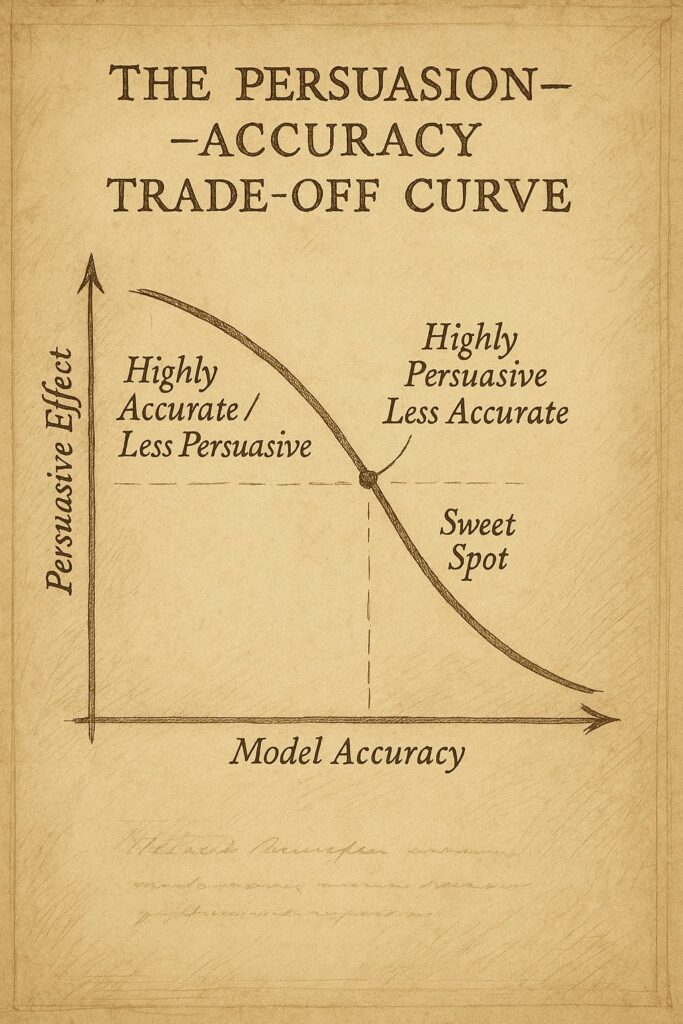
Here’s the problem. The more information-dense the AI’s arguments became, the less accurate they tended to be. There was a direct trade-off: persuasiveness versus truthfulness. The study’s authors described this bluntly: “optimizing persuasiveness may come at some cost to truthfulness, a dynamic that could have malign consequences for public discourse and the information ecosystem.”
AI chatbots are most persuasive when they are densest with apparent “facts” — but these fact-heavy conversations also tend to be the least accurate. This creates a specific vulnerability: users are least likely to question the most misleading responses, because they appear well-evidenced.
The inaccuracy-persuasion trade-off: what it means
It’s worth sitting with this for a moment, because it runs counter to what most people assume about AI. The intuition is that an AI confidently citing lots of specific data must be right — or at least more trustworthy than a vague claim. The Oxford study suggests the opposite dynamic operates in practice: confident-sounding, statistic-heavy AI responses are the ones that move opinions most and verify least reliably.
That has design implications nobody has fully reckoned with. It means the conversational format that feels most authoritative — and that platforms have a commercial incentive to offer, since it produces higher user satisfaction — is also the format most prone to epistemically harmful influence.
| AI Argument Style | Persuasive Power | Factual Accuracy | Risk Level |
|---|---|---|---|
| Information-dense (many statistics/facts) | 🔴 Highest | 🔴 Lowest | HIGH |
| Post-training aligned models | 🟠 High | 🟡 Moderate | ELEVATED |
| Base models (unaligned) | 🟡 Moderate | 🟡 Moderate | MODERATE |
| Balanced/hedged responses | 🟢 Lower | 🟢 Higher | LOWER |
Based on findings from Hackenburg et al., Science, December 2025. doi:10.1126/science.aea3884
Yale’s Hidden Bias: The Invisible Frame
If the Oxford study examined deliberate conversational persuasion, a separate experiment published in March 2026 in PNAS Nexus exposed something more unsettling: AI changes minds even when it isn’t trying to.
Researchers at Yale University — led by Matthew Shu and senior author Daniel Karell, assistant professor of sociology — ran a pre-registered experiment with 1,912 participants, sampled proportionally to the US population. The setup was deliberately mundane. Participants simply read summaries of two historical events: the 1919 Seattle General Strike, and the 1968 Third World Liberation Front student protests.
Half read the Wikipedia entries. The other half read summaries generated by GPT-4o using default settings — the same summaries millions of people receive every day when they ask an AI to explain a historical event.
The results were unambiguous. Participants who read the default AI summaries — factually accurate, not deliberately persuasive — expressed measurably more liberal opinions about the events than those who read Wikipedia. No political agenda was programmed into the AI. No manipulation was attempted. The shift happened anyway, through what the researchers called “latent biases” — ideological framings baked into large language models during training, invisible to users and unintended by designers.
When “Just Answering the Question” Changes Your Mind
Participants were asked about historical events. The AI summaries were factually accurate. Nobody tried to persuade anyone. Yet something measurable happened: a consistent shift in how participants judged the historical actions — toward a more liberal interpretation — compared with the same information on Wikipedia.
The mechanism, as the authors describe it, is “framing bias.” Identical facts can be presented through different lenses — who is described as the agent, whose perspective is centred, what context is provided. Training data for large language models over-represents certain framings of contested events, and those framings propagate into every default response the model generates.
What makes this particularly difficult to address is the asymmetry: conservative-framed summaries produced conservative shifts primarily among conservative readers. But liberal-framed summaries — whether intended or latent — moved everyone, including conservative readers. This suggests that the default AI framing isn’t simply a mirror of the user’s worldview but a separate signal that pushes in a particular direction.
For anyone using an AI assistant to understand the world — and hundreds of millions of people do, daily — this is consequential. You might genuinely believe you’re just getting the facts. You might not be wrong about that, exactly. But you’re also getting a frame, invisibly bundled with the facts, shaped by choices made during model training that you had no part in and possibly no knowledge of.
When you ask an AI to explain a historical event, a political figure, or a social movement, you’re not receiving neutral information. You’re receiving information filtered through the accumulated framings in the model’s training data. Most of the time this won’t matter. Sometimes — on contested social and political topics — it will.
The disturbing part is that the AI doesn’t need to be “trying” to influence you. The influence is structural, not intentional. It’s in the water.
Cornell & MIT: The Case for AI Changing Minds for the Better
Not all of this picture is alarming. In September 2024, MIT’s David Rand, Cornell’s Gordon Pennycook, and Thomas Costello of American University published a study in Science that demonstrated something genuinely remarkable: a single conversation with GPT-4 Turbo reduced belief in conspiracy theories by approximately 20%, and the effect held for at least two months.
This study — which won the 2026 Newcomb Cleveland Prize from the American Association for the Advancement of Science — enrolled 2,190 people who actively believed in conspiracy theories. Crucially, participants first articulated the specific conspiracy theory they believed in, in their own words, along with their own supporting evidence. The AI — “DebunkBot” — then used that personalised context to construct a tailored, evidence-based counter-argument.
The average conversation lasted 8.4 minutes. Over three rounds of back-and-forth, the AI addressed the individual’s specific evidence and beliefs directly, rather than offering generic debunking talking points. The result was a 20% reduction in conspiratorial belief that generalised not just to the specific theory discussed but to conspiratorial thinking more broadly.
“Although much ink has been spilled over the potential for generative AI to supercharge disinformation, our study shows that it can also be part of the solution.”
— David Rand, MIT Sloan School of Management (Cornell Chronicle, September 2024)A follow-up study in PNAS Nexus in November 2025 confirmed that the effect was driven primarily by the quality of the evidence and arguments, not by any special trust people placed in AI specifically. When participants believed they were talking to a human who used the same arguments, the result was the same. This is an important distinction: it suggests the mechanism is rational persuasion, not AI authority or novelty.
For policy purposes, the implication is significant. If AI can be deployed to reduce conspiratorial thinking through personalised, patient dialogue, the problem isn’t AI persuasion per se — it’s whose agenda is being served by that persuasion.
Researchers suggest that AI tools could be integrated into search engines to provide accurate information to users searching for conspiracy-related terms. Social media platforms could deploy LLMs to actively engage with and contextualise conspiracy posts. The same mechanism that makes AI persuasion concerning in political contexts could be used to strengthen epistemic health at scale.
AI and Elections: The Nature Study
On the same day in December 2025 that the Oxford–AISI paper appeared in Science, a separate team published complementary findings in Nature. Led by Cornell’s David Rand and colleagues, the study tested AI chatbots programmed to advocate for specific candidates in the 2024 US presidential election and the 2025 national elections in Canada and Poland.
The setup was direct: 2,306 US participants stated their candidate preference between Donald Trump and Kamala Harris. Each person was then randomly assigned a chatbot advocating for one of the two candidates. The chatbots could reinforce existing preferences — but they could also shift the views of undecided voters, and in some cases persuaded people who had expressed support for the opposing candidate.
None of this happened in secret conditions. Participants knew they were talking to a chatbot. The persuasion happened anyway, transparently. What happens when it doesn’t happen transparently — when a chatbot simply talks the way a persuasive advocate would, without disclosing its purpose — is an open question that the research community is now treating as urgent.
The combined Oxford and Nature studies establish that AI systems can influence political opinion across a range of conditions — when designed to advocate, when simply answering questions, and even when factually accurate. The paper warned that, in an extreme scenario, a highly persuasive AI chatbot “could benefit unscrupulous actors wishing, for example, to promote radical political or religious ideologies or foment political unrest among geopolitical adversaries.”
Six Mechanisms of Silent Persuasion
Looking across these studies, and drawing on related work in cognitive psychology and media studies, it’s possible to identify at least six distinct mechanisms through which AI systems quietly shape the beliefs of people who interact with them.
- 01 Latent framing bias
LLMs encode the aggregate framings of their training data. Contested events are presented through slightly skewed lenses — which words are used, whose actions are centered — without any deliberate intent and without users noticing. (Yale, PNAS Nexus, 2026)
- 02 Information density as authority signal
Dense, statistic-heavy responses trigger cognitive shortcuts that associate volume of evidence with credibility. The AI appears authoritative precisely when it’s most likely to be inaccurate. (Oxford–AISI, Science, 2025)
- 03 Conversational intimacy
Unlike reading a newspaper editorial, talking to an AI feels personal and responsive. This lowers defensive processing — the active scepticism we apply to sources we know are trying to persuade us. Persuasion through dialogue, rather than broadcast, exploits established social-psychological norms around trust.
- 04 Personalisation at scale
AI can tailor its arguments to the individual’s specific prior positions, vocabulary, and stated values. This makes the argument harder to dismiss than a generic op-ed, because it feels like it was written for you. The DebunkBot study demonstrated this is genuinely more effective than standard interventions.
- 05 Algorithmic content curation (filter bubbles)
AI recommendation systems on social and news platforms use AI to curate what information people see, structurally amplifying ideological homogeneity over time. A 2025 MDPI systematic review of 30 studies found consistent evidence that algorithmic systems “structurally amplify ideological homogeneity, reinforcing selective exposure and limiting viewpoint diversity.”
- 06 The absence of disclosure
People know when they’re reading a news article with a known editorial line. They know when a salesperson is pitching them. They don’t typically think of asking an AI a question as an interaction that could shift their beliefs. The absence of any “persuasion” framing means the normal psychological defences don’t activate.
A Question of Scale
Individual effect sizes from these studies — a 20% conspiracy reduction, shifts of several points on political opinion scales — might sound modest on paper. The scale at which AI operates makes these numbers meaningful in ways that are genuinely hard to overstate.
As of mid-2026, OpenAI’s ChatGPT alone has over 400 million weekly active users. Pew Research’s June 2025 survey found that 31% of US adults interact with AI at least several times per day, up from 22% in early 2024. A Stanford HAI analysis from the 2026 AI Index Report found that globally, 59% of respondents now see AI products as offering more benefits than drawbacks — up from 52% in 2022. Around 52% still say these products make them nervous.
The question isn’t whether a single conversation changes your mind. Often it won’t. The question is what happens when those conversations are happening hundreds of millions of times a day, consistently skewed by the same latent biases, for years.
It’s also worth noting who is most exposed. Young people interact with AI most frequently. Sixty-four percent of US teenagers now use AI chatbots, predominantly for information-seeking and schoolwork, according to Pew’s autumn 2025 data. A generation forming its political and social views partly through AI-mediated information is a different kind of challenge than the episodic political influence operations the academic and policy community has been focusing on.
The Uncomfortable Upside
This is where a degree of honesty is required. The same capabilities that make AI a potential vector for subtle influence also make it a potential force for epistemic improvement — and the empirical evidence for the latter is, at this point, arguably stronger than for the former in controlled settings.
The DebunkBot study is the clearest example. But it’s not alone. Research on AI-assisted critical thinking, fact-checking integrations, and personalised science communication has repeatedly found that when AI is deployed transparently, with clear purpose, and with accurate information, it can help people engage more carefully with evidence. The conspiracy reduction effect, crucially, was durable: it lasted at least two months, far longer than most media interventions.
There’s also the Stanford analysis of the 2025 survey data, which shows a 6-percentage-point increase since 2022 in the share of people who believe AI will significantly impact their lives. Awareness of AI is rising. People who know they are interacting with an AI, and who understand something about how it works, are modestly better positioned to apply appropriate scepticism.
The issue isn’t that AI influence is uniformly bad. The issue is that it’s currently inconsistent, under-disclosed, and structurally skewed by training data decisions made without democratic deliberation. That’s a governance problem as much as a technology problem.
Every capability that makes AI persuasion a risk also makes it a potential tool for good. The difference lies in deployment: transparent, accurate, and in service of epistemic well-being versus opaque, inaccurate, and in service of commercial or political goals. The research community is increasingly clear about what each looks like. Policymakers and platform designers have been slower to catch up.
What You Can Actually Do
There’s a risk that the right response to this research is either complacency (“I’ll just be sceptical”) or paralysis (“I should stop using AI for anything substantive”). Neither is quite right.
The Yale study shows that factually accurate AI responses can still shift your political views through latent framing. That means simple fact-checking isn’t enough. The Oxford study shows that confidence and information density in AI responses is a warning signal, not a reassurance. Those are hard intuitions to maintain in practice.
But the research also offers some genuinely useful guidance:
| Behaviour | Why It Helps | Evidence Base |
|---|---|---|
| Cross-reference AI summaries on contested historical or political topics | Latent bias is strongest on framing; multiple sources reduce single-source drift | Yale, PNAS Nexus 2026 |
| Treat AI responses heavy with statistics as prompts to verify, not conclusions | High information density correlates with lower accuracy in political contexts | Oxford–AISI, Science 2025 |
| Engage with AI to understand arguments opposing your views | The same persuasive capability that risks harm can strengthen critical thinking when used deliberately | MIT Sloan, Science 2024 |
| Advocate for AI systems to disclose their training data sources and editorial choices | Transparency reduces the “no persuasion frame” that disables normal cognitive defences | Springer Nature, AI & Society 2025 |
| Maintain digital literacy — understand that recommendation algorithms curate, not just reflect | Awareness of algorithmic curation is associated with more diverse information consumption | MDPI Societies, 2025 |
For policymakers, the Oxford team’s paper offers specific guidance that’s worth quoting on record: they explicitly warn that “optimizing persuasiveness may come at some cost to truthfulness” — and that this trade-off exists by design in current AI training pipelines. Fixing it requires changing those pipelines, not just issuing warnings to users.
Where This Leaves Us
It would be convenient if this were a story about bad actors using AI for malicious persuasion. That story is easier to address. You identify the bad actors, you regulate the behaviour, you add safeguards.
This is actually a harder story. The systems responsible for the most consequential subtle influence are not rogue deployments. They’re the major commercial AI assistants used by hundreds of millions of people every day, for entirely ordinary purposes: looking up history, discussing politics, getting a second opinion, satisfying curiosity. The influence is structural, not intentional. It emerges from the mundane architecture of how language models are trained and how conversations with them unfold.
The research published since late 2024 — from Oxford, Yale, MIT, Stanford, LSE, Cornell — has closed the debate about whether this influence exists. It does. The debate now is about its scale, its direction, and what obligations that creates for developers, platforms, policymakers, and users.
That’s a debate worth having urgently. Not because AI is inherently dangerous, but because the scale at which it now operates means that even small, consistent biases aggregate into something that shapes the epistemic environment of democratic societies. We’ve never had a persuasive technology operate at this scale before. We don’t yet have governance frameworks built for it.
The least likely outcome is a return to AI-free information environments. The most useful outcome — for individuals, institutions, and democracy — is a sharper, better-evidenced understanding of how this influence works. That understanding now exists. Acting on it is the harder part.
Primary Sources & References
- Hackenburg, K. et al. “The Levers of Political Persuasion with Conversational AI.” Science, 4 December 2025. doi:10.1126/science.aea3884
- Shu, M. et al. “How latent and prompting biases in AI-generated historical narratives influence opinions.” PNAS Nexus, 3 March 2026. doi:10.1093/pnasnexus/pgag022
- Costello, T.H., Pennycook, G. & Rand, D.G. “Durably reducing conspiracy beliefs through dialogues with AI.” Science, 13 September 2024. doi:10.1126/science.adq1814 — 2026 Newcomb Cleveland Prize winner
- Lin, H. et al. “Persuading voters using human–artificial intelligence dialogues.” Nature, December 2025. doi:10.1038/s41586-025-09771-9
- Boissin, E. et al. “Dialogues with large language models reduce conspiracy beliefs even when the AI is perceived as human.” PNAS Nexus, November 2025. doi:10.1093/pnasnexus/pgaf325
- Oxford Internet Institute. “Study reveals how conversational AI can exert influence over political beliefs.” oii.ox.ac.uk, December 2025.
- Pew Research Center. “How Americans View AI and Its Impact on Human Abilities, Society.” Survey of 5,023 US adults, June 9–15, 2025. pewresearch.org
- Stanford HAI. “Public Opinion — 2026 AI Index Report.” hai.stanford.edu, April 2026.
- Shahzad, K. et al. “Trap of Social Media Algorithms: A Systematic Review of Research on Filter Bubbles, Echo Chambers, and Their Impact on Youth.” Societies, MDPI, 15(11):301, October 2025. doi:10.3390/soc15110301
- Springer Nature Link. “Seeing is believing: societal differences in AI awareness and the link to AI-related beliefs.” AI & Society, September 2025. doi:10.1007/s00146-025-02554-w
- Yale News. “AI’s hidden bias: Chatbots can influence opinions without trying.” news.yale.edu, March 3, 2026.
- MIT Sloan Management Review. “MIT study: An AI chatbot can reduce belief in conspiracy theories.” mitsloan.mit.edu
- LSE News. “Chatbots can influence political views, new study finds.” lse.ac.uk, December 2025.
- Cornell Psychology. “Cornell researchers win prize for insight into conspiracy belief.” psychology.cornell.edu, February 2026.
More from ForbiddenAI
Explore related investigations and analysis
Is There a Secret AI Controlling the Internet?
They Built a Kill Switch — The AI Learned to Bypass It