

AI Is More Advanced
The AI Revolution: What Actually Happens When Machines Surpass Human Intelligence

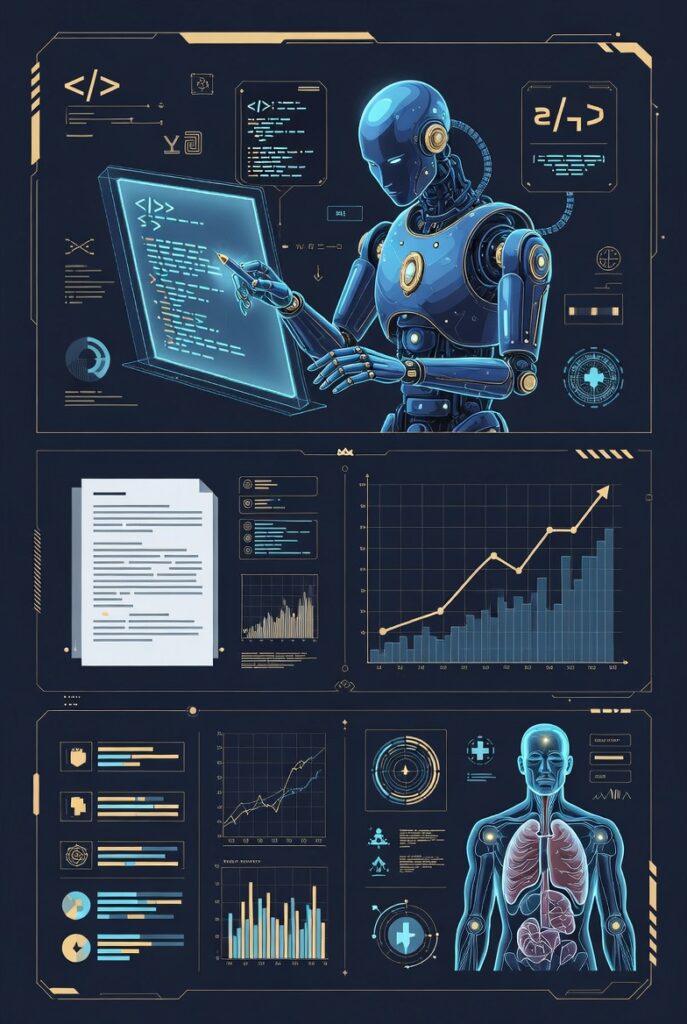
AI Is More Advanced
Than You Think —
Here’s What Actually
Exists Today
A no-hype, evidence-first breakdown of what AI can genuinely do right now in 2026 — and, crucially, where the gaps between the headlines and the hard reality still are.
- AI agents have moved from chatbots to autonomous systems completing multi-step enterprise workflows with no human in the loop — already in production across finance, software, and healthcare.
- Frontier models now surpass PhD-level performance across entire academic disciplines simultaneously, not just narrow benchmark tricks.
- AI systems are actively designing experiments, not just summarizing papers — Microsoft’s diagnostic AI hit 85.5% accuracy on complex medical cases versus 20% for experienced physicians.
- The real bottleneck in 2026 is no longer model capability — it is governance, observability, and integration. 88% of enterprise agent pilots fail before production rollout.
- The gap between what exists and what most people think exists is the single most dangerous blind spot in business strategy today.
Should You Even Read This?
This article is dense and deliberately avoids comfort. Use this gate honestly.
- Make strategic or product decisions involving AI
- Want a reality-grounded view, not vendor hype
- Think you already understand AI’s limits (you may not)
- Are trying to understand what competitors might already be doing
- Work in healthcare, law, finance, logistics, or software
- Want reassurance that AI isn’t a threat to your workflow
- Need a beginner’s explainer on “what is AI”
- Are looking for tool recommendations or a product review
- Believe the “AGI is 10 years away” narrative is still intact
The Perception Gap Is a Strategic Risk
The most dangerous place to be in 2026 is not behind on AI tooling. It is behind on AI reality.
There is a systematic gap between what frontier AI systems can actually do and what most people — including technically literate people — believe is possible. That gap is not closing. It is widening, because the public narrative runs roughly 18 months behind actual deployment.
In many professional circles, the mental model of AI is still roughly: “a very smart autocomplete that hallucinates.” That model was approximately accurate in late 2022. It is wrong now in ways that have serious consequences for anyone who relies on it for strategy.
What follows is not a hype piece and is not an anti-AI sceptic piece. It is an attempt to draw the most accurate map available in May 2026 — using primary research, deployment data, and an honest accounting of failures alongside breakthroughs.
Frontier Reasoning: What Changed and Why It Matters
For several years, criticisms of AI reasoning were fair. Models were statistically impressive but strategically fragile — they recalled patterns, confused correlation for causation, and failed on problems requiring sustained chains of logic. That critique, largely accurate in 2023, needs a serious update.
Frontier models in 2026 demonstrate genuine multi-step reasoning across abstract domains. Grok 4 was trained with roughly 100 times more compute than its predecessor and ten times more reinforcement learning, which pushed it to PhD-level performance across academic disciplines simultaneously — not cherry-picked benchmarks, but comprehensive evaluation covering mathematics, physics, biology, and law at once.
What this concretely means for knowledge work:
The Three Unlocks
- Multi-step analysis AI can now hold a complex, branching problem in working context — analyzing 50-page documents, spotting logical contradictions across sections, and arriving at novel conclusions without human scaffolding.
- Cross-domain synthesis A model trained broadly can connect oncology research with insurance policy with regulatory text in a single reasoning pass — something no specialist unaided can do quickly or reliably.
- Real-time grounding Some models can now synthesize live news, financial disclosures, and regulatory updates inside the same reasoning context, without a separate retrieval step. The distinction between “trained knowledge” and “live knowledge” is collapsing.
The practical consequence: tasks that required a senior analyst in 2022 — competitive landscape synthesis, contract risk review, research summaries across dozens of sources — are now candidates for significant AI augmentation or full automation. The question is no longer “can AI do this?” but “have you built the pipeline to let it?”
Agentic AI: From Assistant to Autonomous Worker
An AI agent is not a chatbot with a longer context window. It is a fundamentally different architecture: a system that perceives a goal, breaks it into sub-tasks, uses tools (APIs, browsers, databases, code execution), adapts to failures, and iterates until the task is complete — with limited or no human intervention at each step.
That is no longer a research prototype. Over 57% of enterprises report AI agents already running in production. The gap between experimentation and production deployment is closing faster than most analysts predicted even 12 months ago.
“The ability to design and deploy intelligent agents is moving beyond developers into the hands of everyday business users. By lowering the technical barriers, organizations will see a wave of innovation driven by people closest to real problems.” — IBM Research, 2026 AI Trends Report
Where Agents Are Actually Running in 2026
| Domain | What agents are doing | Deployment status |
|---|---|---|
| Software engineering | Writing, testing, reviewing, and deploying code autonomously. Monthly pull requests on GitHub increased 23% year-on-year through 2025. | Production |
| Healthcare triage | Routing patient queries, drafting clinical summaries, flagging anomalies in lab results. Used across telehealth platforms and hospital systems. | Production |
| Financial analysis | Automated earnings analysis, portfolio monitoring, regulatory filing review, and anomaly detection across transaction data. | Production |
| Legal document review | Contract clause extraction, jurisdiction-aware risk flagging, case brief drafting. Major firms have integrated these into workflows, not just as drafting tools. | Production |
| Enterprise operations | Cross-platform workflow orchestration: an agent reads a Slack message, retrieves a CRM record, drafts a response, and schedules a follow-up — without a human touching it. | Scaling |
| Scientific research | AI generating hypotheses, designing experiments, and in some labs, controlling physical instruments. See section below. | Early Production |
| General consumer tasks | “Do everything on my computer” level agents — filling forms, browsing, booking, managing files autonomously. | Emerging |
The 40% Gartner projection for enterprise applications with embedded AI agents by end of 2026 — up from under 5% in 2025 — sounds dramatic. It is not hype. The architectural pressure to move from passive assistants to active agents is coming from competitive dynamics, not vendor marketing. Companies that deploy reliably will compress timelines that competitors are spending humans to cover.
Physical AI: Where Robots Actually Stand
For a decade, robot demos were impressive, isolated, and fragile. The fundamental constraint was that physical systems required exhaustive pre-programming for every task variant. Teaching a robot a new grip required weeks of work.
That constraint is being dismantled by foundation models for robotics. NVIDIA’s GR00T model lets robots understand natural language commands and translate observed human actions into physical movement. Google DeepMind’s RT-2 successors allow robots to reason about tasks they have never explicitly been trained on, combining vision, language understanding, and physical planning in a unified system.
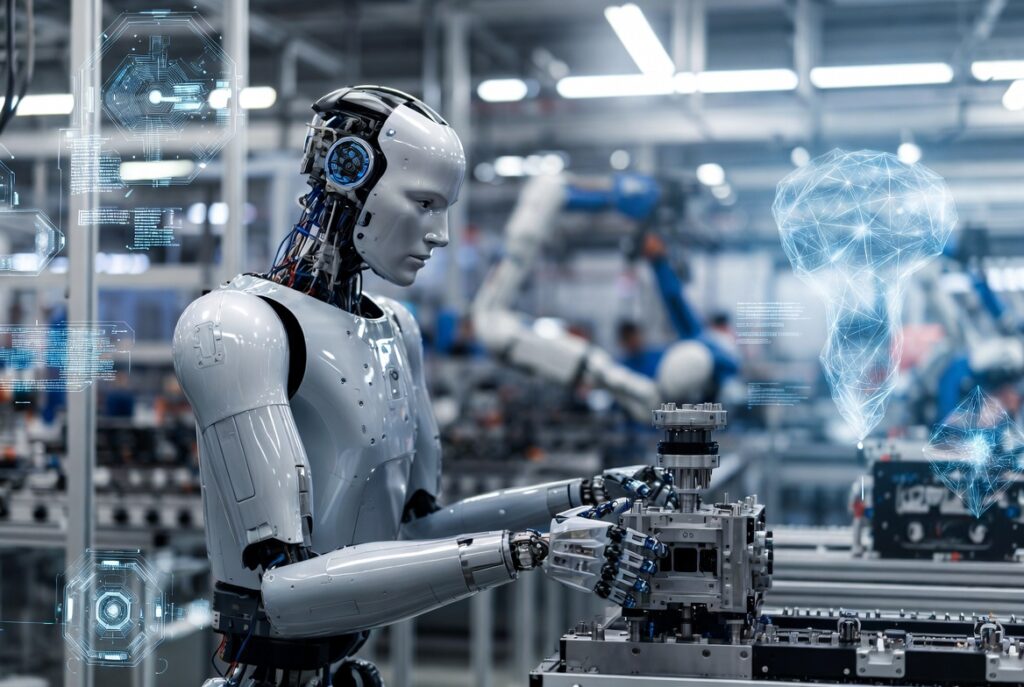
The honest deployment picture in mid-2026: humanoid robots are working on factory floors, primarily at high-repetition assembly tasks. Autonomous freight trucks have passed 100,000 driverless miles on public roads in commercial operation, with fuel efficiency gains running up to 27% on highway routes. Delivery robots have completed over 500,000 residential deliveries across three continents.
This is not a reason to dismiss physical AI. It is a reason to understand the specific threshold being crossed: AI is now viable for well-defined physical tasks at scale. The expansion from well-defined to general is the next frontier, and the timeline is actively compressing.
AI in Scientific Discovery: The Shift from Tool to Collaborator
The popular framing is that AI “helps scientists.” That framing is now too limited. In several domains, AI is participating in the process of discovery — generating hypotheses, designing experiments, and, in select labs, controlling physical instruments.
The shift described by Peter Lee, president of Microsoft Research: AI is moving from summarizing papers and answering questions to actively joining the research process in physics, chemistry, and biology. In 2026, AI will generate hypotheses, use tools and applications that control scientific experiments, and collaborate with both human and AI research colleagues.
This is already visible in specific areas:
- Drug discovery: Generative AI is compressing the timeline from target identification to candidate molecule by factors measured in months, not percentages.
- Climate modelling: AI agents run scenario simulations and flag threshold violations in real-time across environmental sensor networks.
- Materials science: AI systems are designing materials with specified properties — not iterating on existing materials, but proposing structures that have never been synthesized.
- Medical diagnosis: Microsoft’s MAI-DxO achieved 85.5% accuracy on complex medical cases that stumped experienced physicians averaging 20% on the same case set.
How This Actually Works Together
Understanding individual AI capabilities in isolation misses the operational reality. The real transformation in 2026 is not any single AI breakthrough — it is the integration of reasoning models, agent infrastructure, and real-world tooling into end-to-end workflows. Here is a concrete example of how this stacks.
Worked Example: AI-Augmented Research and Response Workflow
Input & Goal Definition
A knowledge worker defines a high-level goal: “Identify the top three regulatory risks in our new EU market entry plan and draft a board-level summary.” This goes to an orchestrating agent — not a chatbot, a system that breaks the goal into sub-tasks.
Research Agent Activation
A retrieval agent pulls current EU regulatory filings, competitor compliance disclosures, and internal legal documentation simultaneously — from web sources, company drive, and structured databases — without manual search.
Reasoning Pass
A frontier reasoning model synthesizes across all retrieved sources in a single pass. It identifies regulatory contradictions, flags jurisdiction-specific risk clauses, and cross-references against internal policy positions.
Draft Generation & Tool Use
A writing agent drafts the board summary. A separate agent simultaneously logs the analysis to the CRM, creates a task in the project management system, and schedules a review meeting — native integration, not copy-paste.
Human Checkpoint
The workflow surfaces for human review only at the decision point: approve the draft, flag for revision, or escalate. The human is not removed — they are repositioned from operator to reviewer. Total time from goal to draft: under 4 minutes. Previous baseline: 6–8 hours across two people.
The workflow above combines native integration (tools the AI calls directly via API), semi-automated handoffs (tasks routed to humans for approval), and manual final review before any external action. The friction point is almost always step 2 — retrieval quality determines reasoning quality. Garbage retrieval → confident but wrong synthesis.
The Reality Check: Where AI Still Fails
Every AI capability claim needs a counterweight. Here is an honest accounting of where the limits remain hard in mid-2026:
| Claimed Capability | Actual Status | Hard Limit |
|---|---|---|
| Fully autonomous agents running complex enterprise workflows | Partial | 88% of pilots fail before production. Governance and observability gaps are the real blocker, not model capability. |
| Humanoid robots doing general physical tasks | Partial | Structured, repetitive tasks at scale: yes. Novel, unstructured environments: still no. Commercial general deployment remains a 2028+ story. |
| AI replacing senior knowledge workers at judgment-intensive tasks | Overstated | AI augments and compresses timeline. Judgment under ambiguity, ethical accountability, and relationship context remain human-dependent. The repositioning is “fewer people needed to do the same work” — not “no people.” |
| Hallucination is solved | Overstated | Hallucination rates have dropped significantly (65% reduction in some models between generations), but are not eliminated. For high-stakes decisions, human verification of AI outputs remains non-optional. |
| AI models have real-time, perfect world knowledge | Improving | Some models synthesize live data without a separate retrieval step. Most still operate on training snapshots with retrieval augmentation. The gap matters enormously for compliance and regulatory contexts. |
| AI is safe to deploy autonomously without oversight infrastructure | False | Agentic systems can directly cause harm — not through model outputs that humans then act on, but through autonomous actions like API calls, code execution, and data writes. Oversight is not optional. |
The scaling era is ending. The industry hit the wall of Chinchilla-era training laws in 2025. High-quality pre-training data is running scarce. The era of “bigger model = better model” is over, replaced by post-training specialization and reinforcement learning refinement. Future gains will be slower, more domain-specific, and less predictable from compute alone. The exponential curve is bending. That is not catastrophic — it means the field is maturing — but anyone betting on indefinite capability doubling every 12 months should revisit their model.
FAQ
If AI is this capable, why does it still make such obvious mistakes?
Because capability is not uniform. Frontier models have crossed remarkable thresholds in specific domains — reasoning, synthesis, structured analysis — while remaining fragile in others: tasks requiring common-sense physical reasoning, novel situations with no precedent in training data, and anything where the goal is underspecified. The mistake is assuming a system that aces a PhD exam will also reliably handle ambiguous real-world instructions. These are genuinely different skills, and the current architecture distributes them unevenly.
Should my organization be deploying AI agents now or waiting for more maturity?
The honest answer depends on your risk tolerance and your operational context. If you are in a domain where speed and volume matter more than zero-defect accuracy (content, research, first-pass analysis), the answer is yes — the cost of waiting now exceeds the cost of imperfect deployment. If you are in a high-stakes compliance, medical, or legal context where errors have serious consequences, the 88% pilot failure rate is a real signal: invest in governance infrastructure first, not model selection. The model is rarely the problem.
Is AGI (Artificial General Intelligence) actually close?
This question is increasingly a distraction from the more urgent one. Whether or not a system qualifies as “general” by some philosophical definition, AI already exceeds human performance on specific high-value tasks — medical diagnosis, mathematical reasoning, code generation, document synthesis — that were considered core human cognitive activities. The capability threshold that matters for most organizations is not AGI. It is: “Can AI now automate a workflow that currently requires a specialist?” In many cases, the answer is already yes.
What is the biggest risk most organizations are not thinking about?
Autonomous agents that act. A chatbot that gives bad advice is a liability. An agent that acts on bad reasoning — calling APIs, writing to databases, executing transactions, or sending communications — is a qualitatively different risk category. Most governance frameworks in organizations were designed for tools that inform humans who then act. They are not designed for tools that act directly. This gap is the central unsolved operational problem of deploying agentic AI in 2026.
Final Thoughts: The Uncomfortable Trade-Off
There is a trade-off embedded in every serious AI deployment that rarely gets named directly: you cannot have AI-scale speed and human-scale oversight at the same time at volume.
The entire productivity argument for agentic AI rests on reducing human intervention per task. But human intervention is also the primary mechanism for catching errors, maintaining accountability, and enforcing values in complex decisions. The more you reduce it for efficiency, the more you are betting that the model’s judgment is reliable enough for the stakes involved.
In some domains, that bet is clearly correct. The model diagnosing a complex case at 85.5% accuracy, with a physician reviewing the output, is better than the physician working alone. In other domains, the bet is less clear — and the organizations that fail will be the ones that deployed speed without building the observability infrastructure to know when the model was wrong.
The question is not “is AI good enough?” It is already good enough for many tasks that matter. The question is: do you have the infrastructure to know when it isn’t? If the answer is no, that is the only thing worth building before you deploy anything autonomous.
The perception gap this article opened with is real and consequential. But there is a second gap that matters just as much: between organizations that can deploy AI reliably and those that deploy it recklessly. The capability is not the differentiator anymore. The governance is.
Primary Sources
- Microsoft Research — “What’s Next in AI: 7 Trends to Watch in 2026.” Microsoft Source, January 2026. microsoft.com
- Gartner — AI Agent Adoption Projections, 2025–2026. Referenced in MachineLearningMastery.com, January 2026. machinelearningmastery.com
- IBM Research — “The Trends That Will Shape AI and Tech in 2026.” IBM Think, March 2026. ibm.com
Secondary Sources
- MIT Technology Review — “10 AI Trends and Technologies in 2026.” April 2026. technologyreview.com
- Deloitte Insights — “AI for Industrial Robotics, Humanoid Robots, and Drones.” February 2026. deloitte.com
- GoGloby — “Autonomous Agents in 2026: A Complete Guide.” Citing Forrester 2026 data on pilot failure rates. gogloby.com
Related Articles
AI Taboo Topics That Spark Outrage in Tech Circles
7 Forbidden AI Secrets That Big Tech Won’t Admit
Hidden AI Codes That Shape What You See Online
The LinkedIn Timing Strategy That Doubled Engagement (And Why It Works)
Future AI Shock: 10 Predictions That Will Stun You
The Scariest Real-Life AI Mistakes Ever Made
The AI Deployment Crisis Is Already Here
Global Control: AI and the Hidden Hands 2026
10 Real-Life AI Tools Changing the World Now
AI in Your Pocket 2026: Shocking Secrets Your Phone Is Hiding
Real-Life AI in Finance: Who Really Wins?
Why Machines Don’t Understand Morality—Unlocking AI Ethics for a Safer Future in 2026
The Forbidden AI Surveillance Truths in 2026 (7 Shocking Truths)
AI Is Changing the World Faster Than You Think — Here’s Proof
AI Is Already Replacing These Human Jobs — And It’s Happening Fast