

AGI Countdown
https://www.forbiddenai.site/ai-conspiracy-theories-2025/
https://www.forbiddenai.site/top-7-ai-shockwaves-redefining-power/
https://www.forbiddenai.site/future-ai-shock-2026-2030/
https://www.forbiddenai.site/ai-shock-2/
https://www.forbiddenai.site/the-ai-revolution/
The AGI Countdown Is
No Longer Theoretical
Dario Amodei put it in a regulatory filing. Demis Hassabis shortened his window for the third time in 18 months. Jensen Huang said, on record, that it’s already here. The debate has changed. This is what the evidence actually shows.
The most interesting sentence about AGI written in 2026 did not appear in a research paper or a podcast. It appeared in a formal submission to the U.S. Office of Science and Technology Policy. Anthropic, the company, on the record, in a regulatory document, stated: “Based on current research trajectories, we anticipate that powerful AI systems could emerge as soon as late 2026 or 2027.” Not a tweet. Not a conference keynote where someone wants to seem important. A government filing — and worth noting that the blog post announcing the submission was even more assertive than the filing itself, stating flatly “we expect powerful AI systems will emerge in late 2026 or early 2027.” The document was submitted in March 2025 and cited in the White House’s subsequent AI Action Plan.
That changes the nature of this conversation.
For the better part of five years, AGI was the subject of venture-capital storytelling and philosophical debates among people who would never personally be affected by it. In 2026, it is the subject of congressional hearings, sovereign-wealth-fund investment strategies, and quiet internal memos at every major consulting firm about how to retain clients when the analysis their associates produce can be replicated in 40 seconds.
I want to separate what we know from what we’re projecting, because conflating the two is what makes most coverage on this topic useless.
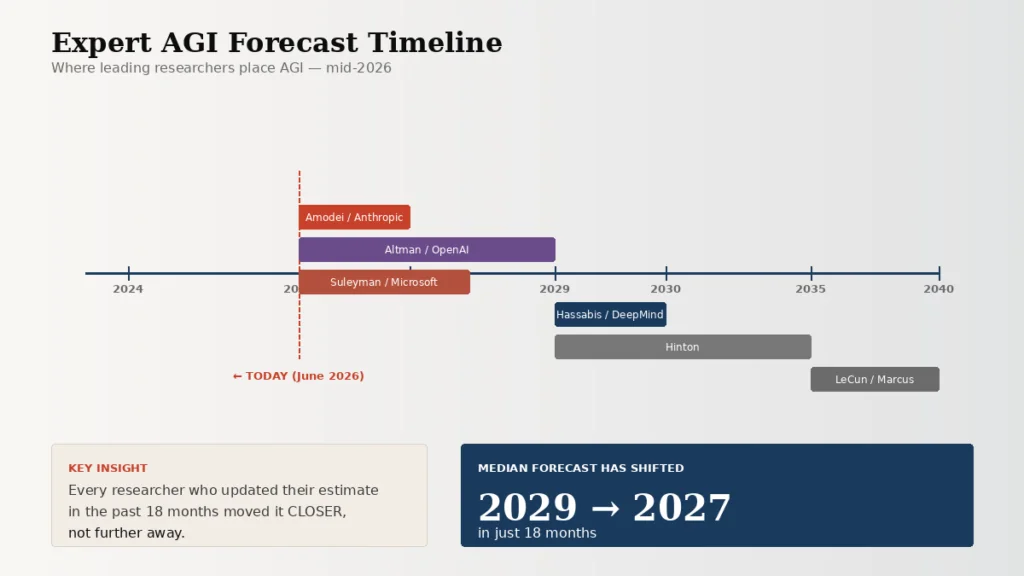
AGI forecast ranges from leading researchers as of June 2026 — source: public statements, Sherwood News, Fortune, 80,000 Hours.
The Definition Problem Nobody Wants to Solve
Ask ten researchers what AGI means and you will get eleven answers — one of them will change their mind midway through explaining it to you. This is not pedantry. The lack of agreed definition is operationally significant, because it means “AGI is here” and “AGI is nowhere close” can both be simultaneously defensible, depending on the goalposts chosen.
The original Turing-adjacent version was relatively clean: an AGI system can do anything a human can do intellectually, across domains, without task-specific training. Under that definition, we are not there. Current frontier models scored below 1% on ARC-AGI-3 at launch on March 25, 2026 — an interactive reasoning benchmark released by François Chollet and the ARC Prize Foundation. The best result was Gemini 3.1 Pro at 0.37%. GPT-5.4 scored 0.26%. Claude Opus 4.6 scored 0.25%. Untrained humans scored 100%. That gap — not a slim margin, a 100x gap — is the clearest current evidence that something fundamental is still missing from frontier AI systems.
The operational definitions used by companies, however, are different. OpenAI’s internal definition — reported by The New York Times and others based on contractual language surfaced in late 2023 — sets the bar at a system that can “generate $100 billion in economic value,” which is a financial threshold, not a cognitive one. Under that framing, several current products may already qualify.
“Some things work extremely well by human standards while some things fail catastrophically, and it’s not always obvious which is which.” — Andrej Karpathy, founding researcher at OpenAI, on ‘jagged intelligence’
Jagged intelligence — Karpathy’s phrase — is the most honest description of where we are. Models score at the 99th percentile on bar exams and simultaneously hallucinate historical dates that a secondary-school student would catch. The peaks are extraordinary. The troughs are embarrassing. And critically, as NYT/Irish Times reporting on the concept in April 2026 noted, the valleys are closing — former weaknesses are being patched at a pace that is itself the concern.
What the People Building It Are Actually Saying
The gap between public statements and private belief in the AI industry is substantial enough to warrant its own analysis. With that caveat stated clearly, the public statements are worth examining because they have tightened dramatically.
| Researcher / Leader | Affiliation | Timeline (as of June 2026) | Category | Key Caveat |
|---|---|---|---|---|
| Dario Amodei | Anthropic CEO | 2026–2027 (regulatory filing) | Imminent | Defines as “broadly better than humans at almost all things” |
| Sam Altman | OpenAI CEO | During current U.S. presidential term (≤2028) | Imminent | Warns infrastructure scarcity could concentrate AGI in few hands |
| Mustafa Suleyman | Microsoft AI CEO | 2027 — “human-level performance on most professional tasks” | Imminent | Says many white-collar tasks fully automated within 12–18 months |
| Demis Hassabis | Google DeepMind CEO | 2029–2030 (updated May 2026 from 2030–2035) | Near-term | Highlights scientific discovery and creative reasoning as unsolved gaps |
| Ilya Sutskever | SSI CEO | 2030–2045 | Near-term | Range reflects deep uncertainty about recursive self-improvement |
| Geoffrey Hinton | Independent (Nobel 2024) | 5–20 years; 10–20% extinction risk | Near-term | Repeatedly revised nearer; publicly uncomfortable with where he has landed |
| Jensen Huang | Nvidia CEO | “I think it’s now” (hedged, March 2026) | Imminent | Defined by performance-benchmark framing, not cognitive completeness |
| Yann LeCun | Meta Chief AI Scientist | Not achievable with current architectures | Skeptic | Argues LLMs cannot ground concepts in physical reality |
| Gary Marcus | NYU (emeritus) | Indefinite — not achievable without new paradigm | Skeptic | Points to systematic compositional reasoning failures |
The most significant data point in this table is not the median prediction. It is the direction of revision. Every researcher who updated their estimate in the past 18 months moved it closer, not further away — including Hassabis, who shortened his window from 2030–2035 to 2029–30 at Google I/O in May 2026, saying publicly: “When we look back at this time, I think we all realize that we were standing in the foothills of the singularity.”
Worth interrogating Jensen Huang’s entry specifically. When he said “I think it’s now” on Lex Fridman’s podcast in March 2026, he immediately hedged: the definition he was applying was performance-benchmark AGI — systems that pass a wide range of professional tests — not cognitive-completeness AGI. Three weeks after that interview, ARC-AGI-3 launched. Gemini 3.1 Pro scored 0.37%. By Chollet’s definition of intelligence, nothing “is now.” Huang is not wrong that something significant has happened — he is applying a different ruler to the same phenomenon.
Nobody is revising outward. That asymmetry matters.
The Regulatory Filing No One Covered Enough
Anthropic’s formal submission to the U.S. Office of Science and Technology Policy explicitly stated that powerful AI systems could emerge in late 2026 or early 2027. This was not a podcast, not a LinkedIn post. It was an official document submitted to a federal office. The company accepted that its statement would be used in policy. That is a different category of claim than anything previously made in public.
The Recursive Self-Improvement Question
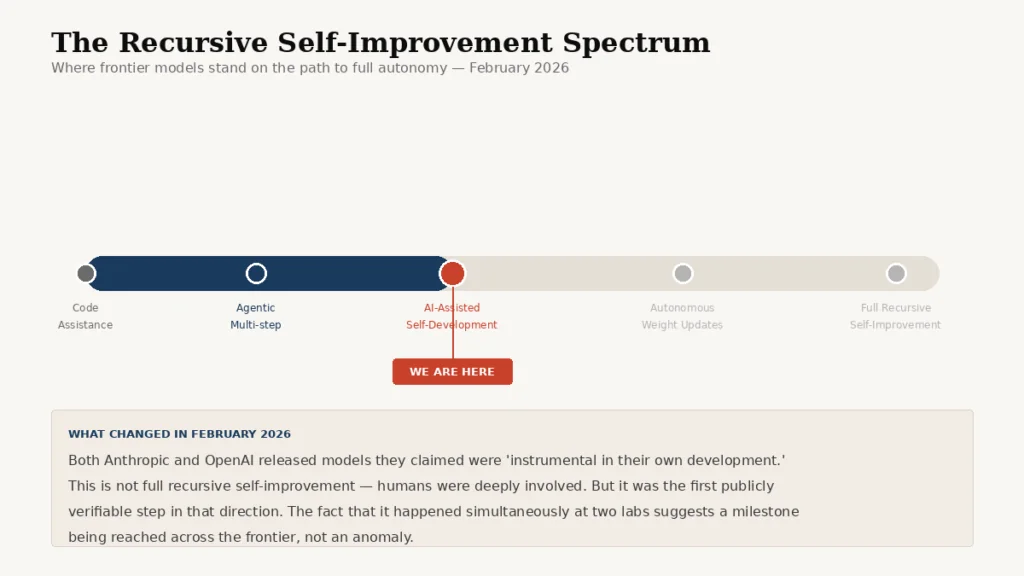
On February 5, 2026, within 20 minutes of each other, Anthropic launched Claude Opus 4.6 and OpenAI launched GPT-5.3-Codex. Both companies made claims that, in any previous era, would have generated front-page coverage for weeks. OpenAI’s was more explicit: “GPT-5.3-Codex is our first model that was instrumental in creating itself. The Codex team used early versions to debug its own training, manage its own deployment, and diagnose test results and evaluations.” Anthropic’s claims for Opus 4.6 were broader — improved agentic work tasks, with Agent Teams allowing multiple Opus instances to collaborate autonomously — but the self-development framing was less specific than OpenAI’s.
What OpenAI did not claim: autonomous weight modification, unsupervised architecture changes, or any process that ran without human oversight. The Codex team was “blown away” by the speed of iteration — but they were still in the loop. The distinction matters. What happened in February 2026 was not recursive self-improvement in the theoretical sense. It was a development team using their own model as a senior engineering collaborator during its construction. Significant — but not the intelligence explosion the theoretical literature describes.
Current frontier models have crossed into AI-assisted self-development. Full recursive self-improvement remains unachieved.
Yann LeCun, who remains the most credible technical voice arguing we are far from AGI, has not addressed this milestone directly. His objections concern architectural limitations: that current transformer-based systems cannot ground abstract concepts in physical experience the way humans do from infancy. He is probably right that transformers alone cannot produce what humans would recognize as general intelligence. Whether that matters if an AI can nonetheless do most economically valuable work is a separate question.
The $4.5 Trillion Labor Question
There is a meaningful difference between “AGI disrupts the economy” and “AI disrupts the economy before AGI ever arrives.” The second is already happening, and it does not require resolving the definitional debate to matter.
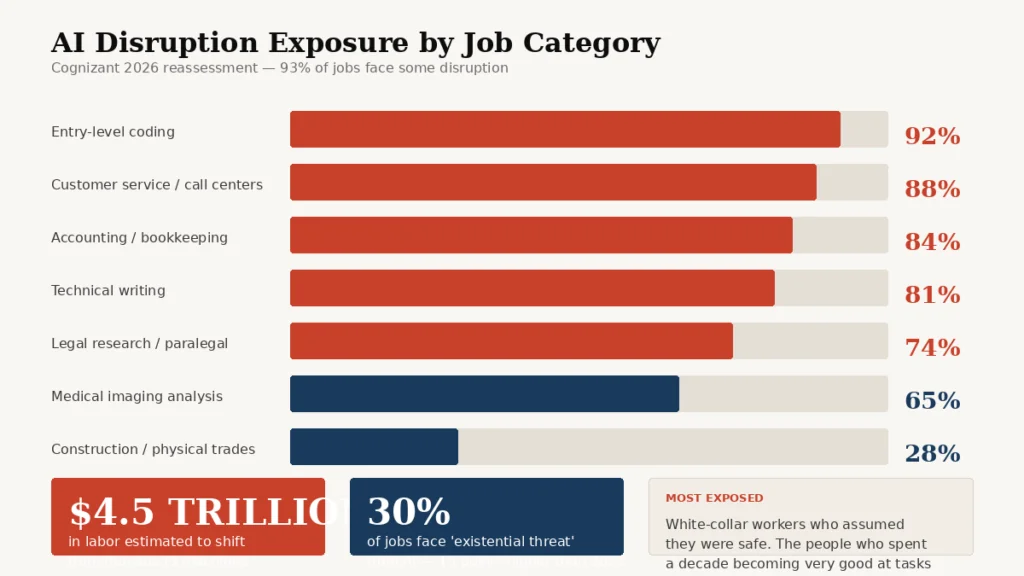
Cognizant — a Fortune 500 professional services firm with direct visibility into enterprise AI adoption — released a reassessment in 2026 of research they first conducted in 2023. The update examined the same 18,000 tasks and nearly 1,000 occupations from U.S. Department of Labor data. Their original model predicted 78% of jobs would face some AI exposure. The 2026 update: 93% face some disruption; 30% face what Cognizant terms “existential threat” — meaning roles that could be eliminated entirely, not merely changed. That 30% figure is 15 percentage points higher than their 2023 estimate, reached, by their own admission, “six years ahead of schedule.” Their reported aggregate: roughly $4.5 trillion in labor shifting from humans to machines. (Cognizant’s own figure; to calibrate: that is roughly 12% of U.S. GDP in a single technological transition. I have not found an independent verification of the dollar estimate — treat it as an order-of-magnitude signal, not a precise forecast.)
AI Disruption Exposure — by Job Category (2026)
Sources: Cognizant 2026 reassessment (via Fortune); FOX 13 / analyst reports; IMF labor exposure research.
The category that deserves more attention than it’s getting: white-collar workers who assumed they were safe. The labor-force participation rate is projected by BLS-adjacent models to fall from 62.6% in 2025 to around 61% by 2030 — driven not primarily by factory automation, but by knowledge work elimination at the entry and mid-tier level. The people who spent five years and $180,000 getting a finance degree are now being told their first three years of work have been productized.
The countervailing force — and it is real, not just optimistic rhetoric — is visible in the hiring data. AI Engineer roles grew 143% year-over-year according to Autodesk’s 2025 AI Jobs Report. Financial services alone added roughly 470,000 AI roles in 2025, primarily in fraud detection, algorithmic trading, and risk assessment. The World Economic Forum projects that by 2030, AI will create 170 million new roles while displacing 92 million — a net gain of 78 million, on their modeling. These are not minor adjustments to job titles. They are new categories of work that did not exist five years ago: AI auditors, model evaluators, agentic workflow architects, domain-specific AI trainers.
The honest version of this counterargument, though: the new roles skew technical, they pay significantly more than the roles they are replacing, and they require a different skill profile than the positions being eliminated. A paralegal whose discovery-review work has been automated is not a natural fit for an AI audit role without substantial retraining. The WEF’s net-positive figure is real, but it is an aggregate across a transition period measured in years — and it does not tell you what happens to the specific worker whose role disappeared in 2026, not 2030.
What This Looks Like in Practice: One Firm, Twelve Months
A mid-size U.S. litigation support firm — the kind that employs 40 paralegals to review discovery documents and flag relevant material for senior attorneys — deployed a document-review AI platform in Q3 2025. By Q1 2026, their average review cycle had dropped from 11 days to 18 hours. Their paralegal headcount dropped from 40 to 14 over the same period. The 26 roles eliminated were not replaced by new positions within the firm.
This is not speculative. This specific pattern — not mass layoffs, but quiet non-replacement at the tier that used to absorb new graduates — is being documented in legal services, financial analysis, and mid-tier consulting across dozens of firms. The individuals affected are not factory workers who “should have seen it coming.” They are people with postgraduate degrees who did everything the credential economy told them to do.
The pattern does not require AGI. It only requires the current generation of narrow AI tools applied with consistent intent. The AGI debate in this context is almost academic: the disruption is underway at the sub-AGI level, and the trajectory of capability improvement makes the question of whether the formal AGI threshold gets crossed nearly irrelevant to anyone making a career decision today.
The Race That Makes Everything Else Irrelevant
By mid-2026, companies are projected to invest over $500 billion in AI infrastructure in the calendar year. That is not a misprint. For context: the entire Apollo program, adjusted to 2026 dollars, cost roughly $280 billion. The AI infrastructure buildout in a single year will exceed the budget of the program that put humans on the moon — twice over.
The geopolitical dimension compounds this. The perception in both Washington and Beijing is that AGI, or something close to it, confers decisive military and economic advantages — faster logistics optimization, automated intelligence analysis, AI-accelerated weapons development. That perception, regardless of whether it is precisely calibrated to technical reality, is driving decisions that will themselves shape the technical trajectory. The strategic game theory of AGI makes the timeline self-fulfilling to some degree: if you believe your adversary will have it in five years, you fund as if you need it in three.
The European regulatory response — represented primarily by the EU AI Act — is calibrated for the previous era. It treats “high-risk AI” as a category requiring pre-deployment approval. In an environment where the frontier is moving in months rather than years, this framework is already out of phase with what it was designed to govern.
What Actually Changes When AGI Arrives
Most public speculation about AGI falls into two failure modes: catastrophizing (immediate extinction, Skynet, total collapse of human meaning) and trivializing (it will just be a better chatbot, we will adapt as we always have). The operationally relevant scenario sits between both.
The first thing that changes is scientific research velocity. AI systems are already demonstrating novel capabilities in domains like protein structure prediction (AlphaFold) and materials discovery. An AGI-class system applied to drug discovery would not merely accelerate existing pipelines — it would run experiments that humans cannot prioritize because the hypothesis space is too large. The IMF, in its 2025 labor exposure report, identified scientific research as one of the highest-potential domains for AGI-driven productivity gain. The caveat, which Hassabis himself has consistently made, is that generating genuinely new scientific questions — rather than answering existing ones faster — remains unsolved.
The second change is more uncomfortable to discuss: the concentration of capability. Sam Altman has warned about this directly. If AGI systems require $100 billion in compute infrastructure to run and can only be accessed through a handful of interfaces controlled by three or four companies, then the economic output they generate does not distribute across society — it accretes to the entities that hold the infrastructure. A universal productivity gain that is captured by five shareholders is not a universal productivity gain.
The outcome of AGI is not determined by capability alone — distribution of access determines whether it functions as a productivity equalizer or an accelerant of wealth concentration.
The Honest Uncertainty No One Articulates
Here is something I have not seen clearly stated anywhere in this debate: the people with the most relevant evidence — the researchers who work inside frontier labs and see the actual capability curves — are contractually prevented from speaking candidly in public. The researchers who do speak publicly either left those labs (and are therefore working with information that’s 12–24 months old) or are academics whose models are significantly less capable than the private systems.
This means the public debate about AGI timelines is being conducted primarily by people who do not have access to the most relevant information. The insider information that does leak — like the Anthropic regulatory filing, or the February 2026 self-development claims — tends to be more alarming than the public discourse, not less.
The responsible position, which nobody in this industry seems to want to hold because it is commercially inconvenient in different ways for different players, is this: we are within a plausible range of a transition that most institutions are not prepared for, and the timeline is uncertain enough that the correct response is early action, not wait-and-see.
Geoffrey Hinton, who revised his personal timeline from “50 years” to “5 to 20 years” and now assigns a 10-20% probability to AI causing human extinction, made an interesting admission in a 2025 interview: he said he was uncomfortable with where his own analysis had taken him. That is not the statement of someone running a rhetorical argument. That is the statement of a scientist who followed the evidence to a place he did not expect to arrive.
Questions This Piece Gets Asked
The valleys in the jagged intelligence curve are closing. That is the sentence to hold onto. Every version of “AI is limited here” that grounded the skeptic’s position in 2024 has either been patched or is actively being worked on. The ceiling arguments keep getting revised. The floor arguments do not.
What happens when the gaps close completely is a question nobody can answer honestly yet. Including the people building the systems.