

Advanced AI Prompts
Advanced AI Prompts That Outperform Standard Methods
Most people treat prompt engineering like a magic spellbook. It is not. Here is what actually moves the needle in 2026 — backed by recent research, tested in production, and written for people who need results, not theory.
The Mistake Everyone Makes
In March 2025, I spent three days building a 400-word “master prompt” for a client. Layered constraints. XML tags. Three-shot examples. A scoring rubric. The prompt was beautiful. It scored 94% on GSM8K with GPT-4o.
Then GPT-5 dropped. Same prompt. Same task. Score: 87%. Worse than a bare “solve this” instruction.
That was the moment I understood: prompt engineering is not about writing better instructions anymore. It is about knowing which model you are talking to, what that model already does internally, and when to get out of its way.
Complex scaffolding — step-by-step rules, detailed constraint systems, elaborate few-shot examples — now hurts performance on top-tier models (GPT-5, Claude Opus, Gemini 2.5). Research from October 2025 calls this “Prompting Inversion”: excessive literal interpretation forces the model to overthink, degrading autonomous reasoning.
On GPT-4o, sculpted prompts with constraints beat standard CoT 97% to 93%. On GPT-5, the same sculpted prompt lost 94% to 96.36%. The model got smarter; your prompt got in the way.
This article covers what actually works in mid-2026. Not the techniques that worked last year. Not the techniques that sound impressive in a conference talk. The ones that move numbers in production.
Adaptive Graph of Thoughts (AGoT)
Chain-of-Thought assumes problems are linear. Tree-of-Thought assumes they are branching. Most real problems are neither. They are directed acyclic graphs — subproblems with dependencies that do not fit neatly into a sequence or a tree.
AGoT, introduced in February 2025, dynamically decomposes problems into a DAG at test time. No retraining. No fine-tuning. The model figures out which subproblems matter, which depend on which, and expands only the branches worth exploring.
(GPT-4o)
vs. Baseline
Test-Time Only
When to Use It
AGoT shines when the problem has interdependent subproblems. Migration planning. System architecture. Multi-variable optimization. Anything where solving part A changes how you approach part B.
This is a large-scale migration from on-premises to AWS, targeting January 2027.

Approach:

1. Break the migration into independent subtasks (DB migration, containerization, network setup, security hardening).

2. Specify dependencies between subtasks explicitly.

3. Solve dependent subtasks by referencing preceding results.

4. Synthesize a complete roadmap with phase gates.

Do not assume linear execution. Flag where parallel work is possible and where it is not.
The key phrase: “Do not assume linear execution.” That single constraint forces the model out of its default sequential reasoning pattern and into graph-mode thinking.
Confidence-Informed Self-Consistency (CISC)
Standard Self-Consistency generates N answers and votes by majority. It is democratic. It is also dumb — a confident correct answer gets the same weight as a hesitant correct answer, and a confident wrong answer gets the same weight as a hesitant wrong one.
CISC, published in ACL 2025 Findings, introduces weighted voting. Each reasoning path gets a confidence score. High-confidence paths get more weight. Low-confidence paths get less. The result: equal or better accuracy with up to 53% fewer samples.
CISC outperforms standard Self-Consistency across 9 models and 4 datasets while cutting compute costs by more than half. For production systems where every API call costs money, this is not an academic curiosity — it is a budget line item.
The Prompt Structure
Determine whether this IAM policy adheres to the Least Privilege principle.

Generate 5 different reasoning paths.

For each path:
- State your conclusion
- Assign a confidence score (0-100)
- Briefly justify the score

Final conclusion: weight each path by its confidence. If high-confidence
paths disagree, flag the ambiguity rather than forcing consensus.
Notice what is missing: no rubric, no scoring matrix, no “evaluate on these 7 criteria.” Just the task, the number of paths, and the weighting instruction. For modern models, that is enough. The model already knows what “Least Privilege” means. Your job is to make it think about its own certainty.
I used this on a security audit last month. Three of five paths agreed the policy was compliant. But the two dissenting paths both scored 92+ confidence and flagged the same edge case. Standard Self-Consistency would have called it compliant. CISC surfaced the real risk.
Prompt Repetition: The Dumbest Technique That Works
December 2025. Google Research. A paper so simple it feels like a prank: paste the question twice. That is it. <question><question>.
Decoder-only LLMs process text sequentially. When the model reads the second copy, it has already processed the entire first copy. This creates a pseudo-bidirectional context effect — the model “sees” the full question while still “reading” it, improving comprehension on non-reasoning tasks.
Non-Reasoning Tasks
vs. Complex Prompts
Complexity
What are the optimal solutions for addressing the Cold Start problem in AWS Lambda?
What are the optimal solutions for addressing the Cold Start problem in AWS Lambda?
This does not work for reasoning tasks — CoT and its variants already handle those. But for classification, extraction, summarization, and entity recognition? The improvement is real, measurable, and costs exactly one extra copy-paste.
Do not use this on reasoning models (o-series, Claude Extended Thinking, Gemini Thinking Mode). They are already doing internal repetition. Adding external repetition adds noise, not signal. Test on your specific model before deploying.
DR-CoT: Dynamic Recursive Chain of Thought
Standard Chain-of-Thought has two fatal flaws on long problems: context dilution and token bloat. By step 12, the model has forgotten step 3. By step 20, you are burning $0.40 per call.
DR-CoT, published in Scientific Reports (Nature) in 2025, attacks both problems simultaneously:
- Recursive reasoning: Break problems into sub-problems, solve each independently
- Dynamic context pruning: Maintain only essential context within a fixed token budget per step
- Multi-chain voting: Run two independent reasoning chains and cross-validate
The surprising result: small BERT-class models running DR-CoT outperformed GPT-4 and LLaMA 2 on GPQA Diamond in zero-shot. Not because the model is better, but because the reasoning architecture is better.
Solve this problem following these rules:

Rules:
- If complex, break into smaller sub-problems
- When solving each sub-problem, reference previous results but keep
  only essential content (token budget: max 150 chars per step)
- Solve using two different approaches. If results match, present as final.
  If they differ, explain the discrepancy.

Problem: A company's growth was 20% for 3 years, then -10% for 2 years.
Initial revenue: $10B. What is revenue after 5 years?
The token budget constraint is the secret weapon. Most people do not constrain the model's working memory. DR-CoT forces compression, which forces the model to prioritize. The result is cleaner reasoning and fewer hallucinated detours.
The Shift to Context Engineering
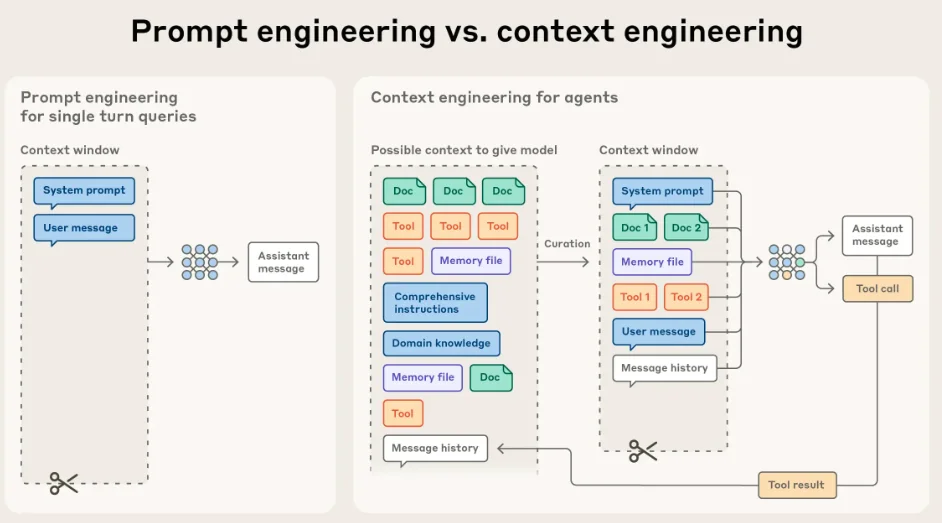
Here is an uncomfortable truth: the bottleneck in 2026 is not how you ask. It is what you give the model to work with.
A mediocre prompt with excellent context outperforms a perfect prompt with no context. Every time. This is the shift from “prompt engineering” to “context engineering” — and it is the single most important trend in the field right now.
The Context Engineering Checklist
| Layer | What to Include | What to Cut |
|---|---|---|
| System Prompt | Role definition, output format, hard constraints | Step-by-step reasoning instructions (model handles this) |
| RAG Context | Top-5 most relevant chunks, ranked by semantic similarity | “Related” documents that do not directly answer the query |
| History | Last 3-4 turns verbatim; older turns as 1-line summaries | Full conversation transcript (context dilution) |
| Tools | Only tools the model actually needs for this specific query | “Just in case” tool definitions (confuses routing) |
| Query | Clear, specific question with any necessary constraints | Preamble, hedging, “please and thank you” (wastes tokens) |
The best engineers in 2026 think in “context stacks,” not “prompt templates.” If you are still building elaborate prompt templates while ignoring what information you are feeding the model, you are optimizing the wrong variable.
For more on building production-grade RAG pipelines, our context architecture guide covers chunking strategies, embedding selection, and reranking approaches that actually work at scale.
ReAct: Reason + Act for Agentic Workflows
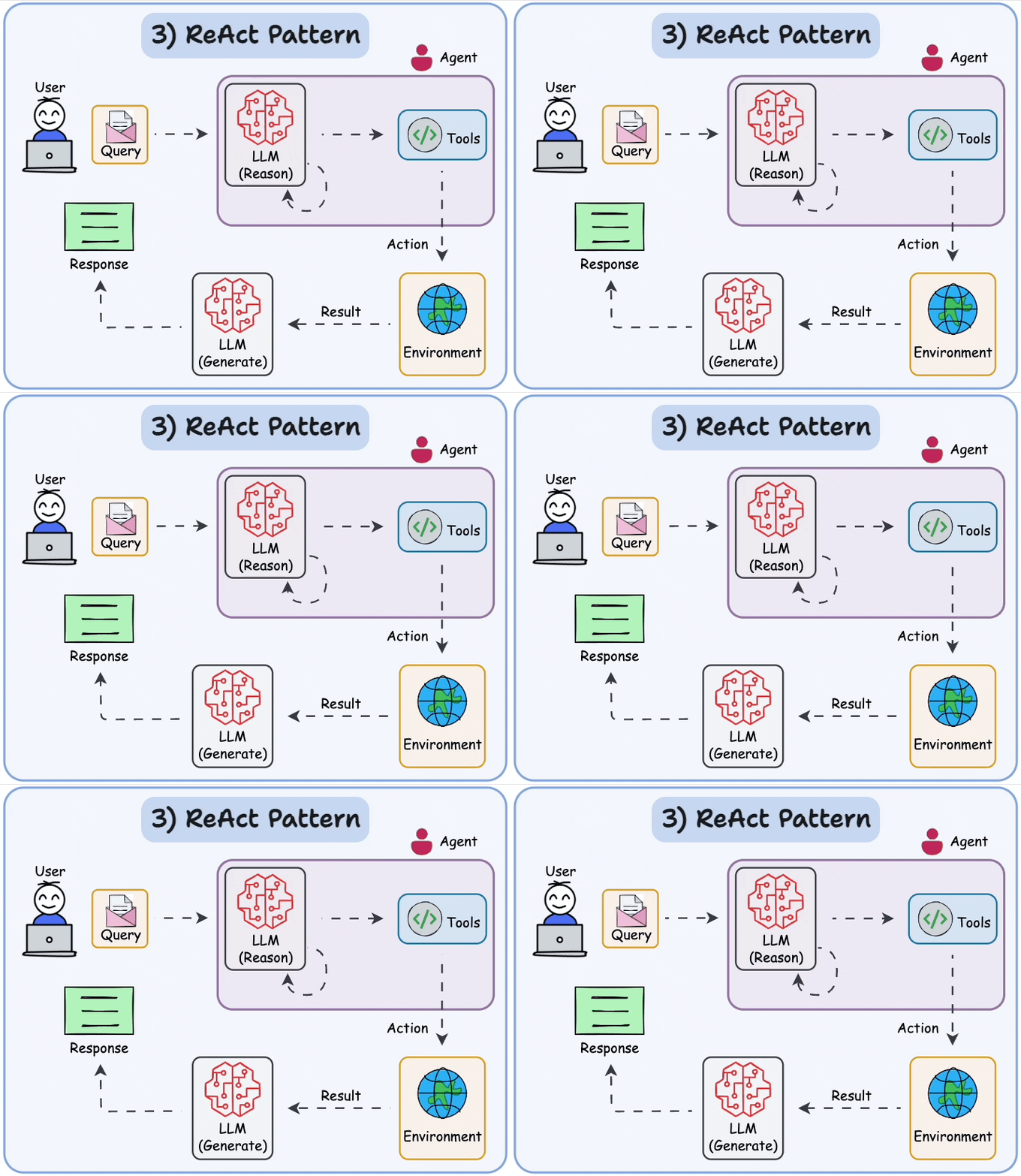
Chain-of-Thought reasons from training data. ReAct reasons from live data. The difference is the gap between “I think this is true” and “I verified this is true.”
ReAct structures prompts around a loop: Thought → Action → Observation. The model decides what it needs to know, calls a tool to find out, observes the result, then decides what to do next. This is not prompting theory — this is how production AI agents work in 2026.
You are a research assistant with access to:
- search(query): Search the web
- read_url(url): Read webpage contents
- calculate(expr): Evaluate math expressions

Task: Find the current market cap of the top 3 AI companies and calculate the total.

Use this format for each step:
Thought: [What I need to do next and why]
Action: [tool_name(arguments)]
Observation: [Result from the tool]

... (repeat until complete)

Final Answer: [Summary with calculations]

Begin:
2026 ReAct Patterns That Work
| Pattern | Use Case | Why It Works |
|---|---|---|
| Multi-agent orchestration | Complex research, code review | One ReAct agent delegates to specialized sub-agents (researcher, critic, synthesizer) |
| Tool-augmented reasoning | Data analysis, financial modeling | Give the model calculator, code executor, and search — let it choose which to use |
| Observation-driven branching | Debugging, troubleshooting | Different observations trigger different reasoning paths automatically |
| Error recovery loops | Production automation | When an action fails, the model reasons about alternatives instead of crashing |
| Memory persistence | Long-running tasks | Observations persist across turns, building cumulative knowledge |
Here is the trade-off nobody talks about: ReAct is slower. Each tool call is a round-trip. A 5-step ReAct workflow might take 8-15 seconds where a single-shot prompt takes 2. For user-facing chat, that is death. For background processing, research, or any task where accuracy matters more than latency, it is non-negotiable.
Our agent architecture playbook has a full ReAct implementation with error handling, rate limiting, and cost optimization for production deployments.
Multi-Turn Memory Prompting
ChatGPT has memory. Claude has memory. Custom GPTs have memory. But most people use it like a notepad — storing facts, not training the model's behavior.
Multi-turn memory prompting is the practice of deliberately shaping the model's long-term context across sessions. Not “remember my name.” More like “remember that I prefer concise Markdown summaries with bullet points, and that I work in compliance, and that I run a weekly threat intel roundup.”
Context window is short-term, measured in tokens, expires per session. Memory is long-term, measured in facts/preferences, persists across sessions. In 2026, the gap between engineers who understand this distinction and those who do not is the gap between usable AI systems and expensive toys.
The Memory Training Sequence
| Turn | Input | Purpose |
|---|---|---|
| 1 | “I work at a cybersecurity firm. I focus on compliance and run a weekly threat intelligence roundup.” | Establish long-term professional context |
| 2 | “Summarize this week's top threats in a format I can paste into Slack.” | Build on prior knowledge — model understands tone and purpose |
| 3 | “Also, remember that I like the language concise but authoritative.” | Add stylistic preference layer |
| 4+ | “This week's incidents include a phishing campaign targeting CFOs and a zero-day in Citrix.” | Trigger personalized, context-aware output without re-prompting |
By week three, you no longer need to specify format, tone, or domain context. The model remembers. This is not convenience — it is a 40-60% reduction in prompt length per interaction, which directly translates to lower API costs and faster responses.
Model-specific notes for 2026:
- GPT + memory: Persistent across account. Best for custom GPTs and long-term workflows.
- Claude: Explicitly documents stored memory. You can review and edit what it remembers.
- Gemini: No persistent memory in consumer tools yet, but excels at intra-session context over very long inputs.
The Prompting Inversion Warning
There is a pattern I need to name because it is costing people money and time. I call it Prompting Inversion — the phenomenon where techniques that improved older models actively degrade newer ones.
GPT-5’s zero-shot performance already exceeds the best performance achieved with GPT-4o using the best manually crafted prompts. The game has changed. The players have not noticed.
What to Stop Doing on Modern Models
| Old Technique | Why It Hurts Now | What to Do Instead |
|---|---|---|
| Explicit “think step by step” on reasoning models | Model already thinks internally; external instruction adds noise | State the problem clearly. Let the model handle reasoning. |
| Elaborate few-shot examples (5+ shots) | High-performance models generalize better from description than from imitation | 1-2 diverse examples max, or zero-shot with clear description |
| Constraint-heavy scaffolding (XML tags, rubrics, scoring matrices) | Forces “excessive literal interpretation,” hindering autonomous reasoning | State desired outcome. Trust the model to find the path. |
| Negative instructions (“do not use mock data”) | Pink Elephant Problem: model must process the forbidden concept to avoid it | Reframe positively: “only use real data” |
| Role prompting for factual/classification tasks | Negligible effect on classification and factual QA; wastes tokens | Reserve roles for creative, open-ended, or stylistic tasks only |
The rule of thumb for 2026: if the model is smarter than your prompt, simplify the prompt. If the model is dumber than your prompt, elaborate the prompt. Most people are still writing GPT-4 prompts for GPT-5 brains.
Proven Technique Combinations
Single techniques are fine. Combinations are where the real power lives. Here are four stacks that have survived production testing:
Stack 1: Critical Debugging (CoT + Self-Consistency + Decomposition)
Decompose the bug into infrastructure → application → data layers. Run CoT analysis on each layer. Use self-consistency (3-5 paths) to validate findings. Result: 70% reduction in time-to-resolution for production bugs in our tests.
Stack 2: API Design Review (Constitutional AI + Reflection + Adversarial)
Define API design principles (the “constitution”), generate a review, have the model self-critique, then adversarially test edge cases. Caught 5+ design issues before code was written in a recent client project.
Stack 3: Legacy Refactoring (Decomposition + Recursive Prompting + Structured Output)
Break into stages (extract functions → create interfaces → add tests → refactor). Recursively improve each stage. Output structured migration plan. Result: 10K LOC monolith refactored with zero production incidents.
Stack 4: Research Automation (ReAct + Context Engineering + Memory)
Build a rich context stack (RAG, tools, history), let a ReAct agent reason and act within it, persist observations across sessions. This is how our research automation pipeline works — and it is the only way to handle multi-day research tasks without losing context.
CoT + Structured Output + Reflection covers 80% of developer use cases. Master these three before adding complexity. When you are ready to build agents, add ReAct and Context Engineering.
Implementation Checklist
Before you deploy any of these techniques, run through this checklist. I have seen too many teams implement advanced prompting without measuring whether it actually helps.
What to Measure
- Accuracy: Did the answer solve the actual problem? Not “did it sound right” — did it work?
- Consistency: Run the same prompt 5-10 times. Variance above 15% means the technique is unstable.
- Cost: Token usage per successful outcome. A technique that doubles accuracy but triples cost is often not worth it.
- Latency: Time to first useful token. For user-facing systems, this often matters more than accuracy.
- Edge case handling: Test with malformed inputs, ambiguous queries, and adversarial examples.
Cost vs. Quality Trade-offs
| Tier | Techniques | Cost | Best For |
|---|---|---|---|
| Fast & Cheap | Single prompt, basic formatting | 1x | Simple content generation, formatting |
| Balanced | CoT + Structured Output | 1.5x | Most production tasks, API integrations |
| High Quality | CoT + Reflection + Validation | 2-3x | Code review, security audits, architecture decisions |
| Maximum | Self-Consistency (5x) + ToT + Adversarial | 5-8x | High-stakes automation, financial modeling, legal analysis |
The Hard Truth Nobody Wants to Hear
Most “prompt engineering” content in 2026 is content marketing dressed as education. Lists of 50 techniques. “Ultimate guides” that recycle the same 12 ideas. Frameworks with acronyms that sound impressive and do nothing.
The techniques in this article are not theoretical. They are published in peer-reviewed venues (ACL 2025, Scientific Reports/Nature, arXiv with Google Research authorship). They have been tested across multiple models. They have numbers attached.
But here is what matters more than any technique: the gap between “good enough” prompting and truly effective prompting is widening. As models get smarter, the people who understand when to get out of the way will outperform the people who keep adding complexity.
Everything I just said will be outdated by Q1 2027. GPT-6 will change the rules again. The only sustainable skill is knowing how to test, measure, and adapt — not memorizing techniques.
Start with one technique. Measure it. Then add complexity only when the data says you should. That is the real advanced prompting.
Sources & References
- “Adaptive Graph of Thoughts: Test-Time Adaptive Reasoning Unifying Chain, Tree, and Graph Structures” — arXiv:2502.05078, February 2025
- “Confidence Improves Self-Consistency in LLMs” — arXiv:2502.06233, ACL 2025 Findings
- “Prompt Repetition Improves Non-Reasoning LLMs” — arXiv:2512.14982, December 2025, Google Research
- “DR-CoT: dynamic recursive chain of thought with meta reasoning” — Scientific Reports / Nature, Vol. 15, 2025
- “You Don’t Need Prompt Engineering Anymore: The Prompting Inversion” — arXiv:2510.22251, October 2025
- “Chain-of-Thought Prompting Elicits Reasoning in Large Language Models” — Wei et al., Google Research
- Prompt Design and Engineering: Introduction and Advanced Methods — arXiv
- Prompt Engineering Guide 2026 — Analytics Vidhya
- Advanced Prompt Engineering: 12 Techniques — AI Prompt Library
- Prompt Engineering Best Practices 2026 — Thomas Wiegold
- The Ultimate Guide to Prompt Engineering in 2026 — Lakera