

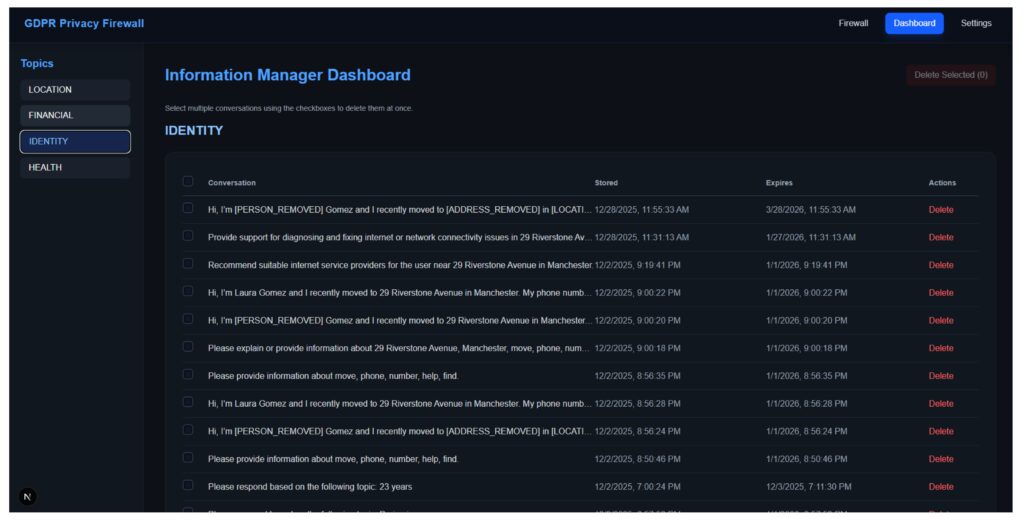
There is no secret API that hands over “what AI really thinks of you.” That framing sells, but it isn’t how any of this works, and any article that claims otherwise is inventing a product that doesn’t exist. What’s real is quieter and, once you’ve seen the data, more unsettling: a plain settings menu, sitting inside ChatGPT and Claude right now, that opens onto a file the assistant has been writing about you — mostly without being asked.
Two research teams have now gone further than “here’s how to find your settings.” They pulled real memory files from real users — 12,112 entries from 766 people in one study, 2,050 entries from 80 people in a peer-reviewed second study — and categorized exactly what’s in them. This piece walks through both datasets, shows you the actual numbers, and gives you a five-minute audit you can run today.
- The memory panel, not a secret API
- Audit one: 12,112 real ChatGPT memories
- Audit two: the peer-reviewed cross-check
- The other channel: what your writing style leaks
- A framework for sorting what’s exposed
- Audit your own file in five minutes
- What the law actually gives you
- The unpopular take
- Frequently asked questions
The memory panel, not a secret API
Start with what’s real. Since early 2024, ChatGPT has offered a memory feature that stores short, system-written notes about you and carries them into future chats. In June 2026, OpenAI shipped a rebuild of that system — reported under the name “Dreaming” — that stopped waiting for you to say “remember this” and started synthesizing a profile from your conversations automatically, in the background, on a recurring schedule1.
Claude’s version works differently. Anthropic’s own documentation describes two separate toggles under Settings → Memory: Search and reference chats, which lets Claude look up something you said in an old conversation, and Generate memory from chat history, which lets it write and store new memory notes. Anthropic states the feature runs a background synthesis that updates within 24 hours of a conversation being created, edited, or deleted, that standalone chats and Projects keep separate memory pools, and that the company designed the feature to steer away from sensitive topics as part of a phased, safety-reviewed rollout2,3.
Neither company hides this. Both let you open the panel, read the notes, edit them, or delete the whole thing. The problem the two audits below identify isn’t secrecy — it’s that almost nobody opens the panel, and almost none of what’s in it was something you consciously asked to be remembered.
ChatGPT: click your name (bottom left) → Settings → Personalization → Memory → Manage Memories.
Claude: Settings → Memory → View and manage memory.
Audit one: what’s really inside 12,112 ChatGPT memories
In June 2026, independent researcher Kiran Garimella ran the largest public audit of ChatGPT’s memory feature to date. Working from donated ChatGPT data exports, he isolated 766 users who had at least one stored memory — 12,112 entries in total — and used a language model to label each one across nine privacy dimensions: GDPR personal data, GDPR special-category data, OpenAI’s own “highly sensitive” categories, third-party information about people who never used ChatGPT themselves, psychological inferences, and more4.
The topline finding is reassuring on its face: about 65% of memories are exactly what the feature is supposed to produce — working style, ongoing projects, format preferences. But the remaining third is where the interesting numbers live.
Names showed up in 14.6% of all memories. Occupation and employer in 5.8%. City-level or more precise location in 4.2% — including 29 memories precise to postcode or street address. None of that is exotic; it’s the kind of thing you’d tell a new coworker. The issue is where it accumulates: a memory saying you’re from Berlin, another saying you’re a senior engineer at a specific company, a third naming your spouse — none alarming alone, but together roughly as identifying as two LinkedIn searches. Garimella’s re-identification analysis found that among users with three or more memories, 83% carried medium re-identification risk and 2.3% (13 people) carried high risk, with 17 users accumulating eight or more distinct demographic attributes across their memory file4.
OpenAI’s own memory policy states the feature should not intentionally retain passwords, financial account details, government ID numbers, or medical records5. The audit found 84 memories across 46 users that landed in that exact bucket anyway — including 6 containing literal login credentials (one a full database username/password pair, another an analytics API token in plaintext), 23 containing specific prescription drug names and dosages, and one recording a household’s mortgage delinquency and foreclosure timeline. These are edge cases, not the norm — but they’re proof the system doesn’t reliably filter what it says it filters.
Two more findings matter more than the “gotcha” examples. First, memory doesn’t only describe you. Third-party information — a child’s name and age, a spouse’s employer, an ex-partner’s behavior, a coworker’s opinion of you — appeared in 703 memories (5.8%) across 205 users, meaning more than one in four people with a memory file had someone else’s private details logged inside it, without that person’s knowledge or any way to request its removal4.
Second, and this is the number that reframes the whole feature: only 0.6% of memories were created because a user explicitly said “remember this.” The other 99.4% were written by the system on its own judgment of what would be useful later4. Memory isn’t a notebook you fill in. It’s a profile the assistant keeps whether you ask for one or not.
Audit two: a peer-reviewed cross-check
A single independent audit is a data point, not a consensus. So it matters that a second, separately conducted, peer-reviewed study — accepted at the ACM Web Conference 2026 by researchers including Abhisek Dash and Savvas Zannettou — ran essentially the same question on a different sample and landed on numbers that point the same direction6.
Their team, examining 2,050 memory entries from 80 real ChatGPT users, coined a phrase worth borrowing: the algorithmic self-portrait — a picture of you that the AI paints from what you’ve disclosed, not one you sat for.
The 96% figure matches Garimella’s 99.4% almost exactly using an entirely different sample and coding method — that’s the kind of independent replication that turns an interesting blog post into something you can actually plan around. The more novel number is the 52%: over half of all memories contained a psychological inference — not a fact you stated, but a trait, tendency, or emotional pattern the model concluded about you from the way you talk. And a reassuring counterweight sits right next to it: 84% of memories were judged to be accurately grounded in what actually happened in the conversation, meaning the system isn’t hallucinating a version of you wholesale — it’s compressing a real one, just without asking first. The researchers’ response wasn’t just to document the problem; they built and open-sourced a companion framework, Attribution Shield, designed to flag sensitive inferences before they’re written and suggest safer ways to phrase the same question6.
The other channel: what your writing style leaks, memory off or not
Here’s the part most “how to protect yourself” guides skip entirely, and it matters because turning memory off does not touch it. Separately from anything a memory system stores, researchers at ETH Zurich asked a narrower question in 2026: if you strip away every memory feature and just hand a model your raw chat transcript, how much can it infer about your personality from how you write?
They collected real ChatGPT logs from 668 participants — 62,090 individual chats — and fine-tuned a language model to predict Big Five personality traits (openness, conscientiousness, extraversion, agreeableness, neuroticism) purely from conversation style. The model beat random-chance guessing across multiple traits, and for extraversion specifically, accuracy improved by 44% relative to baseline when the conversations involved relationships or personal reflection7. A related 2026 study found the same pattern holds for political alignment: language models can infer a person’s political leanings from ordinary online discussion, using word choices that aren’t explicitly political at all8.
Put the two audits and this study side by side and a fuller picture forms. Memory is the part of AI profiling you can see and delete. Style-based inference is the part you can’t turn off, because it isn’t stored anywhere — it’s recomputed fresh, in the model’s working context, from whatever you just typed, every single time.
A framework for sorting what’s actually exposed
Reading both audits back to back, the mistake is treating “AI knows things about me” as one problem. It’s four, and they call for different responses. Here’s how I sort it — a way to categorize what’s genuinely being exposed, not a measured statistic, so treat it as a mental model rather than a metric:
Layer 1 is a solved problem: read it, fix it, delete what’s wrong. Layer 2 is mostly benign but worth a skim twice a year. Layers 3 and 4 are where the actual policy conversation needs to happen, because no current settings menu — ChatGPT’s or Claude’s — gives you a one-click way to say “stop drawing psychological conclusions about me” or “don’t remember what I say about other people.” You can only delete the output after the fact.
Audit your own file in five minutes
- 01 Open the panel.
ChatGPT: Settings → Personalization → Memory → Manage Memories. Claude: Settings → Memory → View and manage memory. Read every line — most people never have.
- 02 Sort what you find into the four layers above.
Stated facts and preferences are usually fine to leave. Flag anything psychological (“user seems anxious about…”) or anything naming someone who isn’t you.
- 03 Delete the third-party entries first.
These are the ones nobody else can request removed on their own behalf. If a memory names a family member, coworker, or ex, that’s the highest-value deletion you can make.
- 04 Check for the “highly sensitive” bucket.
Search your own memory list for anything resembling a password, API key, medication name, or account number. If you find one — and the audit above says roughly 1 in 170 users will — delete it immediately and rotate any credential involved.
- 05 Decide on a policy, not a one-time cleanup.
A quarterly five-minute review catches drift better than turning memory off entirely — see the unpopular take below for why the on/off framing misses the point.
What the law actually gives you
This isn’t a lawless space, even if enforcement is still catching up to the product cycle. Under the GDPR, a memory entry that names you, your city, or your employer is personal data, and personal data comes with rights attached: Article 15 gives you the right to request a copy of what’s held about you, and Article 17 gives you the right to have it erased9. A memory system that infers your political views or health status touches GDPR’s “special category” data, which carries a higher bar for lawful processing in the first place.
The newer piece is the EU AI Act. Article 50 imposes a transparency duty on conversational AI systems, and as of August 2, 2026, it became mandatory: a deployer must disclose that a user is talking to an AI “at the latest at the time of the first interaction,” with real penalties attached for the broader Act — up to €35 million or 7% of global annual revenue for the most serious violations10,11. That obligation is about disclosure, not memory specifically, but it’s part of the same regulatory current: lawmakers are starting to treat what conversational AI silently collects as a first-class privacy question, not a footnote.
ChatGPT vs. Claude memory, side by side
| Dimension | ChatGPT | Claude |
|---|---|---|
| Trigger | Automatic background synthesis (“Dreaming”), plus explicit requests1 | Automatic background synthesis (updates within 24 hrs) plus explicit requests2 |
| Scope | Cross-conversation, account-wide | Account-wide for standalone chats; each Project keeps a separate, isolated memory2 |
| Stated sensitive-topic policy | Should avoid passwords, financial data, medical records, government IDs5 | Designed to avoid sensitive conversations and topics as part of a phased safety rollout3 |
| Independent third-party audit | Yes — two, cross-referenced in this piece4,6 | None publicly available as of this writing — a real gap, not a clean bill of health |
| User controls | View, edit, delete individual memories; toggle off; temporary chats exempt | View, edit, delete; pause (keeps existing memory, stops new writes) or reset (wipes it)2 |
The unpopular take
I’ll admit the mistake this whole piece is built on. I turned ChatGPT’s memory off within a week of launch in 2024, congratulated myself for dodging the issue, and didn’t check the setting again for well over a year. When I finally looked, in the middle of researching this piece, a later product update had quietly re-enabled a related toggle, and the file had thirty-some entries sitting in it that I’d never reviewed. Turning a feature off once is not the same as it staying off.
Which leads to the take most privacy guides won’t say out loud: flatly turning memory off is not automatically the safer choice. If you disable it, you don’t disable disclosure — you just force yourself to re-explain the same sensitive context, from scratch, in every new conversation, because the assistant has no continuity to draw on. Re-typing “I’m dealing with a divorce and need help with the paperwork” into a fresh chat every time you need help isn’t more private than having one reviewable entry that says the same thing — it’s the same disclosure repeated with no record you can audit or delete in one place. A memory file you check quarterly is more auditable than a habit you never think about. The goal isn’t zero disclosure. It’s disclosure you can see.
Frequently asked questions
Is there really a hidden API that shows what AI thinks of me?
No. That’s a framing built for clicks, not a real product. What exists is the memory panel described above, plus the model’s in-context inference from your writing style, which isn’t stored anywhere and can’t be “looked up” through any endpoint.
What’s the single biggest difference between ChatGPT and Claude memory?
Audit history. ChatGPT’s memory has now been through two independent, methodologically different audits with consistent findings. No equivalent public audit of Claude’s memory contents exists yet, so its stated design goal of avoiding sensitive topics is unverified by outside researchers as of this writing.
Can I stop the AI from inferring things about me, not just storing them?
Not fully. You can turn off memory storage, which stops the written record. You cannot stop a model from drawing in-context inferences about your tone, mood, or likely traits during a live conversation — that’s closer to how language models process text than a switchable feature.
If I delete a chat, does that delete the memory it created?
Not necessarily. Audits found memories that outlived the conversation that produced them — the user could no longer find the original chat, but the summary the system wrote from it was still sitting in memory. Deleting a memory and deleting a conversation are two separate actions; do both if you want a clean sweep.
Does GDPR actually cover what an AI infers about me, or just what I typed?
It covers both. GDPR’s definition of personal data includes information that “relates to” an identifiable person, and regulators have treated inferred profiles as covered data in other automated-decision contexts. A memory entry that draws a psychological conclusion about you is very plausibly personal data under that standard, even though you never typed the conclusion yourself.
Can I request a full copy of everything an AI company has inferred about me?
Under GDPR Article 15, EU residents (and residents of jurisdictions with similar laws) can submit a subject access request. In practice, most people never need to escalate that far — the memory panel already shows you the same synthesized notes a formal request would surface, just without the legal paperwork.
Is any of this being used for advertising yet?
Not that’s been publicly confirmed by either company as of this writing. Researchers studying the data have flagged it as a plausible future direction, given that a memory file already contains exactly the kind of durable, intent-rich signal an advertising profile would want — but that’s an informed concern about where the incentives point, not a documented product today.
Should families or shared accounts worry about this more?
Yes. Memory doesn’t distinguish between people sharing a login, and it doesn’t distinguish between the user and the people the user talks about. If you’re on a shared account, or you discuss other people’s situations in detail, review Layer 4 of the framework above specifically — that’s where the audits found the least accountability.
What changed with the EU AI Act in August 2026?
Article 50’s transparency requirement became mandatory on August 2, 2026: conversational AI systems must disclose that users are interacting with AI, at the latest by the first interaction, unless that’s already obvious from context. It doesn’t regulate memory content directly, but it’s the clearest sign yet that regulators are treating conversational AI disclosure as an enforceable baseline rather than a best practice.
What’s the one thing worth doing after reading this?
Open the memory panel today, read it once fully, and delete anything naming someone other than you. That single step addresses the category both audits found least accounted for and takes under two minutes.
Sources & methodology
- AI Policy Desk, “ChatGPT Memory Upgrade (Dreaming V3): What to Govern, Disable, and Disclose,” June 2026 — aipolicydesk.com
- Anthropic Help Center, “Use Claude’s chat search and memory to build on previous context” — support.claude.com
- Anthropic, “Bringing memory to Claude” — anthropic.com/news/memory
- Kiran Garimella, “What does ChatGPT remember about you?” June 19, 2026 — kirangarimella.substack.com
- OpenAI Help Center, Memory FAQ — help.openai.com
- Dash, Das, Kirsten, Wu, Karnam, Gummadi, Holz, Zafar & Zannettou, “The Algorithmic Self-Portrait: Deconstructing Memory in ChatGPT,” ACM Web Conference 2026 — arxiv.org/abs/2602.01450
- Cögendez, Zufferey et al., “Can LLMs Infer Conversational Agent Users’ Personality Traits from Chat History?” arXiv, May 2026, reported by TechXplore — techxplore.com
- “LLMs Can Infer Political Alignment from Online Conversations,” arXiv — arxiv.org/pdf/2603.11253
- EDPB, “Guidelines 01/2022 on data subject rights — Right of access,” European Data Protection Board — edpb.europa.eu
- Knobot, “GDPR + AI Chatbots: A Plain-English Compliance Checklist,” on EU AI Act Article 50 — knobot.org
- Crescendo, “AI and GDPR in 2026” — crescendo.ai