

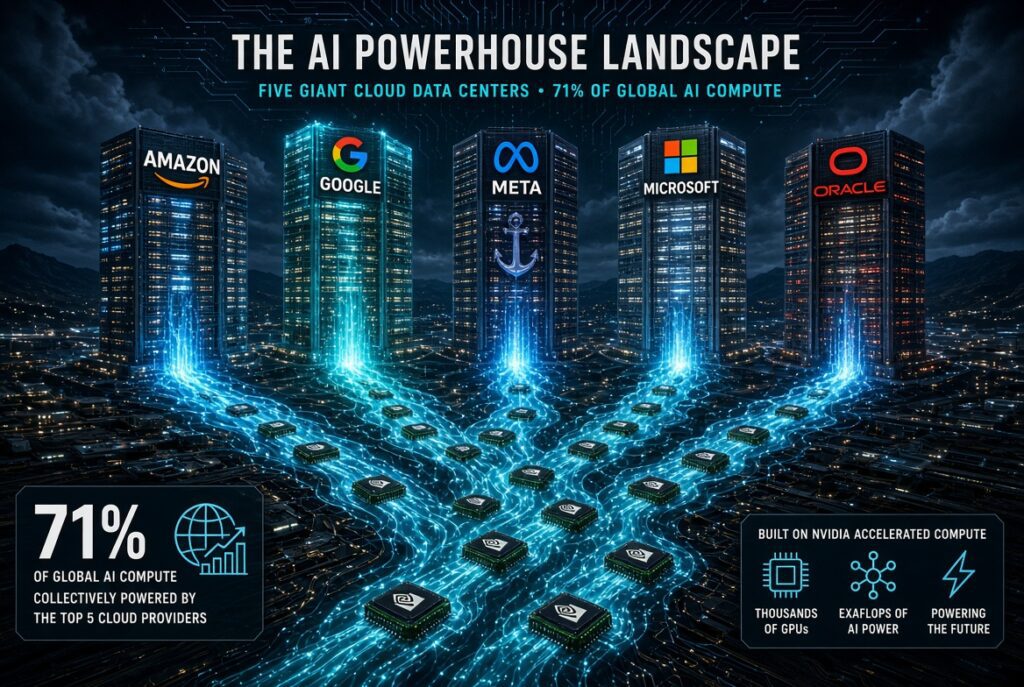
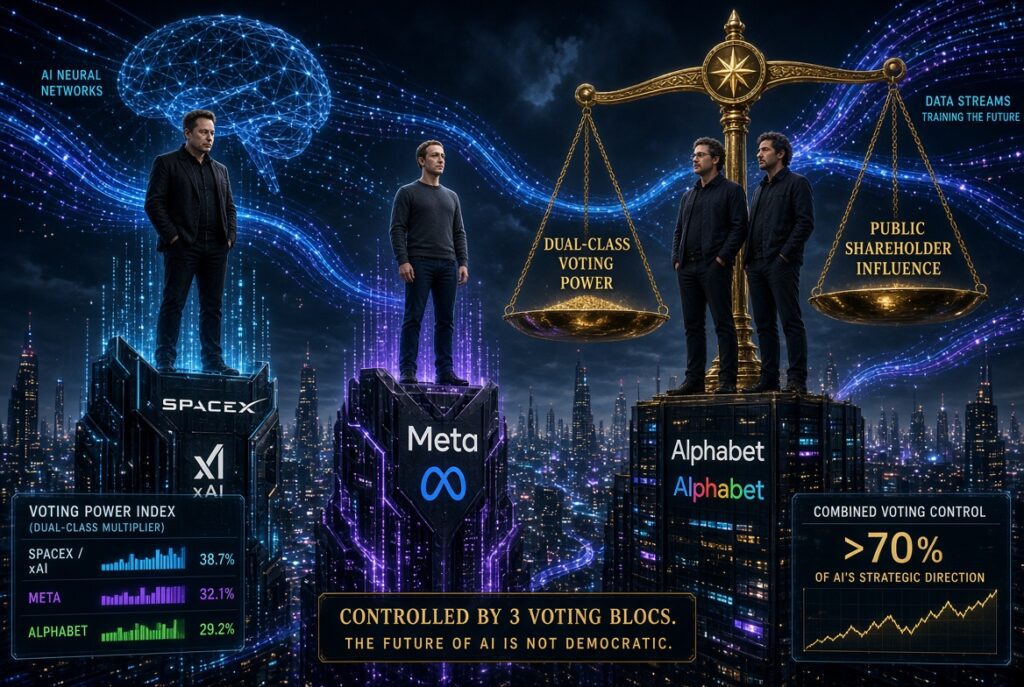
AI is controlled less by “twelve billionaires” than by three voting blocs (Musk at SpaceX/xAI, Zuckerberg at Meta, Page and Brin at Alphabet) sitting on top of five cloud companies that own about 71% of the world’s AI compute. The two best-known independent labs, OpenAI and Anthropic, are governed through a nonprofit foundation and a trust, and both rent most of their compute from those same clouds.
TL;DR
- The “12 people” figure is a headline device. No dataset I reviewed defines such a group, and the count changes depending on whether you measure wealth, votes, or hardware.
- Net worth is the weakest evidence of control. It is marked to market daily, and Sam Altman, the most visible AI executive, holds no equity in OpenAI.
- Votes give a smaller and firmer number: three blocs, four people, with legal control over a frontier-model developer that no ordinary shareholder can remove.
- Hardware concentration is more severe than wealth concentration. Five companies own an estimated 71% of AI compute, and one chip vendor supplies over 60% of it.
The number twelve doesn’t survive contact with the filings
The premise deserves a stress test before it gets a defense. “A dozen billionaires steer machine intelligence” is a clean story, and it mixes together three separate kinds of power that rarely sit in the same hands.
Wealth is what a person’s stock is worth today. Control rights are the legal power to decide who runs a company and what it does: votes, board appointments, charter provisions. Chokepoints are physical or contractual positions that other firms cannot route around, such as owning the chips, the data centers, or the power contracts.
The overlap between those three is small. Some people are extremely rich and hold no control over a frontier lab. Some labs are controlled by bodies with no owners at all. Some of the strongest chokepoints belong to companies whose founders have no unilateral vote. The rest of this piece sorts the players by each kind of power, then shows where the sorting changes the conclusion.
Wealth: the weakest evidence in the story
Net worth rankings make good headlines and bad evidence of control. They are stock prices multiplied by share counts, recalculated after every trading day.
Bloomberg’s index recorded Elon Musk as its first trillionaire on June 12, 2026, the day SpaceX listed, at $1.11 trillion. The same summary of the index shows his net worth at $876 billion on July 13, 2026. That is a drop of roughly $234 billion in about a month, with no change in what he could vote or direct. (Both figures come from one secondary summary of Bloomberg’s index, so treat the exact values as indicative.) Wikipedia
The reverse case is more telling. OpenAI’s own structure page states that the OpenAI Foundation, a nonprofit, continues to control OpenAI Group PBC, the for-profit operating company. The 2025 recapitalization included no equity award for Altman, and he has said he has no ownership position. Someone can be the public face of the most famous AI company and appear in every “AI power” list while owning none of it. OpenAIRevenue Memo
Wealth still matters as a source of influence, since it buys lobbying, acquisitions, and staying power. As a measure of who decides what a model may do, it is a poor proxy. Anything that follows in this article is tagged as votes, hardware, or contracts instead.
Votes: where the number really is three
Ownership and control diverge most sharply in dual-class share structures. In these, a founder class carries ten votes per share and the public class carries one, or none.
Alphabet is the cleanest example, and the company’s own prospectus supplement gives the numbers. As of April 6, 2026, Larry Page and Sergey Brin held about 89.4% of Class B stock, representing roughly 52.7% of Alphabet’s voting power. A shareholder proposal in the 2026 proxy adds that the pair hold a majority of votes while owning less than 11% of the outstanding stock. That proposal is an advocacy document, so read the 11% as a proponent’s count rather than an audited figure. The same text says outside shareholders backed an earlier one-share-one-vote request at 98% in 2025, and it still did not pass, because the founders’ votes decide the outcome. secsec
Meta follows the same pattern. Its 2026 proxy shows Zuckerberg holding 60.8% of voting power on an economic interest of about 13.5%. An investor coalition’s filing puts it at approximately 61% of votes on roughly 14% of the economic interest. The two sources agree closely. SocialBuIccr
SpaceX is the newest and the hardest to pin down, because the sources disagree. It acquired xAI in February 2026, and its S-1 prospectus put Musk at roughly 42% of equity and about 79% of votes. Post-listing summaries give higher figures: more than 80% of voting power, held through Class B shares of which he controls 93.6%, and a range of 82–85% in a reference summary of the IPO. I would not pick one. The safe reading is “roughly four-fifths,” and the source of the spread is probably the difference between the pre-IPO filing and post-offering share counts. TNW | BusinessSpaceX
Here is what those numbers imply when you divide voting power by economic ownership. This is my calculation from the figures above, not a published metric:
| Company | Who holds control | Voting power | Economic stake | Control-to-ownership ratio |
|---|---|---|---|---|
| Meta | Zuckerberg | 60.8% | ~13.5% | ≈ 4.5× |
| Alphabet | Page and Brin (jointly) | 52.7% | < 11% (proponent’s count) | ≥ ≈ 4.8× |
| SpaceX (incl. xAI) | Musk | ~79% (S-1) to 80%+ | ~42% | ≈ 1.9–2.0× |
Notice how Musk’s ratio is the lowest of the three, and his absolute grip is the tightest. Because he owns so much of the equity to begin with, he needs less leverage to hold four-fifths of the vote. The S-1 also states that Musk can be removed as CEO or director only by a vote of Class B holders, which he himself controls. That claim comes from a secondary summary of the filing, so check the S-1 directly before you quote it. Tech Market Briefs
This is the piece of the puzzle the “twelve billionaires” framing gets closest to right. Four people, in three blocs, hold legal control over a frontier-model developer that outside shareholders cannot override. I did not verify voting structures at Amazon, Oracle, or Nvidia in this pass, so I have not counted them. If one of them turns out to carry founder-controlled super-voting stock, the count changes. It would be a legitimate correction to the headline, and I’d want to know.
Notably, none of the three blocs is a coordinated club. Musk sued to stop OpenAI’s restructuring, and Meta, Google, and xAI compete for the same researchers and chips. The structural point is about accountability, not collusion: three separate people-or-pairs, each answerable mainly to themselves.
Compute: the concentration billionaire lists miss
The most consequential concentration is physical, and it is larger than the ownership numbers suggest.
Epoch AI, an independent research group, tracks who owns AI chips by combining chip sales data, company disclosures, and analyst reports. Its estimate: Amazon, Google, Meta, Microsoft, and Oracle together held about 71% of the world’s cumulative AI compute as of Q4 2025, up from 63% in Q1 2024. Google alone holds roughly a quarter, equal to about 5 million Nvidia H100 GPUs, driven mainly by its custom TPU chips. Epoch AIEpoch AI
At the chip layer, Epoch estimates Nvidia’s chips account for over 60% of total compute, with Google and Amazon making up much of the remainder. Epoch AI
Two of Epoch’s caveats deserve attention. These are estimates inferred from revenue and disclosures, not audited inventories, and “cumulative compute” counts chips bought, not chips currently running at full utilization. Even so, the direction is clear, and the trend is easy to project as arithmetic: 63% to 71% over seven quarters is about 1.1 percentage points per quarter. At that pace the five would cross 80% in roughly eight more quarters, around late 2027. That is an extrapolation to illustrate the slope, not a forecast, and a slowdown in capital spending would flatten it.
The money behind the trend
The spending is what keeps concentration rising. Estimates for 2026 capital expenditure by the four largest cloud companies range from about $650 billion to about $770 billion, depending on the source and on whether you use fiscal or calendar years. One widely cited Goldman-based tally puts the four at roughly $725 billion, up 77% from about $410 billion in 2025. The spread is real and comes mostly from Microsoft’s fiscal-year reporting. Using the $725 billion figure, that works out to about $2 billion per day. Yahoo Finance
Spending in the first half of 2026 reached $301 billion across the four, against updated annual guidance of about $732.5 billion. That is roughly 41% of the year’s guidance in six months, which implies the back half is expected to be heavier. I/O Fund
This cuts against a simple “they’re winning” reading. A UBS projection cited by Yahoo Finance suggests Amazon, Alphabet, and Microsoft will spend about 102% of their cloud revenue on capex in 2026. That is a bet financed by other profits and balance-sheet capacity, and it leaves the biggest builders exposed if demand disappoints. Concentration and fragility are arriving together. Yahoo Finance
Frontier labs own less than you’d think
A counterintuitive finding from Epoch’s lab-level analysis cuts against the “AI labs run the world’s compute” picture. OpenAI used an estimated 10–15% of the world’s operational AI compute at the end of 2025, and even adding Anthropic, xAI, and the AI labs inside Google and Meta, the total is probably under half. A large share of compute serves cloud customers and internal products such as recommendation systems, not frontier model training. Epoch AI
OpenAI and Anthropic do not own most of the compute they use; it comes from cloud companies, primarily Microsoft, Oracle, and CoreWeave for OpenAI, and Amazon and Google for Anthropic. That is the crux of the structural argument. Epoch AI
The dependency chain
The diagram below shows the stack as a chain of dependencies. Read it top to bottom: each layer needs what the layer beneath it provides.
Figure: arrows point to what each layer depends on to operate. Percentages are Epoch AI estimates and filing-based voting figures; see sources in the text.
The chain matters because it changes where a failure would bite. Consider the mechanism: a lab’s ability to train or serve a model is capped by the compute it can obtain, which is set by contracts with a cloud owner, which is set by that owner’s chip orders, which are set by one vendor’s output. A disruption anywhere down the chain (a supply constraint, a contract dispute, a power shortage, an export rule) propagates upward to labs that have no alternative supplier on short notice.
That is not hypothetical friction. When OpenAI completed its 2025 restructuring, Microsoft gave up its right of first refusal to be OpenAI’s compute provider, and OpenAI committed to purchase an additional $250 billion of Azure services. The first change loosened a dependency; the second deepened one. Both happened in the same announcement. CNBC
Control without owners: OpenAI and Anthropic
The two labs most people picture when they hear “AI company” fit neither the billionaire nor the dual-class template, and they deserve separate treatment.
OpenAI. At the October 2025 recapitalization, the Foundation held 26% of the for-profit, Microsoft about 27%, and current and former employees and investors the remaining 47%. Despite holding less than Microsoft, the Foundation appoints and removes the entire PBC board. A $122 billion round in 2026 at an $852 billion valuation followed, and OpenAI has not published a fully updated cap table, so the 26/27/47 split is the last official disclosure rather than a current figure. The practical question is how independent the Foundation is from management. As of April 2026, all but one of the Foundation’s board members also sat on the PBC board. Overlapping boards make the nonprofit’s oversight easier to exercise and harder to distinguish from the company’s own judgment. OpenAI’s PBC Conversion: What Every Employee Should Know About Governance and Equity +2
Anthropic. A disclosure first: Anthropic makes Claude, the AI that helped research this article. I’ve applied the same evidence standard here as to everyone else, but a reader should weigh the conflict.
Anthropic says its Long-Term Benefit Trust is an independent body whose members hold no financial stake in the company. The Trust holds a special Class T stock that lets it elect and remove board members on a phased schedule. With the April 14, 2026 appointment of Vas Narasimhan, Trust-appointed directors now hold a majority of the board. That makes it one of the few cases where a governance mechanism written for AI risk has crossed the threshold its founders set. Anthropic’s Long-Term Benefit Trust appoints Vas Narasimhan to Board of Directors \ Anthropic +2
Two limits apply. First, the mechanism is untested in the situation it was designed for: a hard conflict between commercial pressure and safety judgment, where the Trust would have to overrule a board or management. No public case shows that yet. Second, the Trust elects a majority of the board, but the board still includes the founders and investor representatives, and the company is a large compute customer of Amazon and Google, both of which are investors.
Neither lab shows that trusts or foundations beat founder control. They show that a different design is possible and that its outcomes are unproven.
What the concentration does and doesn’t mean
Here is my position, and I’ll state it plainly: the risk is real, but it is structural rather than conspiratorial.
The strongest evidence points to three facts. Four people hold legal control over major AI developers that no outside shareholder can unseat. Five companies own most of the world’s AI compute. One chip vendor supplies most of the silicon. None of these depends on anyone’s intentions. They follow from share classes, purchase contracts, and manufacturing capacity.
The weaker evidence is the picture of a coordinated elite. I found nothing suggesting the blocs act together, and the public record shows them competing and litigating against one another.
The best counterargument. Concentration in the ownership of infrastructure is not the same as concentration in who can build a frontier model, and Epoch’s own numbers point that way: total global AI compute is around 20 million H100-equivalents, and the top labs use well under half of it. The rest serves cloud customers and internal products. Rented compute also means labs can, in principle, switch suppliers, and Anthropic’s use of Amazon’s Trainium chips alongside Google TPUs shows some of that flexibility exists. The counterargument is strongest for the compute layer and weakest for the voting layer, where nobody outside the founder class has a lever. Epoch AI
Can anyone check these blocs?
Three major questions follow from the evidence. Here are the strongest answers it allows.
Can shareholders constrain the founder-controlled blocs? Not through voting. The 98% outside-shareholder vote on Alphabet’s one-share-one-vote request, reported by the proponent, is the clearest proof: near-unanimous outside support has no effect when the founder class votes the other way. Investors’ remaining tools are selling stock and litigation.
Can regulation constrain them? Partly, and unevenly. As of September 2026, sources agree that no federal AI statute has passed, and the executive-branch push to override state AI laws has not become law. California’s SB 53 frontier transparency law has applied since January 1, 2026. In the EU, obligations for general-purpose model providers have applied since August 2025. Those rules impose disclosure and safety duties, which is meaningful, but they do not change who holds control. Legal duties bind a company; they do not change who elects its board. Regulatory sources on this topic conflict on details, and I relied only on points that several sources repeated. Questa AIInside Deep Tech
Will concentration keep rising? The compute data says yes for now, on the 63%-to-71% trend. The evidence that would change my answer: two consecutive quarters of falling hyperscaler share in Epoch’s tracker, a large-scale cut to 2026–2027 capex guidance, or broad adoption of non-hyperscaler compute by frontier labs. I would revisit this within a year, sooner if capex guidance moves.
What to do with this
For different readers, the evidence points to different next steps.
- If you build on a frontier model: treat single-provider dependence as a risk you can measure. Test whether your product runs on a second model API with acceptable quality loss, and price the switching cost now. The dependency chain above means an outage or contract change upstream can reach you with little warning.
- If you invest: read the voting-power line in the prospectus, not just the ownership table. The gap between 13.5% of equity and 60.8% of votes is priced in, or it isn’t, but you should know which.
- If you write policy or advocate: the sharpest lever with the best evidence is the phase-out of multi-class stock. The Council of Institutional Investors recommends a seven-year sunset, according to the Alphabet proxy proposal. It targets control directly, where wealth taxes or lab-specific rules do not.
- If you’re simply trying to read the news accurately: when a headline says a handful of people “control” AI, ask which of the three kinds of power it means. The answer usually changes the story.
The next primary-source check worth doing is the one this article could not complete: Amazon’s, Oracle’s, and Nvidia’s voting structures, which decide whether “three blocs” stays three.