

AI Job Displacement
The Net Math Looks Fine. The Distribution Does Not.
92 million jobs are projected to be displaced by AI before 2030. Another 170 million will be created. Every headline stops there. The problem is that the jobs disappearing and the jobs appearing are not the same jobs — they don’t require the same skills, they don’t pay the same wages, and they’re not in the same cities.
by 2030 (WEF, 2025)
directly attributed to AI
cuts linked to AI in 5 years
tasks performed using Claude
Start with the number that doesn’t make the headlines. In the first six months of 2025, tech companies eliminated 77,999 jobs that were directly attributed to AI-driven restructuring. Not to interest rates. Not to post-pandemic corrections. To automation. That’s roughly 430 people losing their jobs to AI every single working day — before anyone had even agreed on what to measure.
The “AI will create more jobs than it destroys” framing is technically correct and practically useless for the worker sitting in the middle of it. Yes, the World Economic Forum’s Future of Jobs Report 2025 projects 170 million new roles by 2030 against 92 million displaced. The net looks like a gain of 78 million positions. What that arithmetic doesn’t capture is that the Ohio logistics clerk whose sorting job was automated last March doesn’t become a prompt engineer in Austin by August.
“The jobs being destroyed and the jobs being created are not the same jobs. They don’t require the same skills, they don’t pay the same wages, and they’re not in the same cities.”
The real distributional challenge, 2026This article is not about whether AI displacement is “real.” That debate ended somewhere around late 2024, when Goldman Sachs updated its research to confirm that AI had crossed professional-grade benchmarks in law, medicine, and finance. The question now is more specific: which workers, in which roles, over what timeline — and what options actually exist before the window closes.
The measurement problem nobody talks about
Most AI displacement statistics you’ve read were built on a flawed premise: they asked whether an AI could perform a task, not whether it currently was. It’s the difference between a car that can theoretically reach 180 mph and one that does it on your commute route.
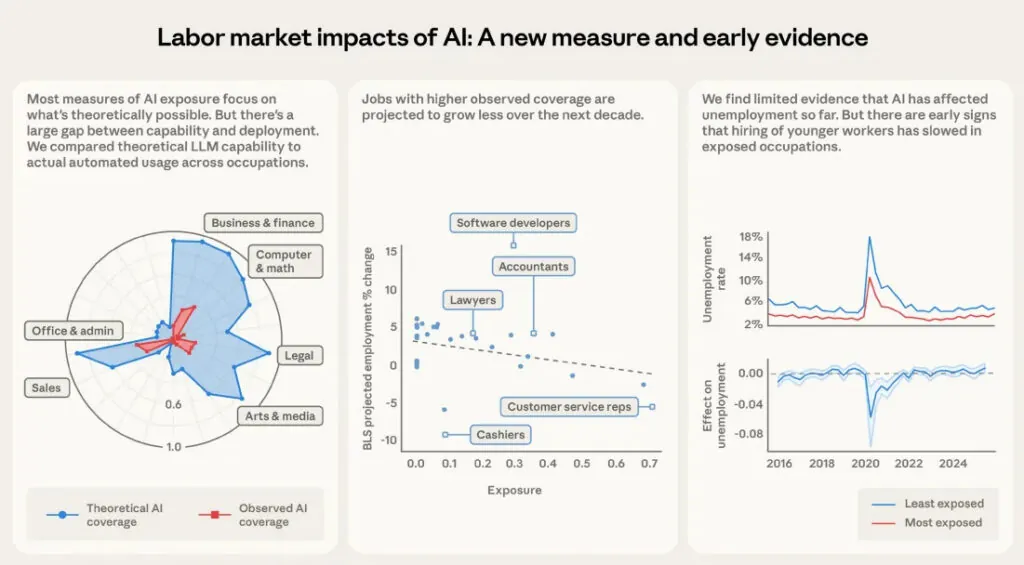
In March 2026, Anthropic published what may be the most rigorous labor market study produced on this question — not because it’s alarming, but because it’s grounded in actual usage data rather than capability theory. The researchers compared theoretical exposure rates to observed exposure rates across 800+ occupations, using anonymized Claude usage logs from millions of real professional interactions. The gap was startling: while theoretical models suggested that 94% of tasks in “Computer & Math” jobs could be automated, Claude was actually being used for roughly 33% of those tasks in practice.
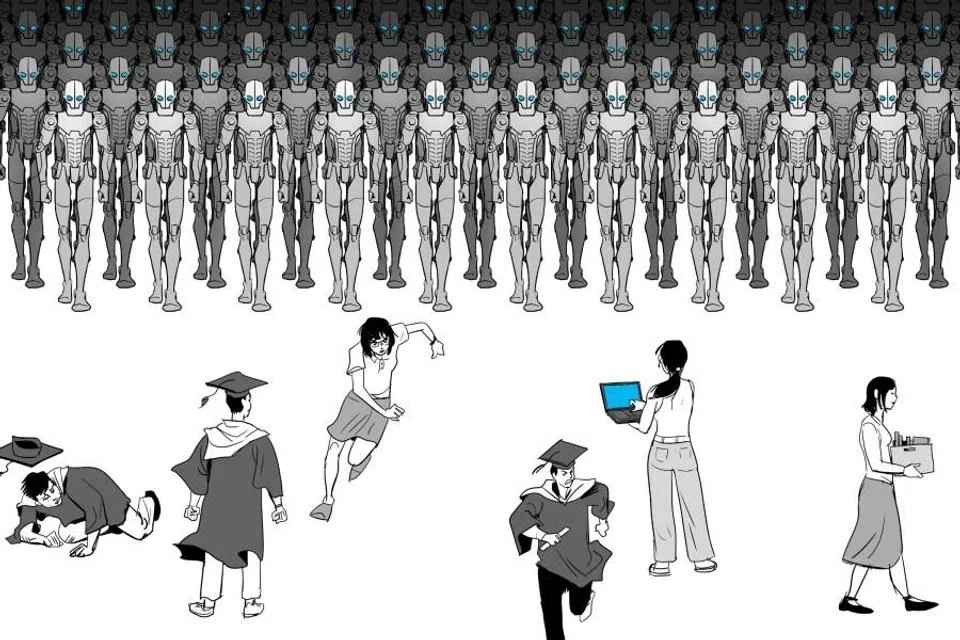
The study found no evidence yet of a systematic rise in unemployment in high-exposure occupations. What it found instead was a “hiring freeze” pattern: entry-level roles in AI-exposed fields are filling more slowly. Workers already employed are keeping their jobs. Recent graduates are entering a market with far fewer rungs on the lower ladder.
This distinction matters enormously. The displacement isn’t always showing up as mass layoffs — it’s showing up as roles that used to exist for people entering the workforce simply not being posted. A junior financial analyst used to be hired to do the first-pass research that senior analysts then refined. That first-pass research is now cheaper and faster if done by a model. The senior analyst still exists. The junior position doesn’t get posted.
Stop treating exposure like inevitability
The single most damaging misconception in workforce planning right now is collapsing “AI can do this” with “this job will disappear.” These are not the same claim. A radiologist’s diagnostic workflow is theoretically 80%+ automatable. In practice, as of mid-2026, AI radiology tools are functioning as a second set of eyes — reducing error rates but not eliminating radiologist headcount in most health systems. The exposure is real. The timeline to elimination is far less clear.
Compare that with data entry. Manual data entry isn’t just theoretically automatable — it’s already automated in most companies that can afford to do it. The 95% automation risk figure for data-entry roles isn’t a forecast. It’s an observation about what’s been happening since 2022, accelerating through 2025. The distinction between these two categories — roles where displacement is theoretical versus roles where it’s already underway — is exactly what most AI job risk articles fail to make.
| Role | Displacement Status | Key Driver | Risk Level |
|---|---|---|---|
| Data entry clerk | Already underway | OCR, LLM document processing | Critical |
| Bookkeeping / payroll clerk | Already underway | End-to-end accounting AI | Critical |
| Junior financial analyst | Hiring freeze phase | Automated research synthesis | High |
| Entry-level software engineer | Hiring freeze phase | AI-assisted code generation | High |
| Administrative assistant | Role compression | AI scheduling, inbox management | High |
| Technical recruiter / sourcer | Role compression | Automated screening platforms | High |
| Copywriter (templated work) | Market rate collapse | LLM content generation | High |
| Radiologist | Augmentation phase | AI diagnostics as second reader | Moderate |
| Registered nurse | Low exposure | Physical care, patient trust | Low |
| Electrician / plumber | Near-zero exposure | Physical manipulation requirement | Low |
What’s actually happening to white-collar work right now
The Anthropic CEO’s assertion — that AI could eliminate half of all entry-level white-collar jobs within five years — generated a lot of coverage when it was made. What generated less coverage was the qualifier: entry-level. Not senior positions. Not strategic roles. The part of white-collar work structured around learning the ropes by doing low-complexity tasks.
Microsoft’s AI chief went further in February 2026, declaring that all white-collar work would be automated within 18 months. This is almost certainly wrong in the absolute sense — not because AI isn’t capable, but because organizations don’t move that fast and human trust in AI outputs for high-stakes decisions remains a real constraint. That said, the direction is correct even if the timeline is aggressive. Wall Street banks are explicitly planning to remove approximately 200,000 jobs over the next three to five years, concentrated in back-office and entry-level positions.
The software development case deserves separate treatment. Many workers using AI income strategies assumed coding was the safe lane. The data has shifted on this. Anthropic’s own Economic Index found that while “Computer & Math” has high theoretical exposure, actual observed coverage is around 33%. But that 33% is concentrated in the exact tasks that define early-career software roles: writing first-pass code, debugging known error types, generating boilerplate. Boris Cherny, the creator of Claude Code, said in early 2026 that he expects the title “software engineer” itself to begin fading this year. That’s an insider prediction worth tracking carefully.
A postal clerk in Ohio is not a prompt engineer in Austin
One of the sharpest analytical observations in the displacement literature comes from a February 2026 Tufts University paper titled “When Wired Belts Become the New Rust Belts.” The researchers ranked not just occupations but geographies by AI vulnerability — and found that the risk distribution maps almost perfectly onto the prior distribution of manufacturing decline.
Communities that lost factory jobs to automation in the 2000s are facing a second wave. The difference is that this wave isn’t hitting the factory floor — it’s hitting the offices. The administrative assistant in Youngstown, Ohio, who replaced the assembly line worker in the previous generation is now facing the same structural displacement their parent did. Except the replacement job isn’t in a different building. It doesn’t exist yet, and when it does emerge it will be in a different city, require different credentials, and pay differently.
The WEF’s net positive job figures are accurate at the global aggregate level. They become misleading when applied to individual workers or communities. The gap between “net jobs gained globally” and “what happens to the specific person whose role was automated” is where the genuine human cost lives — and where policy has consistently failed to intervene in time.
The retraining myth and what actually works instead
In May 2025, Brookings published a 60-year retrospective on U.S. worker retraining programs — the MDTA, JTPA, WIA, WIOA, and Trade Adjustment Assistance. The conclusion, stated with unusual bluntness for an institutional paper: most of them didn’t work. The TAA program, specifically designed for workers displaced by trade, actually left participants worse off in the first two years after displacement compared to non-participants. Four years out, they remained underemployed and earning slightly less than peers who never enrolled.
This doesn’t mean learning new skills is pointless. It means waiting for a government program to teach you is. The Brookings analysis identifies three structural reasons no program redesign has solved: the new jobs may not materialize in the displaced worker’s region, retraining programs move at institutional speed while markets move at competitive speed, and the skills gap isn’t primarily technical — it’s a career capital gap that takes years, not months, to close.
What actually helps, based on the evidence Brookings assembled, is more uncomfortable: workers who moved proactively — before their role was eliminated, not after — fared materially better. Workers who built skills adjacent to AI (managing AI outputs, evaluating AI decisions, human-AI collaboration) while still employed fared better than those who tried to retrain from scratch after displacement. The window for proactive action is open right now, through roughly 2027–2028, before the career transition spike hits its peak.
By Sector: Where to Move, Where to Hedge
The thing AI detectors and most economists miss about this transition
Here is an observation that didn’t come from any of the reports above. It came from watching how early-career workers are actually responding to displacement pressure in real time.
The workers who are faring worst aren’t the ones in the most automated roles. They’re the ones who learned to use AI tools well enough to become dependent on them without developing the meta-skills to function without them. There’s a specific failure pattern: a 24-year-old junior analyst who uses AI to do 80% of their first-pass research gets faster. But they stop developing the judgment architecture that comes from doing that research manually. When the role gets cut, they don’t have the analytical chops that made the senior analyst valuable. They have prompting fluency and a credential — not a career.
INSEAD researchers studying this phenomenon call these “meta-skills” — analogical reasoning, metacognitive regulation, higher-order thinking — and their finding is that AI adoption, poorly managed at the individual level, actively degrades the skills that protect you from AI displacement. It’s a trap precisely because it feels like progress while it’s happening.
“The danger of relying heavily on AI tools is that our meta-skills — the ones that make us genuinely hard to replace — may quietly atrophy.”
INSEAD Knowledge, May 2026What you can actually do before the window closes
This is not a “10 ways to future-proof your career” list. That format belongs to content that exists to confirm what readers already believe. What follows is what the available evidence actually suggests — including one thing that will be unpopular, and one constraint that nobody in the mainstream coverage mentions.
If you’re currently employed in a role with moderate-to-high AI exposure, the 80% of workforce retraining projections are largely irrelevant to you right now. What matters in the 2026–2028 window is different for someone actively employed versus someone already displaced. These are genuinely different situations requiring different responses.
If you’re currently employed in an at-risk role
- 1 Move upstream in your own role before someone else does. The junior financial analyst who starts doing the senior analyst’s judgment calls — framing the question, not just answering it — creates a different value proposition than the one being automated. AI compresses execution. It doesn’t yet frame problems well. Get into the problem-framing business while you’re still employed.
- 2 Build one non-automatable skill aggressively. Not broadly — one. Physical skills (anything requiring dexterous manipulation), high-trust relationship skills (clinical care, legal representation, senior advisory), or governance and accountability roles (AI output review, bias detection, ethical deployment). Professionals with documented AI governance skills earn 28–56% more than equivalent peers without them.
- 3 Keep the manual skills sharp. This sounds counterproductive but the INSEAD research is clear: using AI for all first-pass work while retaining the ability to do it manually is the sustainable position. Delegating entirely is what creates the fragility. A doctor who can no longer read an ECG without AI assistance is not just at risk of displacement — they’re at risk of being caught dangerously wrong if the AI is wrong.
- 4 Build portable credentials now, not after the layoff. The Brookings finding that proactive movers fare better than reactive ones is striking. The specific mechanism isn’t the credential itself — it’s the 6–18 months of applied experience that comes with it. A certificate earned six months before a layoff is worth roughly three times what the same certificate is worth earned six months after.
If you’ve been displaced or are entering the workforce now
- 1 Don’t wait for a government retraining program. The Brookings data on this is unambiguous: these programs historically underperform, and the timeline mismatch between program design and market movement is structural, not fixable. Self-directed learning — specific, role-adjacent, applied — has consistently outperformed institutional programs for displaced workers. Coursera’s AI For Everyone ($49/month) and role-specific certifications are slower to start but faster to market than formal programs.
- 2 Aim for the adjacent sector, not the hot one. AI prompt engineering is already showing signs of compression at the entry level. The more durable near-term moves are: AI output reviewer/quality analyst (strong demand, low competition), healthcare administration (growing fast, AI-resistant at the patient interface), and skilled trades (consistent demand, extreme AI insulation). The toolbelt generation reframing among Gen Z — UK construction hiring of Gen Z workers rose 16.8% in the year to January 2026 — isn’t a trend to mock. It’s a rational response to data.
The constraint everyone is hoping to avoid
Here is the uncomfortable part. The skills premium for AI-fluent workers is real — 28% to 56% depending on sector. The demand for people who can govern, review, and strategically deploy AI systems is real. But there is a constraint that almost none of the career-advice content addresses: geographic and network access is not evenly distributed.
The Anthropic Economic Index found that within the U.S., a 1% increase in computer workers in a region correlates with a 0.36% increase in AI tool adoption. The high-AI-skill job premium is concentrated in the same cities where those workers already cluster. A worker in a low-AI-density region who develops AI governance skills is competing for remote positions against workers in San Francisco, New York, and Austin who have three years of applied experience and existing professional networks in those fields.
This is not a reason to give up. It is a reason to have a realistic model of which skills transfer remotely and which require geographic proximity — and to plan accordingly. AI governance and output review roles are heavily remote-compatible. Senior advisory and high-trust relationship roles are not. If geographic mobility is not an option, the most durable paths are the physically-located ones: healthcare, trades, and local government services that require on-site delivery of AI-insulated work.
The displacement sequence: what to watch for in your own industry
One thing this article will be wrong about
Every AI displacement forecast published before mid-2024 underestimated the pace of change. This article almost certainly does the same. The observed exposure numbers from Anthropic’s March 2026 research will look conservative by the time the next index drops. The 49% of jobs that had 25%+ of their tasks performed using Claude in February 2026 will be a higher number in six months.
What’s less likely to change is the distributional shape of the impact. Technology transitions have consistently followed this pattern: broad aggregate improvement in productivity, uneven distribution of the gains, concentrated losses in specific communities and career stages, and a multi-year lag before new roles emerge at scale. The workers who understood the manufacturing automation of the 2000s early enough to retrain proactively are disproportionately employed today. The workers who waited for the factory to reopen are not.
This time the factory is a cubicle. And it’s 2026. The window is open. Whether it stays open for another year or closes faster than anyone expects is the one honest uncertainty left.
Explore more AI income and workforce strategy analysis on AIEarnerHub →
Primary Sources & Further Reading
- Labor market impacts of AI: A new measure and early evidence Anthropic Research, March 2026 — The most methodologically rigorous measure of actual AI task displacement to date
- What 81,000 people told us about the economics of AI Anthropic Economic Index, April 2026 — Worker survey on perceived job threat and actual productivity speedup
- AI, Labor Displacement, and the Limits of Worker Retraining Brookings Institution, 2025 — Six-decade retrospective on U.S. federal retraining program efficacy
- AI & Jobs: What Workers Can Do to Protect Themselves INSEAD Knowledge, May 2026 — Research on meta-skills and AI dependency risk
- New Skills and AI Are Reshaping the Future of Work IMF, January 2026 — Policy recommendations for governments on AI-era workforce systems