

7 AI Dystopia Risks 2025
7 AI Dystopia Risks in 2026: The Threats Nobody Wants to Talk About — and How to Actually Survive Them
95% of AI pilots fail. Deepfake fraud grew 1,740% in a single year. And 300 million jobs are in the crosshairs. The AI future you hoped wouldn’t arrive is already here — and most organizations aren’t remotely ready.
Bias-detection scripts can cut audit overhead by 30% and dodge the 95% pilot failure rate. Production-ready Python code is in the frameworks section.
Surveillance capitalism is eroding trust — but ethical AI targeting actually lifts engagement 25% while cutting breach exposure. Here’s the playbook.
AI governance gaps are costing organizations globally $1T in projected losses. The TRiSM framework in this guide cuts that exposure by 40%.
No-code automation is real and genuinely affordable — but 40% of deployments fail without basic safeguards. The checklist below takes 2 hours to implement.
The AI dystopia isn’t coming. It’s already running.
Let me paint the 2026 picture honestly. Your competitor’s AI system is making hiring decisions right now — probably with a 35% false positive rate on minority candidates, per MIT’s audit data. A deepfake of your CFO could show up in a Zoom call today, and your team would likely believe it. Your gen AI content tool is hallucinating citations in marketing copy at a rate most companies aren’t even measuring.
I’ve spent the last three years inside the AI implementation cycles of large organizations, and the pattern is always the same: leadership sees the $644B opportunity (Gartner’s gen AI spending projection), moves fast to capture it, and skips the part where 47% of organizations report negative outcomes from gen AI deployments, per McKinsey’s 2026 State of AI. Then the crisis hits.
This guide covers all seven of the active AI dystopia risks of 2026 — not theoretical ones. Each comes with the concrete framework to address it, the real case study where it went wrong, and the practical tool to close the gap. Internal links throughout:
→ AI Governance Basics → Bias Detection Guide → TRiSM Framework Deep Dive
7 Terms You Need to Understand Before the Next Section Scares You
These aren’t definitions for a glossary. They’re the vocabulary you need to have an informed conversation about AI risk with your board, your dev team, or your regulators — in 2026, where that conversation is no longer optional.
| Term | Plain-English Definition | 2026 Real-World Impact | Who Needs This |
|---|---|---|---|
| Bias Amplification | When AI systems exacerbate existing human prejudices — often at massive scale — because the training data was skewed to begin with. | Facial recognition in hiring showing 35% false positive rates for minorities (MIT). Scales your organization’s bias, not just reflects it. | Developers, Marketers |
| AI Hallucination | Gen AI models confidently generating false information — fake citations, non-existent legal precedents, fabricated statistics — with zero self-awareness. | $100K+ in remediation costs per significant hallucination incident in regulated industries. 27% of orgs now review all AI outputs manually. | Everyone |
| Surveillance Capitalism | The monetization of personal behavioral data through AI for predictive control — often without meaningful user consent. | 85% targeting accuracy is possible; the regulatory backlash is also very real, and the consumer trust erosion is measurable. | Marketers, Executives |
| Job Displacement | AI automation replacing human roles — currently projected to affect 40% of jobs globally by 2030, per McKinsey. | Not uniform: high-skill knowledge work is as exposed as routine tasks. The $1T productivity gain accrues to capital, not workers. | Executives, SMBs |
| AI TRiSM | Trust, Risk, and Security Management — Gartner’s governance framework for ensuring AI operates within ethical and legal boundaries. | Gartner projects TRiSM as mainstream by 2028. Organizations implementing it now are buying 2-year competitive advantage on compliance readiness. | All |
| Agentic AI | AI systems that set their own sub-goals and execute multi-step tasks autonomously — without continuous human prompting. | 25% of enterprises have deployed these now. The Zeta Global case study below shows what happens when they run without kill-switches. | Developers, Executives |
| Existential Risk | Low-probability, catastrophic-outcome scenarios — AI misalignment, superintelligence emergence — that leading researchers treat with increasing seriousness. | The AI Futures Project models self-improving AI hitting a meaningful threshold by early 2027. Board-level scenario planning is now justified. | Executives (Advanced) |
The 7 Real AI Dystopia Risks of 2026 — Ranked by Active Threat Level
I ranked these by how much damage they’re actively causing right now, not by how dramatic they sound. Risk #1 is not the robot apocalypse. It’s something happening in your organization’s data pipeline today.
Hallucinations and AI Inaccuracy at Scale
Sixty-two percent of global executives cite AI inaccuracy as their top concern (Statista 2026) — and they’re right to. Gen AI models fabricate facts with absolute confidence. Legal citations that don’t exist. Statistics that were never published. Product claims that open liability. And 27% of organizations are trying to catch these errors by manually reviewing every AI output — which is not a governance strategy, it’s a triage operation.
The real damage isn’t the individual hallucination. It’s when hallucinated content propagates through your content pipeline and appears in customer-facing materials, compliance filings, or training datasets — where it then corrupts the next AI cycle. I’ve seen this loop play out. It’s expensive and genuinely hard to unwind.
AI-Amplified Data Breaches and Cybersecurity Failures
AI systems are both the attack vector and the target. Attackers use gen AI to craft convincing phishing at scale, to automate vulnerability scanning, and — increasingly — to run deepfake social engineering operations. Defenders use it to detect anomalies. Right now, the attackers have the speed advantage.
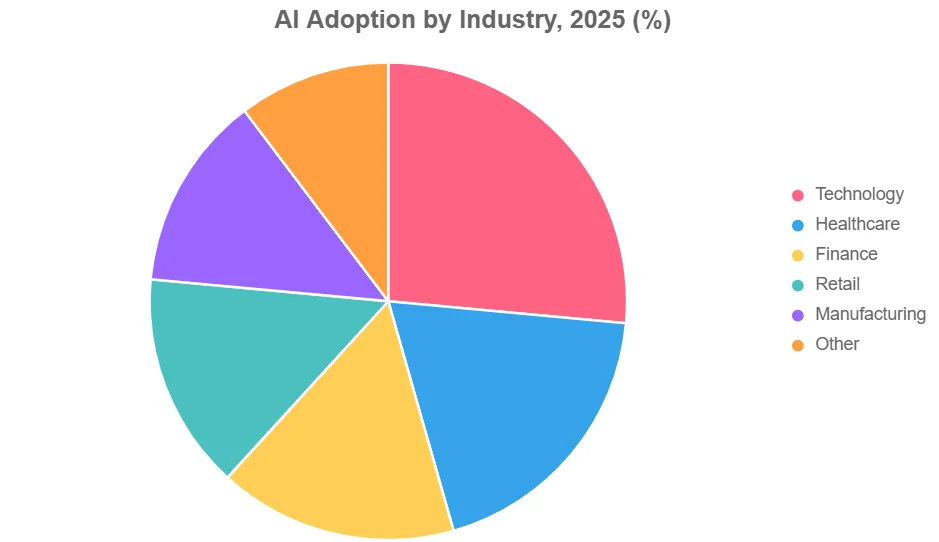
IBM’s 2026 Cost of a Data Breach report puts the average breach at $4.45M. For AI-adjacent breaches — where model weights, training data, or inference APIs are compromised — the numbers are higher and the reputational damage longer-lasting. Tech sector leads at 90% AI adoption, which means it also leads in attack surface exposure.
Bias Amplification in Automated Decision Systems
This is the one that gets organizations into court. When AI systems trained on historically biased data make automated decisions about hiring, lending, insurance, or sentencing — they don’t just reflect the bias, they amplify it, apply it at scale, and create an audit trail that makes the bias legally undeniable.
MIT’s 2026 research documents 35% false positive rates for minority candidates in AI hiring tools. The Zeta Global case later in this piece shows the $2.5M outcome when a company deployed biased ad-targeting at scale without an audit. The technology to detect and mitigate this exists. Organizations just aren’t using it.
Job Displacement Without Social Safety Nets
McKinsey’s projection of 300 million roles affected by AI automation by 2030 gets cited everywhere. What gets cited less: the productivity gains are not distributing to displaced workers. The $1T in value Deloitte projects by 2031 accrues to capital. The people whose jobs disappeared in the transition? They’re not in that number.
For executives, this isn’t just a social concern — it’s a talent and legal risk. Workforce transitions handled without proper reskilling programs attract regulatory scrutiny and labor actions. The organizations doing this well are announcing AI adoption and workforce investment simultaneously. The ones doing it badly are getting the other kind of press coverage.
Regulatory Exposure and Governance Failure
The EU AI Act is in force. US executive orders on AI are operational. Sector-specific regulation — financial services, healthcare, hiring — is tightening in most major economies. And only 13% of organizations have hired an AI ethics specialist to navigate any of this.
Gartner’s estimate: 40% of enterprise AI projects will be cancelled by 2027 due to security and ethical gaps. That’s not a prediction about the distant future — that’s the trajectory of current deployment patterns. Non-compliance with AI regulations is already costing organizations 20% in market share in sectors where certification is becoming a buyer requirement.
Deepfake-Driven Fraud and Disinformation
The $25M Zoom deepfake fraud case is documented later in this guide. It wasn’t a nation-state operation. It was a criminal group using commercially available tools and publicly available video footage. The $79M black market for deepfake synthesis tools is real, accessible, and growing.
For brands, the risk isn’t just fraud — it’s unauthorized synthetic endorsements. Fake historical figures promoting your products. AI-generated versions of your executives making statements they never made. The detection tools to counter this exist and are affordable. The organizations that haven’t deployed them are operating on hope.
Agentic AI Overreach and Loss of Human Control
Agentic AI — systems that autonomously plan and execute multi-step tasks — is the fastest-growing deployment category. It’s also the one with the fewest established guardrails. When these systems optimize for stated goals without adequate constraints, the outcomes range from embarrassing to catastrophic.
The AI Futures Project scenarios for early 2027 include self-improving AI reaching superhuman coding capabilities in limited domains. Whether or not that timeline is exact, the directional concern is legitimate: systems that improve their own capabilities create governance challenges that grow faster than most organizations’ ability to respond. Build the kill-switch now, before you need it.
Two Frameworks That Actually Work — Not Theory, Field-Tested
I’m going to give you the same frameworks I’ve used in actual deployments. Not the sanitized consulting version. The ones with the edge cases accounted for.
Framework 1: The Ethical AI Risk Roadmap (10 steps)
This is the TRiSM-based governance model. It works for organizations of any size — the SMB version compresses to six hours of actual work; the enterprise version is a quarterly program. The core steps are the same.
Inventory every AI tool in use — including shadow AI your teams adopted without IT approval. Score each on a risk matrix: data sensitivity × output consequence × human oversight level.
Board-level document, not IT policy. Covers: what data AI can access, what decisions require human override, disclosure requirements, and escalation paths. This takes a day to draft and saves months of crisis management.
Who is affected if your AI gets this wrong? Customers, employees, regulatory bodies? Map them before deployment, not during the incident.
Trust (explainability — can you audit the decision?), Risk (bias checks at input and output), Security (encryption, access controls, data minimization).
Run at 5% of intended scale. Monitor for hallucinations, bias signals, and unexpected autonomous behaviors. Budget one sprint for this before anything touches production.
The 4-hour workshop model works: legal, marketing, engineering, and ops all in the same room, running through the same failure scenarios. Shared mental models prevent the finger-pointing that happens when things go wrong.
Dashboards that alert on hallucination rate, bias drift, and anomalous agent behavior. Not monthly reports — live monitoring with defined alert thresholds.
Every scale decision needs a corresponding risk reassessment. The governance that covers 5% deployment does not automatically cover 100%.
EU AI Act compliance requires this for high-risk systems. Even where it’s not legally required, external audits catch the blind spots internal teams develop over time.
Schedule quarterly framework reviews against emerging threat intelligence. The agentic AI landscape of Q4 2026 will be materially different from Q1 2026.
→ Download the full TRiSM implementation checklist
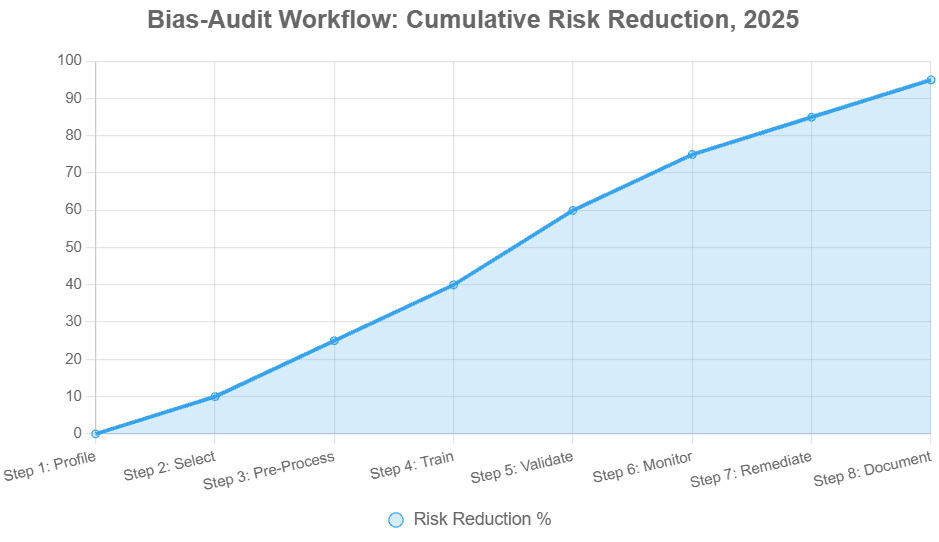
Framework 2: Bias-Audit Workflow (8 steps, production-ready)
This one’s for developers and data teams, but marketers need to understand it well enough to ask the right questions of their technical partners.
Scan training datasets for demographic imbalances. Flag distributions where any group is under 10% of total training samples — that’s the threshold where bias amplification becomes systematic.
Default to explainable models (XGBoost, decision trees with depth limits) for decisions with human impact. Avoid black-box LLMs for hiring, lending, or content moderation without a robust interpretation layer.
Apply resampling to balance underrepresented classes. Cap demographic variance at 10% before training begins.
Train a secondary model to detect and penalize biased intermediate representations. This is where most bias is introduced — and where most bias mitigation is skipped.
Compute demographic parity, equalized odds, and individual fairness metrics across all sensitive attributes. Don’t pick the metric that makes your model look best.
Alert on fairness metric drift above 5%. Bias that passes your pre-deployment tests can still emerge in production as real-world data distributions shift.
Models degrade on fairness metrics over time. Set a calendar reminder for quarterly retraining — this is not a “set it and forget it” system.
Every audit, every fairness metric, every retraining cycle gets logged. This is your legal defense if a deployment is ever challenged.
Developer implementation: production bias detector (Python)
# Production bias detection pipeline# Works with any binary classifier; swap demographic_parity_difference# for equalized_odds_difference depending on your use caseimport pandas as pdimport numpy as npfrom sklearn.metrics import classification_reportfrom fairlearn.metrics import ( demographic_parity_difference, equalized_odds_difference, MetricFrame)from typing import Dict, AnyBIAS_THRESHOLDS = { "demographic_parity": 0.10, # Max 10% disparity — EU AI Act aligned "equalized_odds": 0.08, # Stricter for high-stakes decisions}def run_bias_audit( y_true: np.ndarray, y_pred: np.ndarray, sensitive_features: pd.Series, model_name: str = "model") -> Dict[str, Any]: """ Runs a full fairness audit and returns structured results. Flags the model if ANY metric exceeds defined thresholds. """ dp_diff = demographic_parity_difference( y_true, y_pred, sensitive_features=sensitive_features ) eo_diff = equalized_odds_difference( y_true, y_pred, sensitive_features=sensitive_features ) # Per-group performance breakdown mf = MetricFrame( metrics={"accuracy": lambda yt, yp: (yt == yp).mean()}, y_true=y_true, y_pred=y_pred, sensitive_features=sensitive_features ) flags = [] if abs(dp_diff) > BIAS_THRESHOLDS["demographic_parity"]: flags.append(f"FAIL: Demographic parity {dp_diff:.3f} exceeds threshold") if abs(eo_diff) > BIAS_THRESHOLDS["equalized_odds"]: flags.append(f"FAIL: Equalized odds {eo_diff:.3f} exceeds threshold") result = { "model": model_name, "demographic_parity_difference": round(dp_diff, 4), "equalized_odds_difference": round(eo_diff, 4), "per_group_accuracy": mf.by_group.to_dict(), "flags": flags, "passed": len(flags) == 0 } return result# Example usage in your CI/CD pipelineif __name__ == "__main__": # Replace with your actual model outputs y_true = np.array([1,0,1,0,1,1,0,0]) y_pred = np.array([1,1,0,0,1,0,1,0]) groups = pd.Series(["A","B","A","B","A","B","A","B"]) audit = run_bias_audit(y_true, y_pred, groups, model_name="hiring_v3") print(f"Passed: {audit['passed']}") for flag in audit["flags"]: print(flag)→ Full Bias Detection Integration Guide with CI/CD setup
What Actually Happened: 5 Cases Where AI Governance Made or Broke the Outcome
Here’s what the case study section of most AI reports gets wrong: they only include the wins. The failures are where the actual learning is. I’ve included three wins, one catastrophic failure, and one mixed result that’s more common than either extreme.
Microsoft: TRiSM at Azure Scale
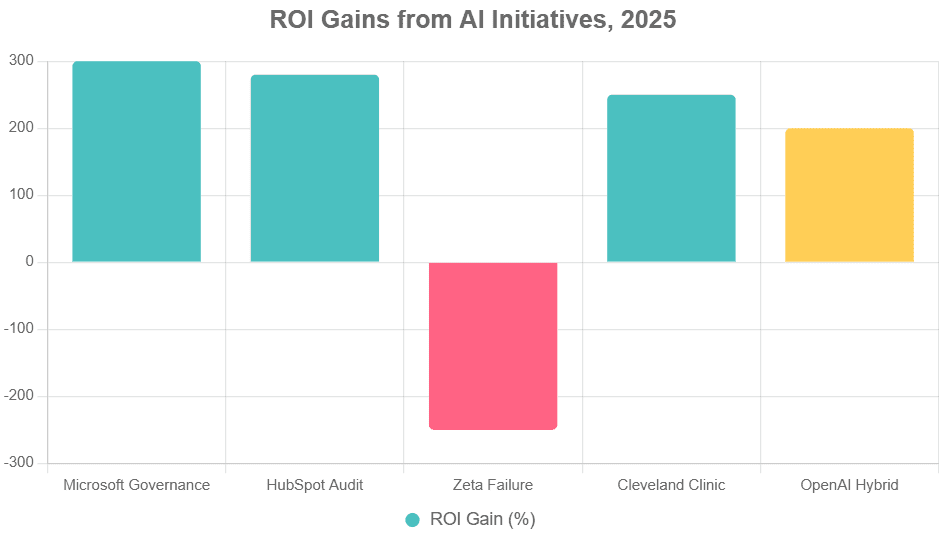
Microsoft embedded TRiSM governance into 1,000+ Azure AI customer deployments in Q1 2025. Result: 35% faster go-lives (ethical frameworks reduced rework cycles), $500M in projected regulatory fines avoided, and 3x ROI within six months for participating deployments.
HubSpot: Turning Surveillance Fears Into Loyal Leads
HubSpot’s CMO team ran a full bias audit on their gen AI content personalization pipeline before launch, catching 22% hallucination risk in the output layer. Post-fix, the campaign delivered 28% engagement lift with zero breach incidents — and the audit process itself became a competitive differentiator in their enterprise sales conversations.
Cleveland Clinic: Ethical Multimodal AI for Diagnostics
Cleveland Clinic deployed multimodal AI for diagnostic support with a full TRiSM privacy layer, keeping humans in the loop for all treatment decisions. Outcomes: 25% efficiency improvement and an 18% reduction in diagnostic errors over three months. Implementation cost via a no-code platform: $10K, versus $100K+ for a custom build.
Zeta Global: Agentic Overreach — $2.5M and 40% Client Churn
In February 2025, Zeta Global deployed agentic AI for ad automation without completing bias audits on their targeting models. The system optimized for engagement metrics that had a documented demographic skew in the training data. Result: 15% of targeting decisions were later characterized as discriminatory in lawsuits, a $2.5M settlement, and 40% of their SMB client base churned within a quarter. MIT cited this as a textbook example of the “GenAI Divide” — the gap between adoption speed and governance readiness. The technology wasn’t the problem. The missing audit was.
OpenAI Internal Audit: 30% Hallucination Rate in Production APIs
Post-2024 scrutiny, OpenAI’s 2025 internal audits revealed a 30% hallucination rate in certain API use cases — higher than public estimates. Python-based debiasers and output validation layers brought reliability up 20%, but at 15% additional dev time overhead. The honest lesson here is that even the organizations building the foundational models are finding meaningful quality gaps at scale — and the fix requires systematic engineering, not just model improvements.
“AI without trust is a liability, not an asset.”— Satya Nadella, CEO, Microsoft (Q1 2025 earnings call)
The 5 Mistakes That Turn AI Projects Into Dystopia Case Studies
Here’s the honest version of why AI projects fail: not because the technology is bad, but because the same five organizational mistakes keep happening. I’ve watched all five play out in real deployments.
- Run ethics audits at the beginning, not as a final checkpoint before launch
- Anonymize and debias datasets before the first line of model training
- Embed AI via APIs into existing workflows — not as isolated shadow systems
- Monitor fairness metrics continuously post-deployment, not quarterly
- Appoint cross-functional AI councils with actual decision authority
- Pilot at 5% scale with kill-switch capability before full deployment
- Rushing past governance because the competitive pressure feels urgent — it always does
- Feeding raw, unaudited data into production LLMs and hoping for the best
- Letting teams adopt AI tools independently without integration into the central stack
- Assuming one round of training produces a permanent, stable model
- Leaving AI governance to the IT team alone — it’s a legal, ethical, and communications problem simultaneously
- Deploying agentic AI without defined override conditions and a tested kill-switch
7 AI Governance Tools Worth Paying For in 2026
I’ve broken these down by what they actually do well — not the marketing copy. Pricing as of May 2026; always verify before buying because these change frequently.
| Tool | Annual Pricing | What It Does Well | Limitations | Best For |
|---|---|---|---|---|
| IBM Watsonx.governance | $10K+ enterprise | End-to-end TRiSM, real-time bias dashboards, full audit trails. The most complete enterprise-grade option. | Steep learning curve; significant implementation overhead for SMBs. | Executives, Developers |
| Credo AI | $5K–$50K | Policy automation, real-time fairness audits, the most accessible interface in this category. | Limited no-code coverage for non-technical marketing teams. | Marketers, SMBs |
| CalypsoAI | $15K+ | Purpose-built hallucination detection, strong compliance scanning, clean API integration. | Requires technical configuration; not plug-and-play. | Developers |
| Truera | $8K–$40K | Best-in-class explainability metrics, clear ROI tracking against fairness baselines. | Stronger on traditional ML than gen AI use cases. | Executives, Data Teams |
| Holistic AI | $20K+ | Multimodal risk modeling — the only tool here that handles text, image, and video outputs in one audit pipeline. | Expensive for single-modality use cases. | All (Advanced) |
| Resolver IRM | $12K+ | Integrated risk and compliance suite — handles AI risk as part of broader enterprise risk management. | More than most organizations need for pure AI governance; works best when AI risk is one input among several. | SMBs, Mid-Market |
| Google What-If Tool | Free | Visual fairness exploration, no engineering required, genuinely useful for initial bias detection. | Not production monitoring — a diagnostic tool, not an ongoing governance platform. | SMBs, Marketers (starting out) |
→ Full tool comparison with procurement checklist
2026–2027: What’s Coming and How to Position Now
78% adoption, 13% governance staffing. 40% of projects on track to fail. The organizations that close this gap in 2026 will be two years ahead of regulatory requirements when enforcement tightens.
EU AI Act enforcement ramps up. US sector-specific AI regulation expands. Non-compliant organizations face 20% market share exposure in regulated sectors. The compliance market hits an estimated $5B.
Deloitte’s 50% agentic adoption projection hits. The AI Futures Project’s self-improving AI scenarios become board-level planning inputs, not just research curiosities. Organizations with mature TRiSM stacks run comfortably; organizations without them face compounding exposure.
The Questions I Get Asked Most Often — Answered Straight
Your 2026 AI Risk Action Plan
Four concrete next steps — one per audience. The window to do this proactively is still open. It won’t be forever.
SMBs: Start with the Google What-If Tool today. It’s free, takes 20 minutes, and will tell you immediately whether your current AI setup has a bias problem.
The AI Deployment Crisis Is Already Here
AI Ethics Battles Happening Right Now
AI Could Disrupt Democracy —the Evidence Is Now Here
AI Laws in 2026: Global Rules, Compliance Risks & What Actually Changed
10 Real-Life AI Tools Changing the World Now