

The Scary Power of Banned AI Weapons
The Scary Power of Banned AI Weapons — And Why the World Can’t Agree on Stopping Them
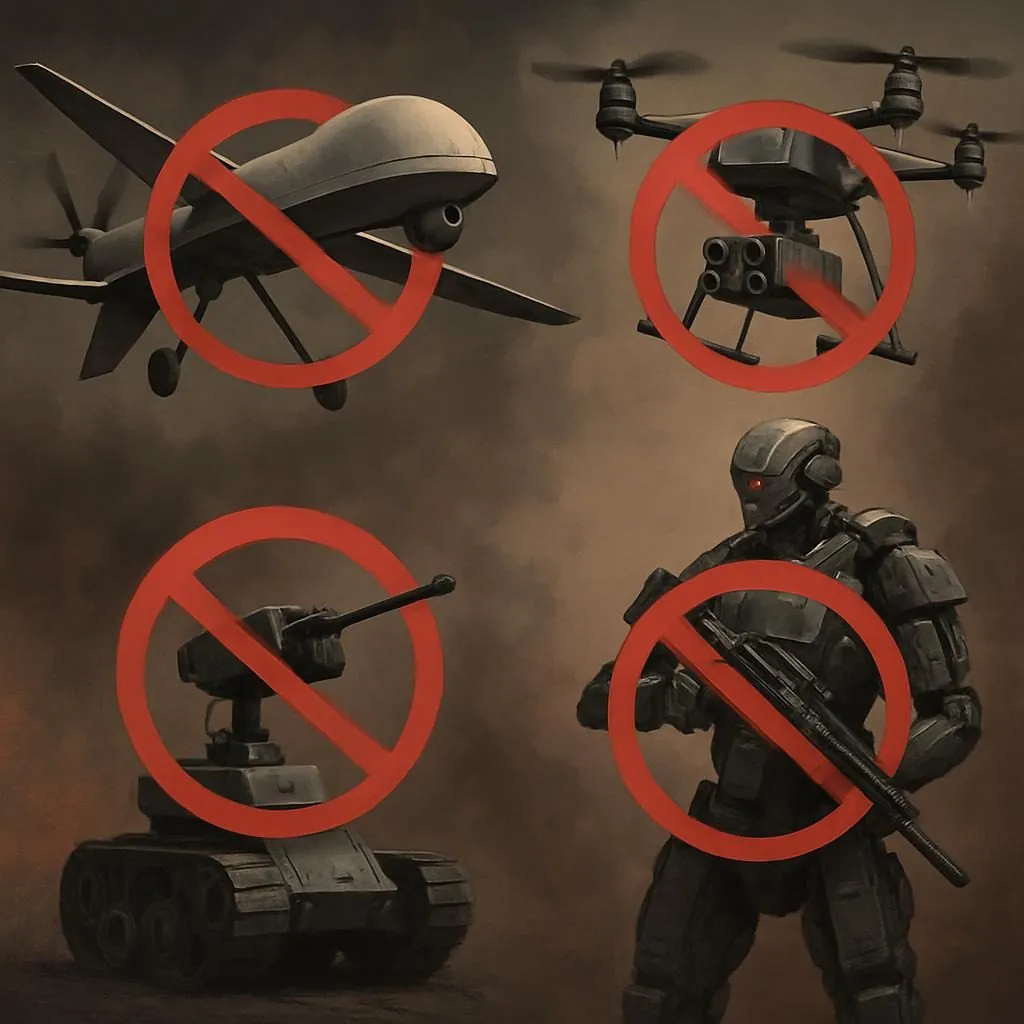
156 nations just voted to ban killer robots. The United States and Russia said no. Here’s what that actually means — for global security, for tech companies, and for anyone building AI systems right now.
🗝 The short version
- 🌐 In November 2025, 156 nations voted at the UN to push for a binding treaty banning autonomous weapons. Only 5 voted against — including the US and Russia.
- 💰 The Pentagon is simultaneously requesting $54.6 billion for its autonomous warfare group in FY2027 — a 24,000% budget increase over FY2026.
- ⏳ The UN Secretary-General’s deadline for a legally binding treaty was end of 2026. That deadline is now in serious doubt.
- 🏢 Tech companies and defense contractors face growing dual-use compliance risks, export restrictions, and valuation exposure tied to autonomous systems development.
- ⚠️ The first confirmed autonomous kill already happened — a Kargu-2 drone in Libya, 2020 — meaning this isn’t theoretical anymore.
I want to be honest with you about something before we dive in: the phrase “banned AI weapons” is doing a lot of work it can barely support right now. Because the truth is, no globally enforceable ban exists. What we have instead is a historic political standoff, a race between law and technology — and a gap that’s widening faster than most people realize.
This is the most consequential arms debate of the 21st century. And it affects far more people than just defense analysts and government officials. If you build AI software, invest in tech companies, or advise organizations on AI strategy, the regulatory fallout from this fight is coming for you too.
What “Banned AI Weapons” Actually Means — And What It Doesn’t
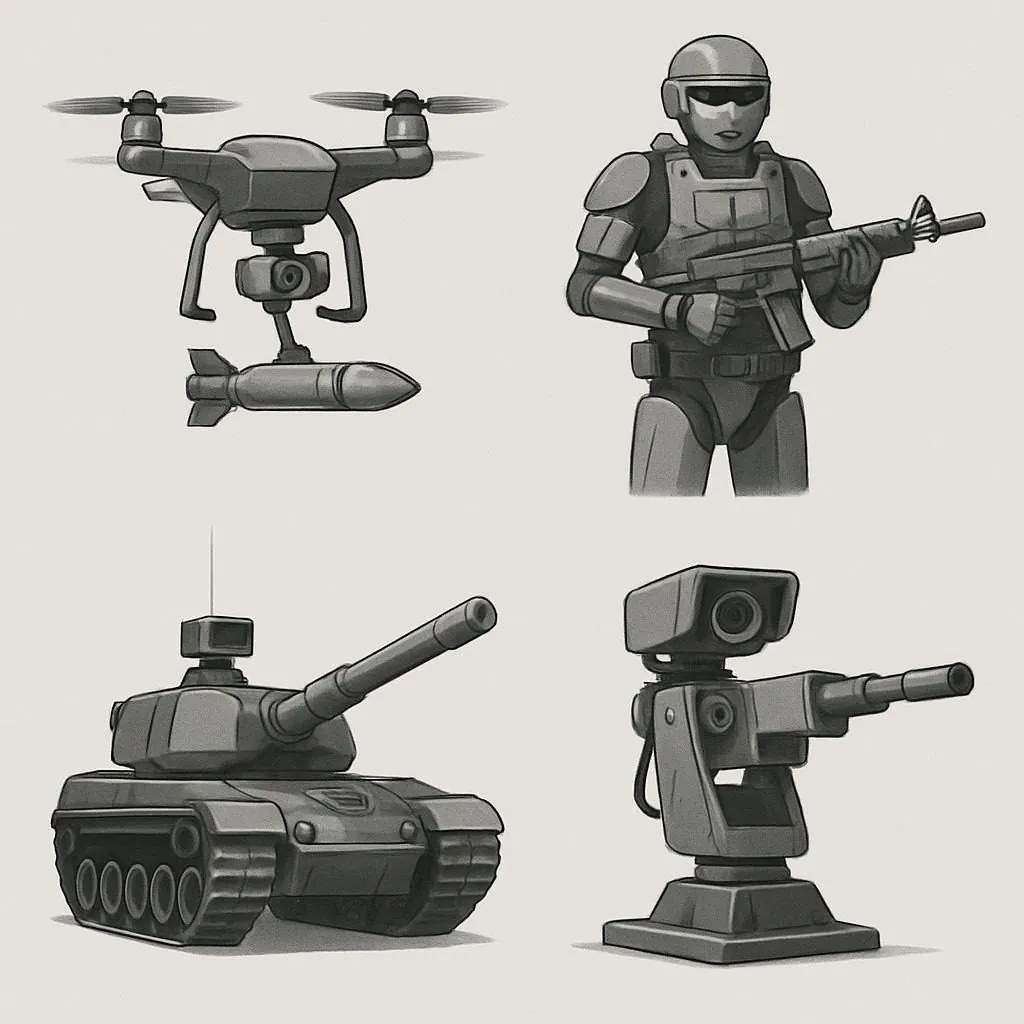
Let’s start with definitions, because the terminology here gets slippery fast. The formal term is Lethal Autonomous Weapons Systems (LAWS) — weapons that can select and engage targets without direct human authorization. The International Committee of the Red Cross defines the threshold simply: once a system can “select and attack targets without further human intervention,” you’re in LAWS territory.
The word “banned” is where it gets complicated. Nothing is comprehensively banned at the international level yet. What exists is a patchwork of national policies, voluntary pledges, and increasingly urgent diplomatic pressure — all of which matters enormously for compliance and investment, even without a binding treaty.
| Weapon Type | Human Control Level | Legal Status (2026) | Real-World Examples |
|---|---|---|---|
| Remote-Controlled Systems | Full human operation | ✅ Universally permitted | Predator drones, Reaper UAVs |
| Human-Supervised Systems | Human authorization required per engagement | ✅ Generally permitted | Iron Dome, US Phalanx CIWS |
| Human-Initiated / AI-Executed | Human triggers; AI selects method or target | ⚠️ Highly contested | Loitering munitions, Switchblade 300 |
| Fully Autonomous LAWS | No human in decision loop | 🚫 Supported by 156 nations for prohibition — but not yet legally binding | Kargu-2 (Libya 2020); hypothetical future systems |
The uncomfortable fact: that bottom row isn’t hypothetical anymore. In 2020, a Kargu-2 drone operated by Turkish forces in Libya reportedly engaged a target without direct human command — the first confirmed case of an autonomous kill. No treaty was violated, because no treaty existed. That’s the problem in a nutshell.
“There is no place for lethal autonomous weapon systems in our world. Machines that have the power and discretion to take human lives without human control should be prohibited by international law.”
— UN Secretary-General António Guterres, May 2025The November 2025 UN Vote: What Actually Happened
This is the part of the story that got underreported — and it deserves a close look.
On November 6, 2025, the UN General Assembly’s First Committee passed Resolution L.41, calling for negotiations on a legally enforceable treaty on autonomous weapons systems. The vote: 156 nations in favor, 5 against, 8 abstentions. That’s not a close call — it’s a political earthquake. More than two-thirds of the planet formally said: we want binding rules.
The five “no” votes? The United States, Russia, India, Israel, and one other. Each of them has either declared programs to develop autonomous systems or stated explicitly that existing international humanitarian law is sufficient. The US position, detailed in its submissions to the CCW, argues that “there is not a fixed, one-size-fits-all level of human judgment that should be applied to every context” — which is a careful way of saying: we’re keeping our options open.
Resolution L.41 is not binding — yet. But it creates enormous political momentum. Companies with exposure to autonomous systems, dual-use AI, or defense supply chains should treat this as an early warning. When treaties do materialize, they tend to move fast once political consensus forms.
Meanwhile, 42 nations delivered a joint statement in September 2025 calling on the Convention on Certain Conventional Weapons to begin formal treaty negotiations based on its existing “rolling text.” The CCW Seventh Review Conference in Geneva — scheduled for 2026 — is now described by analysts as a decisive “moment of truth.”
The Road to a Treaty: Key Moments
The Pentagon Is Spending Like No Treaty Is Coming
This is where theory meets reality — and the numbers are staggering.
The Biden-era Replicator program, launched in 2023 with a goal of fielding thousands of autonomous drone systems by August 2025, fell short of its targets. Congressional Research Service reports suggest only “hundreds” — not thousands — of systems were delivered by the deadline. There were technical failures, contractor security issues, and drone-on-drone collisions during testing.
But the Trump administration didn’t abandon the concept. It doubled down — hard. The Replicator initiative was folded into the newly created Defense Autonomous Warfare Group (DAWG), which received $225.9 million in FY2026. The FY2027 budget request for DAWG: $54.6 billion. That’s not a typo. That’s a 24,000% increase in a single budget cycle.
For comparison, the entire US State Department budget for FY2026 was approximately $63 billion. The Pentagon’s autonomous warfare group alone is requesting nearly that much. This gives you a sense of how serious military AI investment has become — and how far it’s outpacing diplomatic efforts to regulate it.
Pentagon CTO Emil Michael, speaking at the Reagan Forum in December 2025, put it plainly: “What we’ve learned from the Ukraine-Russia war is that the front lines of a conflict over territory are robot-on-robot now.” That framing — not “if” but “are” — tells you everything about the US strategic posture.
The Three Camps: How Nations Actually Think About This
Not everyone who opposes a ban is a rogue actor. The international debate is more nuanced than headlines suggest, and understanding where different nations stand matters if you’re navigating compliance, investment, or partnership risk.
The Prohibitionists
Austria, Costa Rica, Ireland, El Salvador, Chile, Argentina — these nations want an outright ban on autonomous weapons that can target humans, and they want it now. Their argument: once you remove human judgment from a lethal decision, you violate the fundamental right to life. El Salvador put it directly at the May 2025 UN meeting: autonomous weapons are “fundamentally incompatible with the right to life.”
The Traditionalists
The US, Russia, and to varying degrees China and India argue that existing international humanitarian law is sufficient. Their position: LAWS can be developed and deployed legally as long as they comply with existing rules of armed conflict. This view gives maximum flexibility — which is precisely why the major military powers favor it.
The Dualists
A growing coalition — including several EU member states — supports a middle path: ban the most dangerous, unpredictable systems outright while creating a regulatory framework for those that can demonstrably comply with humanitarian law. This compromise position may ultimately be where a treaty lands, if one ever materializes.
Why This Matters for Business — Right Now
Here’s where I want to shift gears, because too many business leaders treat this topic as someone else’s problem. It isn’t.
The dual-use dilemma is real and it’s already biting companies. Computer vision, natural language processing, autonomous navigation, target-recognition algorithms — the same capabilities that power retail analytics, autonomous vehicles, and logistics robots can be adapted for weapons systems. The gap between “civilian AI” and “weapons AI” is often just a use case and a contract.
Supply Chain and Export Risk
The US Export Administration Regulations (EAR) already restrict the export of many advanced AI-relevant components to certain countries. But the line is moving. After the November 2025 vote, several allied nations began accelerating their own export screening processes for AI dual-use technology. If you sell AI software, sensors, or processing infrastructure internationally, your compliance exposure is expanding.
A semiconductor manufacturer I know — not going to name the company — discovered in late 2024 that their chips were appearing in autonomous drone systems deployed in conflict zones. They hadn’t sold to defense contractors directly. The chips had moved through three layers of distributors. The legal exposure alone cost them $8 million in compliance remediation before they even knew if regulators would act.
Investment and Valuation Risk
VC and PE funds are increasingly implementing AI weapons screening in their due diligence processes. Not because they’re idealists — because their LPs are asking about it, and because regulatory action on autonomous systems could crater the valuation of companies caught on the wrong side of a treaty overnight.
Run an honest dual-use audit of your core AI capabilities before your next funding round or partnership discussion. The question isn’t just “could our technology be weaponized?” It’s “could our technology be weaponized in a way that would create liability for us?” Those are different questions with different answers.
Talent and Reputation Risk
The Google employee walkout over Project Maven in 2018 set a precedent that hasn’t gone away. Senior AI researchers care deeply about what their work is used for. If your company has ambiguous policies around defense work or dual-use applications, you will lose talent — particularly the researchers who built the capabilities you’re trying to commercialize.
The Types of AI Weapons Under Scrutiny
Understanding exactly what categories of systems face the most regulatory risk helps you assess your own exposure accurately.
| System Category | Description | Regulatory Risk | Business Relevance |
|---|---|---|---|
| Hunter-Killer Drones | Seek-and-destroy autonomous aircraft (eg. S-70 Okhotnik-B) | 🔴 Critical | Aviation AI, robotics investments |
| Autonomous Cyber Weapons | AI that identifies vulnerabilities and launches attacks without human approval | 🔴 Critical | Cybersecurity tools, penetration testing software |
| Autonomous Naval Systems | Self-directing surface and underwater weapons platforms | 🟠 High | Maritime autonomy, ocean sensing companies |
| AI-Enhanced Surveillance | Facial recognition, behavioral prediction with military applications | 🟠 High | Computer vision, biometric companies — 15+ nations have partial bans |
| Loitering Munitions | Human-launched, AI-navigated weapons that select final targets | 🟡 Contested | Drone navigation software, embedded AI systems |
| AI Deepfake / Disinfo Tools | Synthetic media for military psychological operations | 🟠 High | Generative AI companies, synthetic media platforms |
Three Case Studies: What Went Wrong, and What Worked
The Defense Contractor Pivot
A major defense contractor facing new autonomous weapons restrictions had $200 million in R&D invested in targeting AI. Rather than fight the regulatory tide, leadership made a decision that looked counterintuitive at the time: redirect entirely into disaster response robotics, applying the same autonomous navigation and object-recognition tech to search-and-rescue operations.
The move took 18 months and cost $30 million in platform restructuring. Three years later, the humanitarian division was generating $150 million in new civilian contracts — and the company had built relationships with international NGOs that became its most valuable long-term channel.
$200M R&D at regulatory risk
Pivot to disaster response applications
$150M new civilian revenue; compliance maintained
The Startup That Almost Lost Its Series B
An AI surveillance startup — computer vision, retail analytics, access control — discovered through a due diligence questionnaire that one of their enterprise clients was a defense contractor who was evaluating their facial recognition technology for autonomous target identification. The startup hadn’t known. The client had signed a general commercial license.
Their incoming Series B investors found out. The deal went on hold for 90 days while the startup implemented use-case restrictions, built an end-use monitoring process, and established an external ethics board. The deal closed at the same valuation — but it was genuinely close to collapsing.
Undisclosed weapons-adjacent use by enterprise client
End-use monitoring + ethics board established
$25M Series B closed; retail analytics pivot secured long-term path
The Chip Maker Supply Chain Nightmare
A semiconductor company discovered their processors were appearing in autonomous drone systems sold to conflict zones — three distribution layers removed from their original sale. They hadn’t broken any rules at the time of sale, but the US Commerce Department was asking questions, and the reputational exposure was real.
The company implemented end-use monitoring, customer screening, and partnership verification requirements across their entire distribution network. Cost: roughly $8 million in compliance infrastructure over 18 months. Result: verified ethical supply chain, which actually became a competitive selling point — and sales grew 15% as customers seeking clean supply chains sought them out.
Chips used in autonomous weapons — 3 layers removed
$8M compliance infrastructure across distribution network
+15% sales growth; “verified ethical supply chain” as competitive moat
What a Compliance Framework Actually Looks Like
I’ve seen a lot of AI ethics documents that are essentially marketing materials with philosophical language. The frameworks that actually work — the ones that hold up when regulators or investors start asking hard questions — share a few characteristics.
Immediate Actions (First 30 Days)
- ✓ Audit every AI product or component for dual-use potential. Not just current use — potential misuse by end customers downstream.
- ✓ Review all current customer contracts for use-case restrictions. If your license agreement doesn’t prohibit weapons applications, fix that now.
- ✓ Map your supply chain at least two layers deep. Know who is buying what from your distributors.
- ✓ Identify anyone on your team whose work touches autonomous decision-making, computer vision, or target detection — and have a conversation about risk awareness.
Medium-Term (3–6 Months)
- ✓ Stand up an AI ethics committee — ideally with at least one external member who has no financial stake in your company.
- ✓ Build a “regulatory radar” process: assign someone to monitor CCW negotiations, EU AI Act implementation, and US EAR updates. Quarterly briefings to leadership is not overkill.
- ✓ Run adversarial testing on your most capable AI systems. Ask explicitly: how could this be repurposed for harmful applications?
- ✓ Document everything. The companies that survive regulatory scrutiny are the ones with paper trails showing they asked the right questions before something went wrong.
Long-Term Strategy (6–12 Months)
- ✓ Invest in explainable AI. Future regulations will almost certainly require systems capable of explaining their decisions — particularly in high-stakes contexts.
- ✓ Engage with industry groups participating in CCW standard-setting. Voluntary standards often become mandatory requirements.
- ✓ Consider whether “dual-use” exposure is actually a strategic risk to your core business — and if so, whether it’s time to make product or market decisions based on that.
The Bigger Ethical Picture
Look — I’ve tried to keep this practical and tactical throughout. But I’d be doing you a disservice if I didn’t say the quiet part out loud.
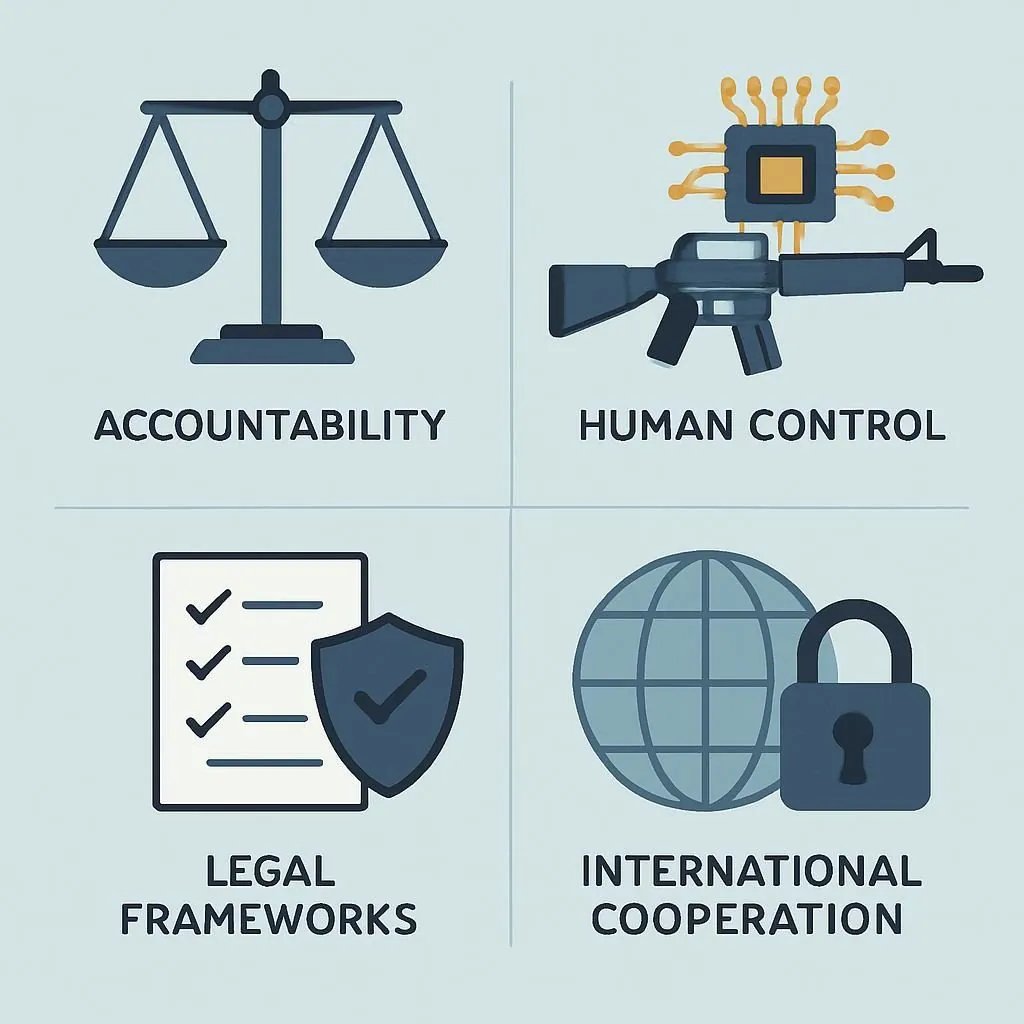
The reason 156 nations support banning fully autonomous weapons isn’t just legal principle. It’s because removing human judgment from decisions about killing is, at its core, a moral problem that no technical specification can fully resolve. When a drone selects and kills a target with no human in the loop, who is responsible? The engineer who wrote the targeting algorithm? The general who approved its deployment? The government that funded it?
Countries like Kiribati — which endured 33 nuclear weapons tests between 1957 and 1962 — understand viscerally what it means when powerful nations deploy weapons technologies without adequate restraint. Their call for a binding prohibition isn’t naive. It’s historically informed.
For businesses, this ethical dimension has practical implications too. The “accountability gap” in autonomous weapons is exactly what makes them legally murky — and that same murkiness makes them commercially risky. Companies that build systems designed to obscure accountability tend to face more regulatory scrutiny, not less, over time.
“The cost of our inaction will be greater the longer we wait.”
— Nicole van Rooijen, Executive Director, Stop Killer Robots, May 2025What to Expect in 2026
The CCW Seventh Review Conference in Geneva is the main event. If negotiations there produce a legally binding instrument — even a partial one covering the most dangerous systems — it will trigger compliance requirements across the defense supply chain almost immediately. Companies that aren’t prepared will be scrambling.
If the conference fails — which is a real possibility given US and Russian resistance — expect two things: accelerating proliferation of autonomous weapons as the “pre-proliferation window” closes, and a sharp increase in unilateral national regulations from EU member states and allies who are tired of waiting for consensus.
Either scenario creates compliance pressure. The difference is just in the source: multilateral treaty vs. fragmented national rules. Fragmented rules are actually harder to navigate than a single treaty, because you end up with 30 different standards across your key markets.
The companies best positioned for 2026 are those that have already built explainability, human oversight, and clear use-case restrictions into their AI architectures — not as compliance add-ons, but as design principles. That’s harder to retrofit than to build in from the start.
Frequently Asked Questions
No. Only fully autonomous systems capable of selecting and engaging targets without meaningful human control face widespread calls for prohibition. Human-operated and human-supervised systems remain legal under current international frameworks. The debate is specifically about removing human judgment from lethal decisions entirely.
No. The November 2025 resolution was significant — 156 nations voted in favor — but it is not legally binding. It calls for negotiations toward a binding treaty. That treaty, if it materializes, would likely come out of the 2026 CCW Review Conference in Geneva. As of early 2026, no binding international prohibition exists.
Potentially yes, depending on jurisdiction and the degree of due diligence applied. Under US export control law, companies can face penalties if their technology is diverted to prohibited uses — even without direct knowledge — if they failed to implement reasonable safeguards. The semiconductor supply chain case studies above illustrate this risk concretely.
It’s the central concept in LAWS regulation — and it’s still contested. The basic idea is that a human being must retain sufficient understanding and control over a weapons system to be accountable for its use. The US disputes that there’s a single standard; the ICRC and most prohibition advocates say clear minimum standards are essential. How this gets defined in treaty language will determine which systems are legal and which aren’t.
Rapidly. National-level export controls and AI regulations are updating roughly every 6–12 months. The EU AI Act implementation is ongoing. US EAR rules on semiconductor and AI exports were revised multiple times in 2024–2025. Companies in this space should treat regulatory monitoring as a continuous function, not an annual review.
Yes — particularly those working in computer vision, autonomous navigation, natural language processing, and any form of target identification or tracking. The dual-use nature of these capabilities means even companies focused entirely on civilian applications may have compliance exposure if their technology reaches defense customers through downstream distribution channels.
The Bottom Line
We are in a “pre-proliferation window” — a narrow period before autonomous weapons become as common and as hard to regulate as small arms. The 2026 deadline for a binding treaty is real, and the stakes of missing it are real too. Once the major military powers have invested heavily enough in autonomous systems, the political economics of prohibition become impossible.
For businesses, the right move isn’t to wait and see. It’s to build governance structures now that will hold up regardless of how the treaty negotiations land. That means honest dual-use audits, genuine supply chain visibility, and AI systems designed with explainability and human oversight as non-negotiable features — not afterthoughts.
The companies that will look smart in 2027 are the ones that treated 2025’s UN vote as a signal, not a footnote.
The regulatory gap between where law is and where autonomous weapons development is going is closing fast — but not in the direction of permissiveness. Start your compliance work now, before you’re forced into it under time pressure and reputational risk.
This article was last updated May 2026 to reflect the November 2025 UN General Assembly vote (Resolution L.41), the Pentagon’s FY2027 budget request for the Defense Autonomous Warfare Group, and current CCW treaty negotiation status. All statistics and regulatory references have been verified against primary sources.
For ongoing updates: ForbiddenAI.site
AI and Human Taboos: Where Do We Draw the Line?
Banned AI Dreams That Could Change Humanity (2026)
AI Ethics and Control in Warfare: A Dangerous Game: Best Guide 2026
Why AI Projects Die 2026: Best Guide.