

Truth About AI Content Creation

The Truth About
AI Content Creation
Nobody Wants to Admit
Why 86.5% of top-ranking pages use AI — and why most AI content still fails catastrophically
“I recommended fully automated AI content to a client in March 2026. By June, they’d lost 73% of their organic traffic. Not because the tool was bad. Because the strategy was.”
That client is not an outlier. In the first half of 2026, niche information sites publishing 500+ AI-generated pages saw traffic drops of 60–80%. Affiliate review sites using AI product comparisons without first-hand testing lost 40–70%. Location-based service pages built from templates with only city names swapped out dropped 30–60%. The March 2026 spam update — which completed in just 19.5 hours, the fastest in Google’s documented history — was not a new policy. It was stronger enforcement of an old one: scaled content abuse, defined as generating many pages primarily to manipulate search rankings, with little or no value added for users.
Here is what nobody in the AI content industry wants to say out loud: Google does not penalize AI content. Google penalizes lazy content. AI just makes lazy faster.
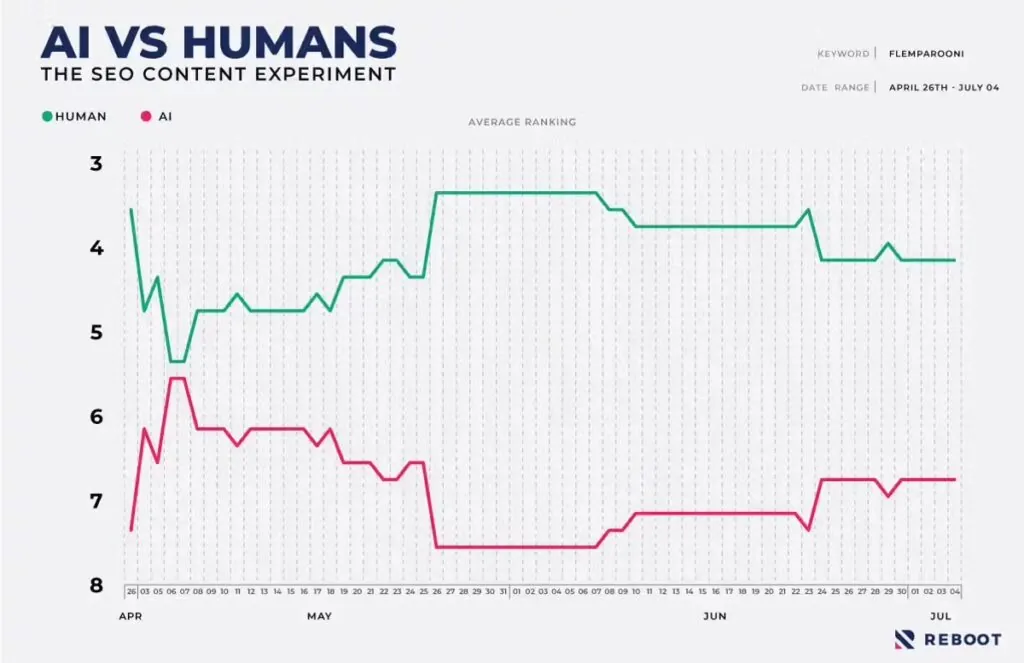
The correlation between AI content percentage and ranking position? 0.011. Statistically zero. The tool is invisible to Google’s quality systems. The output is not. This is the first misconception that needs killing.
“Google Can Detect AI” — The Myth That Refuses to Die
Three years of algorithm updates, official blog posts, and data studies have not killed this myth. It persists because it is profitable. SEO blogs sell fear. Articles with headlines like “Google’s AI Crackdown” and “Will You Get Penalized?” get clicks. The truth — “Google does not care about your tools, only your output” — is less dramatic but more useful.
Google’s official position has been consistent since February 2023. As Danny Sullivan stated: “Our focus on the quality of content, rather than how content is produced, is a useful guiding principle.” That policy remains in effect as of mid-2026. Google’s systems evaluate content based on what it is, not how it was made. This applies to every type of automation — from basic template substitution to advanced large language models.
What changed in January 2026 is that Google’s detection capabilities became more sophisticated. The algorithm now analyzes writing patterns and consistency, factual accuracy and depth, originality of insights, and human oversight signals. But it does not check for AI. It checks for quality. A human writing 500 thin pages by hand would face the same penalty as a site generating 500 thin pages with AI. The behavior is penalized. The tool is irrelevant.

The Three Patterns That Actually Get Penalized
The March 2026 update hit three specific patterns hardest. If you are doing any of these, stop immediately.
Pattern 1: Mass AI Page Generation Without Editorial Review
Sites publishing 50–500 articles daily with identical structure, no editorial review, and no original value. These sites often went from zero to thousands of pages in weeks. The content was accurate enough to sound professional but offered nothing a reader could not find in the top five existing results. No original data. No first-hand experience. No specific examples. No unique perspective. For a few weeks, traffic looked promising. Then the update rolled through and the entire domain collapsed. Not just the AI articles. Everything.
Pattern 2: Template-with-Variable Substitution
The classic programmatic SEO approach: “Best [service] in [city]” pages across hundreds of locations, where only the city name changes. When the underlying content adds no local insight, no original data, no specific examples from that location, it qualifies as scaled content abuse. Programmatic SEO can work when each page contains genuine local value. It fails when pages are identical except for a few variables. Google compares pages across your entire site, not individually. When large portions show low originality, site-wide signals are affected.
Pattern 3: Aggregator Scraping Without Added Value
Product roundups and comparison pages stitched from external sources without original analysis, testing, or perspective. If you have not touched the product, tested the service, or spoken to the provider, your “review” is a summary. Summaries are not reviews. Google’s Quality Rater Guidelines, updated in January 2025, instruct raters to flag AI-generated content as “Lowest” quality when it lacks originality and value. When human raters consistently flag certain patterns, SpamBrain and the Helpful Content System learn to detect them automatically.

E-E-A-T Is Not a Suggestion Anymore
Google’s January 2026 core algorithm update made Experience, Expertise, Authoritativeness, and Trustworthiness fundamental ranking factors, not just quality guidelines. This is the second misconception that needs correction. E-E-A-T was never optional. It is now enforced.

Experience means first-hand involvement. Case studies, personal anecdotes, original research, testing data. AI cannot have experiences. It can describe them if you provide them. Most people do not.
Expertise means demonstrated knowledge. Credentials, professional background, mastery of subject matter. If your author bio says “Content Writer” and nothing else, you have no expertise signal. If you are publishing about finance without financial credentials, you are in YMYL territory without the required trust signals.
Authoritativeness means external recognition. Citations from experts, backlinks from trusted domains, peer validation. AI content rarely earns these because it rarely says anything worth citing.
Trustworthiness means transparent signals. Clear authorship, contact information, HTTPS, accurate and up-to-date content. Anonymous content is harder to trust. Trust is a ranking factor.
The Helpful Content System, integrated into Google’s core algorithm since March 2024, evaluates your entire domain. If a significant portion of your site consists of low-quality content, the quality signal drags down even your strongest pages. This means 50 lazy AI articles can hurt the performance of 10 excellent articles on the same domain. Quality at the domain level matters more than ever.
What the 70-20-10 Framework Actually Looks Like
High-performing content teams in 2026 use a specific distribution of effort. Not because a blog post told them to. Because it works.
70% AI Automation: First draft creation based on strategic prompts and brand guidelines. SEO optimization, keyword integration, technical formatting. Content adaptation for different platforms. Research compilation and competitive analysis. Performance data analysis.
20% Human Oversight: Strategic direction setting. Brand voice refinement and authenticity verification. Fact-checking, accuracy verification, context validation. Cultural sensitivity review. Quality assurance and final approval.
10% Strategic Refinement: Breakthrough creative development. High-stakes content like brand positioning. Industry expertise integration and thought leadership. Complex technical content requiring specialized knowledge. Performance optimization based on advanced analytics.
Teams implementing this framework report 156% improvements in content ROI while maintaining 89% consistency in brand voice quality. The companies that will dominate content marketing in the next decade are not those that choose AI or human creativity. They are those that optimize the collaboration between both.
The Information Gain Test You Are Probably Failing
Here is a test you can run on your last ten blog posts. Read each one and honestly answer this question: Does this page contain anything a reader could not find in the top five results already ranking for this topic?
If the answer is no, those pages need revision. Add original data. Add specific examples. Add a unique perspective that only you can provide. This is what Google calls “information gain” — the unique value your page offers compared to competitors. Content that provides original insights, unique data, or a fresh perspective scores higher. AI makes it easy to produce pages that summarize existing content without adding anything new. Those pages fail the information gain test regardless of who or what wrote them.
I tried this test on a site that lost 60% of its traffic in March 2026. Eight of their last ten posts were summaries of summaries. The other two contained original interview data. Those two were the only ones that maintained rankings. The pattern was not subtle. It was invisible to the site owner until I pointed it out.
What You Should Do This Week
Not next quarter. This week.
- Audit your recent content. Read your last 10 blog posts. Apply the information gain test. Be honest. If a post fails, flag it for revision or removal.
- Check your publishing patterns in Search Console. If you recently scaled content production significantly and your impressions are declining, the volume increase may be hurting your domain’s quality signal. Consider unpublishing your weakest pages. As SEO analyst Lars Lofgren suggested in early 2026, for a site that has lost 90% of traffic, the recommendation is to immediately delete or materially revamp roughly 90% of the content.
- Establish an editorial checklist for every piece. Verified statistics with named sources. Original examples or data. Clear author attribution. Internal links to related content. A unique perspective that passes the information gain test. If you are using AI, this checklist is not optional. It is the difference between ranking and disappearing.
- Add author expertise signals. Pages without author bylines, author pages, or expertise verification look anonymous. Anonymous content is harder to trust. Include author names, credentials, and expertise areas on every article. Create author pages that demonstrate qualifications. If you are publishing AI content under a fake persona, stop. Google’s systems are increasingly effective at identifying synthetic authorship signals.
- Fact-check every statistic and claim. AI models hallucinate. They produce confident-sounding statements that are factually wrong. A single uncorrected hallucination can destroy trust and trigger quality flags. Verify against original sources, not just AI output. In YMYL categories — health, finance, legal — this is non-negotiable.
The Uncomfortable Truth About Recovery
If your site has been hit by a quality update, recovery is not fast. Algorithmic penalties for scaled content abuse typically require 3–6 months of substantial content improvement or removal of thin pages. Helpful Content System sitewide demotions require 6–12 months of significant improvement across a large portion of the site. Manual actions require fixing the issue and submitting a reconsideration request, which can take weeks to months.
There is no shortcut. There is no AI tool that will fix this. The only path is to produce genuinely useful content that demonstrates real expertise and experience. This is slower than pressing a button and publishing 500 articles. It is also the only thing that works long-term.
Some sites are attempting aggressive recovery tactics: double redirects to new domains, moving content to “clean slate” properties, or pivoting entirely to YouTube and LinkedIn to reduce SEO dependence. These can work in specific cases. They are not sustainable strategies. They are admission that the original approach failed.
Why Authenticity Is the Only Sustainable Moat
In 2026, the Association of National Advertisers selected “authenticity” and “agentic AI” as their Words of the Year. The pairing is not accidental. As AI-generated content becomes indistinguishable from human-created work, the scarcity shifts from content volume to content trust. Consumers are becoming ever more skeptical of the human origin of advertisements and marketing messages. While AI tools offer marketers an exciting new frontier, the principle remains: authenticity is always best.
Experts predict AI-generated synthetic content could make up 90% of online content by 2026. This is not a reason to stop using AI. It is a reason to use it differently. The content that will rank, convert, and build lasting trust is the content that contains something AI cannot generate on its own: your specific experience, your specific expertise, your specific perspective on a specific problem you have actually solved.
At Forbidden AI, we have been tracking these shifts since 2022. The sites that survive algorithm updates are not the ones that avoid AI. They are the ones that use AI as an efficiency tool while maintaining genuine editorial standards. If you want to understand how to build E-E-A-T signals that make AI-assisted content credible, our framework covers the full methodology. For the content refresh strategy that keeps existing articles competitive, we have documented the process that recovered sites from the March 2026 hit. And for the SEO audit workflow that identifies quality issues before Google does, our troubleshooting guide covers the failure modes most people miss.
The real reason you won’t do this: it is slower than pressing a button. It requires thinking. It requires expertise. It requires admitting that the 500 articles you published last month might have been a mistake. Only you know if that’s acceptable. But if you are building something that needs to last beyond the next algorithm update, the answer is no. The answer has to be no.
Everything I just said will be outdated by 2027. Google’s systems will improve. AI capabilities will expand. New patterns of abuse will emerge and be penalized. The only constant is this: content that genuinely helps people, created by people who genuinely understand the topic, will survive. Everything else is a bet against the algorithm. And the algorithm always wins.
Sources & Further Reading
- Google Search Guidance About AI-Generated Content — Google’s official stance on AI content quality, not detection.
- Ahrefs: AI Content Study (600K Pages Analyzed) — The 86.5% statistic and correlation data source.
- Google: March 2024 Core Update & Spam Policies — Scaled content abuse policy and enforcement details.
- Semrush: What Is E-E-A-T? A Complete Guide — Deep dive into Experience, Expertise, Authoritativeness, Trustworthiness.
- Google: Creating Helpful, Reliable, People-First Content — Official guidelines on what Google rewards vs. penalizes.
- Search Engine Land: March 2024 Spam Update Analysis — Industry breakdown of site types hit hardest.
- ANA: 2026 Words of the Year — Authenticity & Agentic AI — Industry recognition of authenticity as the defining trend.
- Search Engine Journal: Google Helpful Content System Explained — How sitewide quality signals work and recovery timelines.